
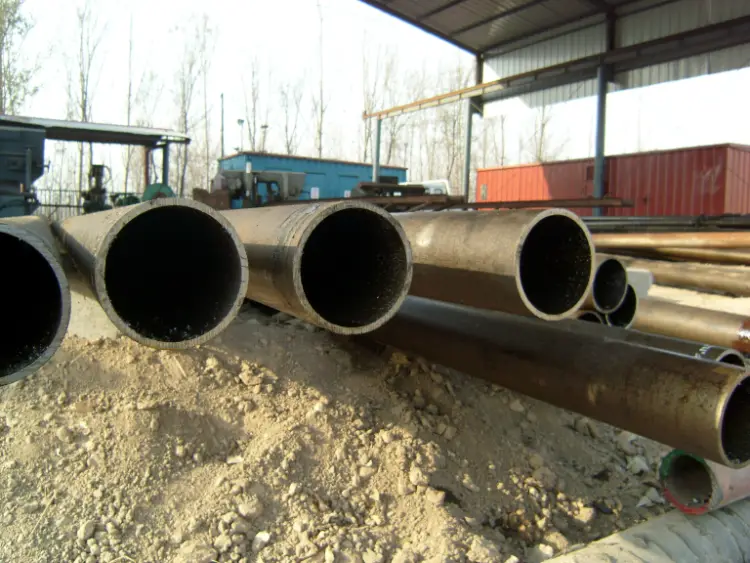
EN 10219 S460MLH LSAW Pipe
EN 10219 S460MLH LSAW Pipe: High-Strength Low-Temperature Structural Hollow Sections
Comprehensive material datasheet for S460MLH thermomechanically rolled fine-grain steel welded hollow sections according to EN 10219, suitable for low-temperature structural applications.
Cold forming from thermomechanically rolled steel strip or plate, longitudinal submerged arc welding (LSAW), possible hot-dip galvanizing or coating
- Phone : +8618037372205
- Email : [email protected]
- WhatsApp: Contact via Whtsapp
- WeChat: +8618037372205
EN 10219 S460MLH LSAW Pipe Introduction
EN 10219 S460MLH is a European standard cold-formed welded structural hollow section made from thermomechanically rolled fine-grain steel. It is designed for demanding structural applications that require high strength, excellent weldability, and reliable low-temperature impact toughness. The designation S460 indicates a minimum yield strength of 460 MPa, M stands for thermomechanical rolling, L for low-temperature notch toughness at -50 °C, and H for hollow section. The LSAW (Longitudinal Submerged Arc Welded) manufacturing process produces large-diameter, thick-wall pipes with consistent properties. S460MLH offers a balanced combination of strength, ductility, and toughness, enabling lighter structures without compromising safety. Its fine-grained microstructure ensures good resistance to brittle fracture, making it highly suitable for offshore, bridge, and heavy construction projects in cold climates. The material conforms to the strict chemical composition and mechanical property requirements of EN 10219-1, providing standardized reliability for engineers and fabricators across Europe and internationally.
EN 10219 S460MLH LSAW Pipe Chemical Composition
Typical maximum values according to EN 10219-1 for grade S460MLH. The steel is fully killed and contains fine-grain elements to ensure a uniform fine-grained microstructure after thermomechanical rolling. Low carbon equivalent improves weldability.
| Element | Typical Max. Value (Heat Analysis) | Remarks |
|---|---|---|
| C | 0.16 | Max. carbon content for weldability |
| Si | 0.65 | Silicon for deoxidation |
| Mn | 1.80 | Manganese for strength and toughness |
| P | 0.030 | Phosphorus – impurity control |
| S | 0.025 | Sulfur – impurity control |
| Nb | 0.05 | Niobium – microalloy for grain refinement |
| V | 0.12 | Vanadium – optional microalloy |
| Al (total) | ≥0.020 | Aluminum as grain refiner |
| Ti | 0.05 | Titanium – optional grain refiner |
| Cu | 0.60 | Copper – may be present |
| Cr | 0.35 | Chromium – optional alloying |
| Ni | 0.85 | Nickel – optional, improves toughness |
| Mo | 0.10 | Molybdenum – optional |
| N | 0.020 | Nitrogen – limited |
| CEV (typical) | ≤0.47 | Carbon equivalent value (for t≤40mm) |
EN 10219 S460MLH LSAW Pipe Physical and Thermal Properties
The following data represent typical physical properties of thermomechanically rolled fine-grain structural steel similar to S460MLH. These values are not mandatory by EN 10219 but serve as useful engineering reference. Exact properties may vary slightly depending on exact composition and microstructure.
| Property | Typical Value | Unit | Conditions / Remarks |
|---|---|---|---|
| Density (ρ) | 7850 | kg/m³ | At room temperature |
| Modulus of Elasticity (E) | 210 | GPa | At 20 °C |
| Shear Modulus (G) | ≈ 81 | GPa | Calculated from E and ν |
| Poisson's Ratio (ν) | 0.3 | – | At room temperature |
| Thermal Expansion Coefficient (α) | 12 × 10⁻⁶ | /K | Between 20 °C and 100 °C |
| Thermal Conductivity (λ) | 50 | W/(m·K) | At 20 °C, typical for fine-grain steel |
| Specific Heat Capacity | 460 | J/(kg·K) | At 20 °C, typical |
| Electrical Resistivity (ρ_e) | 0.20 | μΩ·m | At 20 °C, typical |
EN 10219 S460MLH LSAW Pipe Mechanical Properties
Minimum mechanical properties as required by EN 10219-1 for S460MLH hollow sections. The values apply to the finished product in as-delivered condition. Higher thickness may have slightly reduced strength requirements; consult the standard for exact thickness-dependent values.
| Property | Value | Unit | Test Condition / Remarks |
|---|---|---|---|
| Yield Strength (ReH) | 460 | MPa | Minimum for thickness ≤ 16 mm |
| Yield Strength (ReH) | 430 (t > 16 to ≤ 40 mm) | MPa | Minimum for thickness >16 mm |
| Tensile Strength (Rm) | 540 - 720 | MPa | For thickness ≤ 40 mm |
| Elongation (A) | 17 | % | Minimum longitudinal, gauge length L₀ = 5.65√S₀, for t ≤ 40 mm |
| Impact Energy (KV₂) | 27 | J | At -50 °C, minimum average of 3 longitudinal V-notch specimens; individual min. 19 J |
| Bend Test (for flattening / drift – optional) | No cracks | – | As per EN 10219-2, applicable for certain sizes if required |
EN 10219 S460MLH LSAW Pipe Exactly Matching Material Standards and Substitutable Grades
| Country / Region | Standard | Grade | Remarks |
|---|---|---|---|
| Europe | EN 10210-1 | S460MLH | Hot-finished structural hollow sections – identical steel grade; thermomechanically rolled, same chemical and mechanical requirements, different manufacturing route. |
| Europe | EN 10025-4 | S460ML (plate) | Flat products from which EN 10219 S460MLH hollow sections are fabricated; same chemical and mechanical requirements for the starting material. |
| International | ISO 630-3 | E460 | Similar thermomechanically rolled fine-grain steel for structural purpose; not a hollow section standard but frequently referenced. |
EN 10219 S460MLH LSAW Pipe Application Introduction
S460MLH LSAW pipes and hollow sections deliver high strength-to-weight ratio and excellent low-temperature performance, making them ideal for critical structures that must operate in cold climates or under cyclic loading. Their good weldability allows efficient fabrication using standard welding procedures with low hydrogen consumables, typically with preheat according to CEV. The fine-grained microstructure provides superior resistance to brittle fracture, which is essential for safety in offshore, bridge, and heavy lifting applications. Designers can reduce weight by replacing lower-strength steels while maintaining structural integrity. The material is supplied with full traceability and certified mill test reports according to EN 10204 Type 3.1 or 3.2.
Product Applications: Longitudinal submerged arc welded (LSAW) pipe for offshore piles and conductors, Circular hollow sections for truss chords and columns, Square and rectangular hollow sections for welded frameworks and gantries, Flame-cut rings and segmental bends for pipeline risers, Pre-fabricated structural modules and pipe spools
Processed into products: Tubular joints (K, T, Y connections) in offshore jackets, Bridge arch segment and cross-beams, Wind turbine tower tubular segments, Spreader bars and lifting beams for heavy lifts, Crane lattice booms and jibs, Heavy-duty roller coaster supports, Piling pipes for arctic foundation systems, High-pressure process piping and headers (non-corrosive)
Application industries: Offshore engineering (jackets, topsides, flare booms), Bridge construction (arch ribs, trusses, girders), High-rise building frames and heavy columns, Wind energy (towers, base sections, transition pieces), Shipbuilding and marine structures, Mining and heavy machinery (booms, arms, chassis), Arctic and cryogenic storage structures
EN 10219 S460MLH LSAW Pipe Similar / Alternative Materials
| Country / Region | Standard | Grade | Remarks |
|---|---|---|---|
| Europe | EN 10219 | S460MH | Same strength, but impact test temperature at -20 °C instead of -50 °C; suitable for less severe low-temperature applications. |
| Europe | EN 10219 | S420MLH | Lower yield strength (420 MPa), similar toughness; good alternative where 460 MPa yield is not required. |
| Europe | EN 10025-6 | S460QL / S460QL1 | Quenched and tempered high-strength steel with comparable strength and low-temperature toughness; often used for heavy welded structures. |
| Europe | EN 10025-3 | S460NL | Normalized fine-grain steel; similar strength and -50 °C toughness, but different microstructure; widely used in structural hollow sections. |
| USA | ASTM A500 / A501 | Grade C (shapes) – similar not identical | Yield 345 MPa (50 ksi) — much lower strength, only suitable if 460 MPa is not required. |
Notes:
EN 10219 S460MLH must be fabricated by qualified manufacturers complying with EN 10219-2 for tolerances and inspection. Welding should follow EN 1011-2 recommendations, using matching low-hydrogen electrodes (e.g., E55 class). Where fatigue resistance is critical, additional post-weld treatments may be required. For corrosion protection in aggressive environments, hot-dip galvanizing or multi-layer coating systems are recommended. CEV typically ≤0.47 ensures air-hardenability is low enough for field welding with moderate preheat. This material is suitable for use in compliance with Eurocode 3 (EN 1993-1-8) for structural design of hollow section joints.
- Share



