
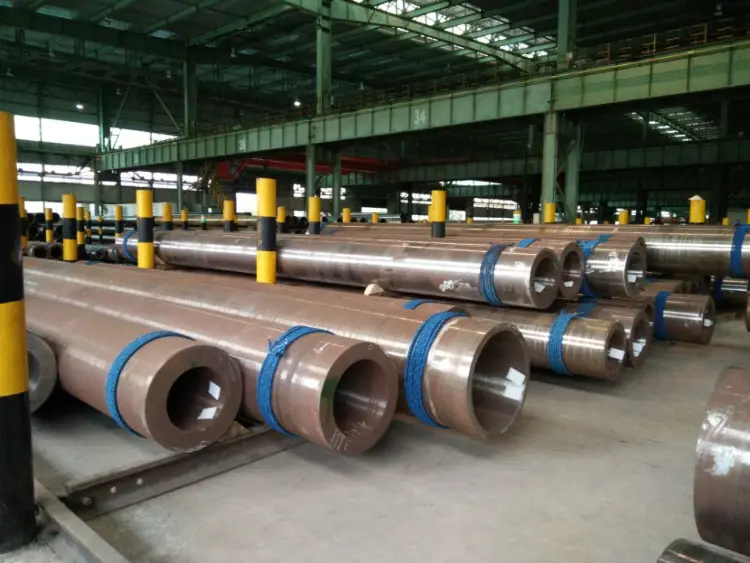
Q345C SHS/RSH Pipe
Q345C SHS/RSH Pipe: High-Strength Cold-Formed Hollow Structural Section per GB/T 3094
Comprehensive material data for Q345C square and rectangular hollow structural section pipes under GB/T 3094 standard, including chemical composition, mechanical properties at 0°C impact, thermal and electrical physical properties, equivalent international grades, and application guidelines.
Cold forming, welding, hot rolling, normalizing, cutting, drilling, bending
- Phone : +8618037372205
- Email : [email protected]
- WhatsApp: Contact via Whtsapp
- WeChat: +8618037372205
Q345C SHS/RSH Pipe Introduction
Q345C is a Chinese standard low-alloy high-strength structural steel widely used for cold-formed square (SHS) and rectangular (RHS) hollow sections in accordance with GB/T 3094. This grade provides a minimum yield strength of 345 MPa for thicknesses up to 16 mm and guarantees impact energy of at least 34 J at 0°C, making it suitable for structural applications in moderate low-temperature environments. It offers excellent weldability, cold formability, and toughness, and is commonly delivered in hot-rolled or normalized condition. Key features:
- High strength-to-weight ratio
- Good ductility and toughness
- Superior welding performance
- Reliable low-temperature impact properties
Q345C SHS/RSH Pipe Chemical Composition
The chemical composition corresponds to Q345C steel according to GB/T 1591-2008. The limits ensure balanced strength, weldability, and low-temperature toughness. Elements such as V, Nb, Ti are micro-alloyed to refine grain size and enhance mechanical properties. Remarks:
- Carbon equivalent (CEV) is typically ≤0.45% for good weldability.
- Aluminum is added as a deoxidizer and grain refiner; minimum 0.015% soluble Al is required.
| Element | Standard Value (wt%) | Remarks |
|---|---|---|
| Carbon (C) | ≤ 0.20 | For thickness ≤ 16 mm; may be adjusted for thicker sections |
| Silicon (Si) | ≤ 0.55 | Improves strength and deoxidation |
| Manganese (Mn) | 1.00 - 1.60 | Enhances strength and hardenability |
| Phosphorus (P) | ≤ 0.035 | Controlled to ensure toughness |
| Sulfur (S) | ≤ 0.035 | Kept low for better weldability |
| Vanadium (V) | 0.02 - 0.15 | Micro-alloyed grain refinement |
| Niobium (Nb) | 0.015 - 0.060 | Grain refinement and precipitation strengthening |
| Titanium (Ti) | 0.02 - 0.20 | Grain boundary pinning and deoxidation |
| Aluminum (Alt) | ≥ 0.015 | Deoxidation; soluble aluminum |
| Chromium (Cr) | ≤ 0.30 | Residual element; can be higher in some variants |
| Nickel (Ni) | ≤ 0.30 | Residual element |
| Copper (Cu) | ≤ 0.20 | Residual element |
| Nitrogen (N) | ≤ 0.012 | Tied up by Ti or Al to avoid aging |
| Carbon Equivalent (CEV) | ≤ 0.45 (typical) | Based on formula: C+Mn/6+(Cr+Mo+V)/5+(Ni+Cu)/15 |
Q345C SHS/RSH Pipe Thermal and Electrical Physical Properties
These properties are typical for low-alloy structural steel like Q345C at room temperature (20°C) unless noted. They are useful for design calculations involving heat transfer, thermal expansion, and electrical conductivity. Note:
- Thermal conductivity decreases with rising temperature.
- Elastic moduli are valid for static loading.
| Property | Typical Value | Unit | Remarks |
|---|---|---|---|
| Density (ρ) | 7850 | kg/m³ | At 20°C |
| Elastic Modulus (E) | 205 | GPa | Room temperature |
| Shear Modulus (G) | 80 | GPa | Room temperature, calculated from E and ν |
| Poisson's Ratio (ν) | 0.30 | - | Room temperature |
| Thermal Expansion Coefficient (α) | 12.0 | 10⁻⁶/K | From 20°C to 100°C |
| Thermal Conductivity (λ) | 45 | W/(m·K) | At 20°C |
| Specific Heat Capacity | 460 | J/(kg·K) | At 20°C |
| Electrical Resistivity (ρe) | 0.23 | μΩ·m | At 20°C, approximate |
Q345C SHS/RSH Pipe Mechanical Properties
Mechanical properties are specified for Q345C steel in hot-rolled or normalized condition, applicable to cold-formed hollow sections. Values depend on wall thickness. Impact test at 0°C is mandatory for Q345C to ensure low-temperature toughness. Bend test: 180° bend around a mandrel with diameter specified below; no cracks permitted. Remarks:
- For thicknesses outside the listed ranges, refer to GB/T 1591.
- Minimum elongation may be lower for larger thicknesses.
| Property | Standard Requirement | Unit | Test Condition |
|---|---|---|---|
| Yield Strength (ReH) | ≥ 345 | MPa | Wall thickness ≤ 16 mm |
| Yield Strength (ReH) | ≥ 335 | MPa | Wall thickness 16 - 35 mm |
| Yield Strength (ReH) | ≥ 325 | MPa | Wall thickness 35 - 50 mm |
| Tensile Strength (Rm) | 470 - 630 | MPa | Wall thickness ≤ 16 mm |
| Tensile Strength (Rm) | 470 - 630 | MPa | Wall thickness 16 - 35 mm |
| Tensile Strength (Rm) | 470 - 630 | MPa | Wall thickness 35 - 50 mm |
| Elongation (A) | ≥ 21 | % | Gauge length 5.65√So; wall thickness ≤ 40 mm |
| Elongation (A) | ≥ 20 | % | Gauge length 5.65√So; wall thickness 40 - 63 mm |
| Bend Test (D=diameter of mandrel, a=wall thickness) | d = 2a | - | 180° bend; wall thickness ≤ 16 mm |
| Bend Test | d = 3a | - | 180° bend; wall thickness 16 - 100 mm |
| Impact Energy (KV2) | ≥ 34 | J | Longitudinal, 0°C |
Q345C SHS/RSH Pipe Fully Equivalent Material Standards and Substitutable Grades
| Country/Region | Standard | Grade | Remarks |
|---|---|---|---|
| China | GB/T 1591-2008 (base material) | Q345C | Original specification; replaced by Q355C in GB/T 1591-2018 but chemically equivalent |
| International | ISO 4950-2 | FeE355C | High yield strength steel; equivalent impact class at 0°C |
| European Union | EN 10025-2 | S355J0 | Minimum 0°C impact energy 27 J (comparable to Q345C) |
| USA | ASTM A572/A572M | Grade 50 [with CVN at 0°C] | Strength equivalent; order with supplementary Charpy requirement for 0°C |
| Japan | JIS G 3106 | SM490B | Similar strength and weldability; impact test at 0°C |
| Germany (legacy) | DIN 17100 | St52-3U | Withdrawn; comparable to S355J0 |
Q345C SHS/RSH Pipe Application Introduction
Q345C SHS/RSH pipes are selected for structural applications requiring a combination of high strength, good weldability, and moderate low-temperature toughness. They are easy to fabricate into trusses, columns, beams, and frameworks. Advantages in application:
- Efficient load transfer due to closed cross-section
- Reduced overall structure weight compared to carbon steel grades
- Good fatigue resistance for dynamic structures
- Suitable for painting and galvanizing
Product Applications: Structural hollow section profiles (SHS, RHS, CHS), Welded steel pipes for fluid transmission (when supplementary requirements are met), Prefabricated building modules, Agricultural machinery frames, Billboard and signage columns
Processed into products: Columns and beams in steel frame structures, Lattice boom segments for mobile cranes, Transmission tower legs and bracings, Bus and truck chassis members, Purlins and girts in pre-engineered buildings, Handrails and balustrades (with additional corrosion protection), Support structures for conveyor belts
Application industries: Construction and civil engineering (high-rise buildings, stadiums, airports), Heavy equipment manufacturing (crane booms, excavator arms), Bridge engineering (truss members, support towers), Automotive and trailer production (chassis, roll cages), Machinery and industrial platforms (frames, walkways, pipe racks), Shipbuilding (deck structures, masts), Renewable energy (wind turbine towers, solar panel frames)
Q345C SHS/RSH Pipe Similar/Alternative Materials and Their Characteristics
| Country/Region | Standard | Grade | Remarks |
|---|---|---|---|
| China | GB/T 1591-2018 | Q355C | Direct successor of Q345C; yield strength raised to 355 MPa; improved impact properties |
| European Union | EN 10025-2 | S355J2 | Higher toughness at -20°C; can be used when Q345C is specified if better cold-temperature performance is needed |
| USA | ASTM A500 | Grade C | Cold-formed welded structural tubing; yield 345 MPa; may not have 0°C impact guarantee |
| India | IS 2062 | E350 C | Similar chemical and mechanical properties; 0°C impact option |
| Russia | GOST 19281 | 345-3 | Low-alloy steel, comparable strength class, 0°C impact |
Notes:
When ordering Q345C cold-formed hollow sections per GB/T 3094, the actual wall thickness and corner radius influence mechanical properties. Corrosion protection such as hot-dip galvanizing or painting is recommended for outdoor exposure unless a weathering grade is used. For welded structures, low-hydrogen welding consumables should be selected. The grade is not intended for pressure vessel applications unless explicitly approved by the relevant standard.
- Share



