
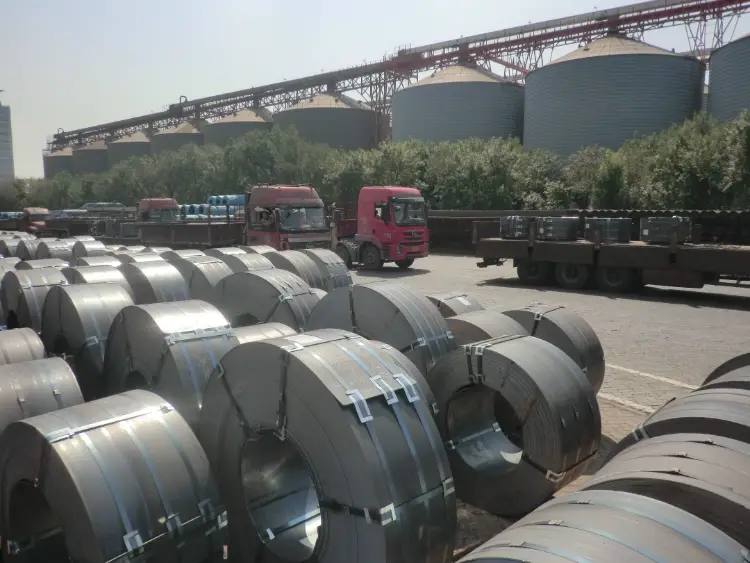
ABS Grade DQ63 Shipbuilding Steel Coil
ABS Grade DQ63 Shipbuilding Steel Coil - High-Strength Quenched & Tempered Marine Steel
Comprehensive material data for ABS DQ63 shipbuilding steel coil: chemical composition, mechanical and physical properties, international equivalents, and application guide for ship and offshore structures.
Hot rolling, quenching and tempering, cutting, cold forming, welding (with preheating and post-weld treatment recommendations)
- Phone : +8618037372205
- Email : [email protected]
- WhatsApp: Contact via Whtsapp
- WeChat: +8618037372205
ABS Grade DQ63 Shipbuilding Steel Coil Introduction
ABS Grade DQ63 is a high-strength quenched and tempered structural steel for shipbuilding, certified under the American Bureau of Shipping rules. It belongs to the Q (quenched and tempered) series with a D toughness level, meaning impact tested at -20°C. With a minimum yield strength of 620 MPa and tensile strength in the range 720–890 MPa, it is designed for heavily loaded hull sections, offshore platforms, and other marine constructions where weight reduction and high load-bearing capacity are critical. The steel exhibits excellent notch toughness at low temperatures, good weldability with proper procedure, and consistent mechanical properties through thickness up to 100 mm. Key features:
- Minimum yield 620 MPa
- Impact test at -20°C (27 J min)
- Good formability and weldability
- Available in coil form for efficient processing
ABS Grade DQ63 Shipbuilding Steel Coil Chemical Composition
Chemical requirements according to ABS Rules for Grade DQ63 (identical to EQ63 chemistry). All elements shown as maximum unless a range is given. Fine-grained practice is required; aluminium or other grain-refining elements are mandatory. Boron may be added as an optional microalloying element for hardenability. The steel is fully killed and fine-grained.
| Element | Standard Value (max, or min–max) | Remarks |
|---|---|---|
| C | 0.20 | Carbon |
| Mn | 0.90 – 1.60 | Manganese |
| Si | 0.10 – 0.55 | Silicon |
| P | 0.025 | Phosphorus |
| S | 0.025 | Sulfur |
| Cr | 0.30 | Chromium |
| Ni | 1.00 | Nickel |
| Mo | 0.15 | Molybdenum |
| Cu | 0.35 | Copper |
| V | 0.10 | Vanadium |
| Ti | 0.02 | Titanium |
| Nb | 0.05 | Niobium (Columbium) |
| Al (acid soluble) | ≥ 0.015 | Aluminium, total or acid soluble |
| N | 0.012 | Nitrogen |
| B | 0.0005 (if added) | Boron, optional |
ABS Grade DQ63 Shipbuilding Steel Coil Thermal and Electrical Physical Properties
Physical properties are provided for general engineering reference. These values are typical for quenched and tempered low-alloy steel of this class and are not directly specified in the ABS rules. Actual properties may vary slightly depending on exact composition and heat treatment. Measurements at room temperature (20°C) unless otherwise stated.
| Property | Typical Value | Unit | Test Condition / Note |
|---|---|---|---|
| Density (ρ) | 7.82 – 7.85 | g/cm³ | Ambient temperature |
| Elastic Modulus (E) | 205 | GPa | Room temperature, tensile |
| Shear Modulus (G) | 80 | GPa | Room temperature, estimated |
| Poisson's Ratio (ν) | 0.29 – 0.31 | – | Within elastic range |
| Thermal Expansion Coeff. (α) | 11.5 | ×10⁻⁶/K | 20 °C to 100 °C |
| Thermal Expansion Coeff. (α) | 12.2 | ×10⁻⁶/K | 20 °C to 200 °C |
| Thermal Conductivity (λ) | 25 – 30 | W/(m·K) | At 100 °C |
| Specific Heat Capacity (cp) | 460 – 480 | J/(kg·K) | At 20–100 °C |
| Electrical Resistivity (ρe) | 0.20 – 0.25 | μΩ·m | At 20 °C |
ABS Grade DQ63 Shipbuilding Steel Coil Mechanical Properties
Mechanical properties for quenched and tempered condition. Test pieces taken in transverse direction for plates; longitudinal for coil unless otherwise agreed. The values apply to thickness ≤100 mm. For thickness >100 mm, properties shall be specially agreed. Impact test temperature is -20°C with minimum average absorbed energy 27 J (longitudinal). Bend test mandrel diameter depends on thickness and tensile strength.
| Property | Standard Requirement Value | Unit | Test Condition |
|---|---|---|---|
| Yield Strength (ReH) | ≥ 620 | MPa | t ≤ 100 mm, transverse |
| Tensile Strength (Rm) | 720 – 890 | MPa | t ≤ 100 mm, transverse |
| Elongation (A) | ≥ 15 | % | t ≤ 50 mm, gauge length 5.65√So |
| Elongation (A) | ≥ 14 | % | 50 < t ≤ 70 mm, gauge length 5.65√So |
| Elongation (A) | ≥ 14 | % | 70 < t ≤ 100 mm, gauge length 5.65√So |
| Bend Test (Mandrel Diameter) | 3 t | – | t ≤ 30 mm, bending angle 180° |
| Bend Test (Mandrel Diameter) | 4 t | – | t > 30 mm, bending angle 180° |
| Charpy V-Notch Impact (KV) | ≥ 27 (average) | J | at -20 °C, longitudinal, t ≤ 100 mm |
| Charpy V-Notch Impact (KV) | ≥ 20 (single) | J | at -20 °C, longitudinal, t ≤ 100 mm |
ABS Grade DQ63 Shipbuilding Steel Coil Fully Equivalent Material Standards and Replaceable Grades
| Country / Region | Standard / Class Society | Grade | Remarks |
|---|---|---|---|
| International (IACS) | DNV GL | D63 | Identical toughness level (-20°C) |
| International (IACS) | Lloyd's Register (LR) | D63 | Equivalent to ABS DQ63 |
| International (IACS) | Bureau Veritas (BV) | D63 | Equivalent to ABS DQ63 |
| International (IACS) | China Classification Society (CCS) | D63 | Equivalent grade with same tensile class |
| International (IACS) | ClassNK (NK) | KD63 | K toughness corresponds to -20°C (similar) |
| International (IACS) | RINA | D63 | Equivalent grade |
ABS Grade DQ63 Shipbuilding Steel Coil Application Introduction
ABS Grade DQ63 is designed for heavy-duty marine and offshore applications where high strength-to-weight ratio, excellent weldability, and low-temperature toughness are mandatory. It is widely used in newly built vessels and offshore structures, particularly in areas of high stress and fatigue. The coil form allows continuous processing, roll forming, and automated cutting.
Product Applications: Merchant ships (container ships, bulk carriers, tankers), Offshore jack-up rig legs and spudcans, Semi-submersible and floating production units, Arctic-class vessels and icebreakers, Large crane booms and lifting equipment, Pressure hulls and structural reinforcements
Processed into products: Hull bottom and side shells, Deck plating and stringer plates, Longitudinal stiffeners and web frames, Bulkhead plates and box girders, Transverse floors and brackets, Offshore platform deck and leg components, Crane pedestals and heavy brackets
Application industries: Shipbuilding and ship repair, Offshore oil & gas exploration platforms, Marine renewable energy (wind turbine foundations, tidal energy structures), Heavy engineering and construction, Ice-class vessel manufacturing, Naval and defense shipbuilding
ABS Grade DQ63 Shipbuilding Steel Coil Similar / Alternative Material Recommendations
These materials exhibit comparable strength levels but may differ in impact test temperature or standard specifications. They can be considered for substitution when design requirements allow.
| Country / Region | Standard / Class Society | Grade | Remarks |
|---|---|---|---|
| USA / International | ABS | EQ63 | Same strength, impact at -40°C (E toughness) – more stringent |
| USA / International | ABS | FQ63 | Impact at -60°C for cryogenic applications |
| Europe | EN 10025-6 | S620Q | Comparable yield strength (620 MPa min), quenched & tempered; not ship-specific but often used in offshore structures |
| USA | ASTM A514 / A514M | Grade Q or H | High strength Q&T steel plate, but different chemistry and not class-approved; careful review required |
| Japan | JIS G 3128 | SHY685 | High yield strength steel for welded structures; similar strength level but requires class approval for marine |
Notes:
Welding requires strict adherence to approved procedures, including proper preheating (typically 150–200°C depending on thickness and ambient conditions), low-hydrogen electrodes, and post-weld heat treatment if necessary. For coil material, the manufacturer must ensure uniform quenching and tempering through the entire coil length. The typical carbon equivalent (CEV) should be controlled below 0.50–0.55 to maintain weldability.
- Share



