
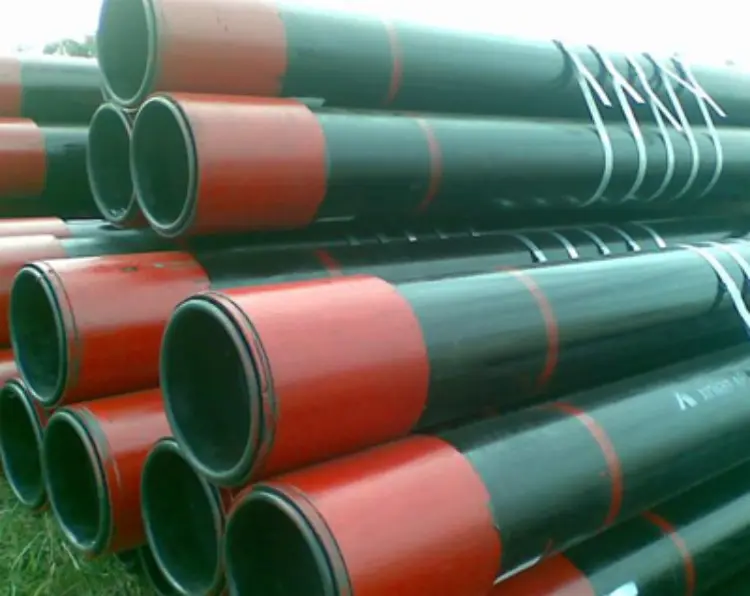
GB/T 3094 Q345B SHS/RSH Pipe
Q345B SHS/RSH Steel Pipe per GB/T 3094: High-Strength Structural Hollow Sections for Demanding Applications
Q345B square and rectangular hollow sections (SHS/RSH) produced to GB/T 3094 offer excellent weldability, high strength, and good cold-forming ability for structural and mechanical engineering applications.
Cold drawing, cold forming, welding, heat treatment as required
- Phone : +8618037372205
- Email : [email protected]
- WhatsApp: Contact via Whtsapp
- WeChat: +8618037372205
GB/T 3094 Q345B SHS/RSH Pipe Introduction
Q345B square hollow section (SHS) and rectangular hollow section (RSH) steel pipes are manufactured in accordance with GB/T 3094, China's national standard for cold-drawn special-shaped steel tubes. The base material is Q345B, a low-alloy high-strength structural steel defined in GB/T 1591. Key features:
- Minimum yield strength of 345 MPa for thicknesses up to 16 mm, providing robust load-bearing capacity.
- Excellent weldability and formability, suitable for cold bending and welding fabrication.
- Good low-temperature impact toughness, with guaranteed Charpy energy at 20°C.
- Available in a wide range of sizes and wall thicknesses for structural frameworks, machinery, and construction projects.
These hollow sections combine reduced weight with high torsional rigidity, making them ideal for columns, beams, trusses, and other load-carrying components.
GB/T 3094 Q345B SHS/RSH Pipe Chemical Composition
The chemical composition of Q345B steel used for GB/T 3094 hollow sections is specified in GB/T 1591-2008. The elements are controlled to achieve a fine-grained microstructure and consistent mechanical properties. Typical ladle analysis limits are shown below. The steel shall also contain at least one grain-refining element such as Al, Nb, V, or Ti.
| Element | Required Value (%) | Remarks |
|---|---|---|
| Carbon (C) | ≤ 0.20 | Max. |
| Silicon (Si) | ≤ 0.50 | Max. |
| Manganese (Mn) | ≤ 1.70 | Max. |
| Phosphorus (P) | ≤ 0.035 | Max. |
| Sulfur (S) | ≤ 0.035 | Max. |
| Niobium (Nb) | ≤ 0.07 | Optional grain refiner; max. |
| Vanadium (V) | ≤ 0.15 | Optional grain refiner; max. |
| Titanium (Ti) | ≤ 0.20 | Optional grain refiner; max. |
| Aluminum (Al) | ≥ 0.015 | If used as grain refiner |
GB/T 3094 Q345B SHS/RSH Pipe Physical, Thermal, and Electrical Properties
The following physical properties are typical for low-carbon low-alloy steel equivalent to Q345B at room temperature and under standard conditions. These values are based on widely accepted engineering references and are applicable to structural hollow sections made from this grade. Actual values may vary slightly with specific manufacturing processes and heat treatment conditions.
| Property | Typical Value | Unit | Test Condition |
|---|---|---|---|
| Density (ρ) | 7.85 | g/cm³ | 20°C |
| Young's modulus (E) | 200 | GPa | 20°C, static loading |
| Shear modulus (G) | ~79 | GPa | Calculated from E and ν |
| Poisson's ratio (ν) | 0.3 | — | Elastic range |
| Thermal expansion coefficient (α) | 12.0 × 10⁻⁶ | K⁻¹ | 20 – 100°C |
| Thermal expansion coefficient (α) | 12.5 × 10⁻⁶ | K⁻¹ | 20 – 200°C |
| Thermal conductivity (λ) | 53 | W/(m·K) | 100°C |
| Specific heat capacity (cp) | 480 | J/(kg·K) | 20 – 100°C |
| Electrical resistivity (ρₑ) | ~0.23 × 10⁻⁶ | Ω·m | 20°C |
GB/T 3094 Q345B SHS/RSH Pipe Mechanical Properties
The mechanical properties of Q345B SHS/RSH pipes are validated according to GB/T 3094-2012 and the underlying material standard GB/T 1591-2008. Test specimens are taken from the finished tube. Impact test values are guaranteed for the base material. Bending test requirement: 180° bend around a former with diameter d = 2a (where a is wall thickness) without cracking.
| Property | Required Value | Unit | Test Condition |
|---|---|---|---|
| Upper yield strength (ReH) | ≥ 345 | MPa | Wall thickness ≤ 16 mm |
| Upper yield strength (ReH) | ≥ 335 | MPa | Wall thickness > 16 mm and ≤ 40 mm |
| Tensile strength (Rm) | 470 – 630 | MPa | All thicknesses (typical range) |
| Elongation after fracture (A) | ≥ 21 | % | Proportional gauge length L₀ = 5.65√S₀, wall thickness ≤ 40 mm |
| Elongation after fracture (A) | ≥ 20 | % | Wall thickness > 40 mm |
| Bend test | d = 2a, 180° | — | Sample width ≥ 2× thickness; no cracks |
| Charpy impact energy (KV₂) | ≥ 34 | J | Test temperature +20°C, longitudinal specimen |
GB/T 3094 Q345B SHS/RSH Pipe Fully Equivalent Material Standards and Replaceable Grade Recommendations
| Country/Region | Standard | Grade | Remarks |
|---|---|---|---|
| China | GB/T 1591 | Q345B | Base material standard for hot-rolled or normalized structural steel; equivalent chemistry and mechanical properties. |
| European Union | EN 10219 | S355J2H | Cold-formed welded structural hollow sections; yield strength 355 MPa, impact at -20°C, direct substitute for Q345B SHS/RSH. |
| United States | ASTM A500 | Grade C | Cold-formed welded and seamless carbon steel structural tubing; min yield 345 MPa (50 ksi), tensile min 425 MPa (62 ksi). Comparable for square/rectangular shapes. |
| Japan | JIS G 3466 | STKR490 | Carbon steel square and rectangular tubes for general structural purposes; min tensile strength 490 MPa, yield approx. 325 MPa. Close substitute with slightly different strength range. |
GB/T 3094 Q345B SHS/RSH Pipe Application Introduction
Q345B SHS/RSH tubes are widely used in load-bearing structures where high strength-to-weight ratio, good weldability, and reliable impact toughness are required. The hollow sections offer excellent resistance to bending and torsion, making them ideal for columns, beams, and trusses. They can be easily cut, welded, and drilled using standard fabrication techniques. Typical applications span from heavy civil engineering to light industrial framing.
Product Applications: Steel frameworks for high-rise buildings and industrial plants, Bridge girders and support structures, Transmission line towers and telecommunication masts, Truck chassis, trailers, and crane booms, Scaffolding systems and temporary structures, Solar panel mounting structures
Processed into products: Hollow structural columns and beams, Truss chords and web members, Frames for heavy machinery and presses, Roll cages and protective guards, Railing and balustrade posts, Structural base plates and connectors (when fabricated from tube sections)
Application industries: Construction and civil engineering, Machinery and equipment manufacturing, Automotive and transportation, Energy and transmission towers, Agricultural and greenhouse structures, Shipbuilding and offshore structures
GB/T 3094 Q345B SHS/RSH Pipe Similar/Alternative Materials with Comparable Performance
| Country/Region | Standard | Grade | Remarks |
|---|---|---|---|
| China | GB/T 1591 | Q345D | Low-temperature impact variant (KV₂ ≥ 27 J at -20°C) with same strength level; suitable for more demanding cold-region applications. |
| China | GB/T 700 | Q235B | Lower yield strength (235 MPa) structural carbon steel; can be used for less stressed components but not a direct strength replacement. |
| European Union | EN 10219 | S275J2H | Lower strength grade (275 MPa yield) with good toughness; often used where Q345B may be over-specified. |
| ISO | ISO 630 | E355 | Comparable low-alloy structural steel plate/strip; not directly for tubes but similar base material properties. |
Notes:
Note: Q345B grade was officially superseded by Q355B in GB/T 1591-2018; however, Q345B is still widely referenced in legacy designs and current production. When ordering, it is recommended to specify Q355B + N (normalized) or + M (thermo-mechanically rolled) to meet the updated standard. For GB/T 3094 tubes, always confirm the applicable edition of both material and dimensional standards to ensure full compliance. The impact test temperature (+20°C) for Q345B is mandatory; alternative low-temperature grades (e.g., Q345D, Q345E) should be selected if service temperatures are lower.
- Share



