
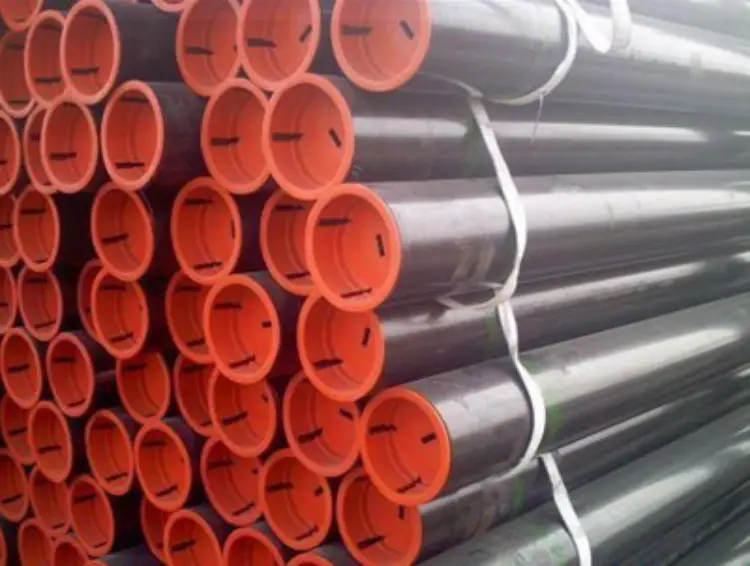
Q235B SHS/RHS Pipe
Q235B SHS/RHS Pipe: Material Data for Cold-Formed Square & Rectangular Hollow Sections per GB/T 3094
Complete technical specification for Q235B carbon structural steel used in cold formed square and rectangular hollow sections, including chemical composition, mechanical & thermal properties, equivalent grades, and application guidance.
Cold forming, electric resistance welding (ERW), bending, cutting, machining, hot-dip galvanizing, painting, powder coating
- Phone : +8618037372205
- Email : [email protected]
- WhatsApp: Contact via Whtsapp
- WeChat: +8618037372205
Q235B SHS/RHS Pipe Introduction
Q235B is a widely used carbon structural steel in China, defined under GB/T 700-2006. When manufactured into square (SHS) or rectangular (RHS) hollow sections conforming to GB/T 3094-2012, it offers a balanced combination of strength, ductility, and weldability. Typical yield strength is not less than 235 MPa. These hollow sections are produced by cold forming and welding, resulting in uniform wall thickness and good dimensional accuracy.
Key features:
- Suitable for structural and general engineering applications.
- Excellent weldability and formability.
- Available in various sizes and wall thicknesses.
- Can be supplied with surface treatments such as hot-dip galvanizing or painting for corrosion protection.
- Cost-effective solution for construction and mechanical components.
Q235B SHS/RHS Pipe Chemical Composition
Chemical composition of Q235B steel according to GB/T 700-2006. Values are maximum percentages unless a range is given. Residual elements may be present but are not intentionally added. The product analysis tolerances are specified in GB/T 222.
| Element | Required Value | Remarks |
|---|---|---|
| C | ≤ 0.20 | |
| Si | ≤ 0.35 | |
| Mn | ≤ 1.40 | |
| P | ≤ 0.045 | |
| S | ≤ 0.045 | |
| Cr (residual) | ≤ 0.30 | residual element |
| Ni (residual) | ≤ 0.30 | residual element |
| Cu (residual) | ≤ 0.30 | residual element |
| N | ≤ 0.008 | optional, not usually specified |
| As | ≤ 0.080 | optional, not usually specified |
Q235B SHS/RHS Pipe Thermal and Electrical Physical Properties
Physical properties of Q235B steel, typical for low-carbon structural steel. Values may vary slightly with exact composition and heat treatment. Density, thermal expansion, thermal conductivity, specific heat capacity, and elastic moduli are essential for structural design and thermal calculations.
| Property | Typical Value | Unit | Test Condition / Remarks |
|---|---|---|---|
| Density (ρ) | 7.85 | g/cm³ | 20 °C |
| Elastic modulus (E) | 200 – 210 | GPa | 20 °C |
| Shear modulus (G) | 79 – 81 | GPa | 20 °C |
| Poisson's ratio (ν) | 0.30 | ||
| Thermal expansion coefficient (α) | 12.0 × 10⁻⁶ | /K | 20–100 °C |
| Thermal expansion coefficient (α) | 12.8 × 10⁻⁶ | /K | 20–200 °C |
| Thermal expansion coefficient (α) | 13.5 × 10⁻⁶ | /K | 20–300 °C |
| Thermal conductivity (λ) | 53 | W/(m·K) | at 100 °C |
| Specific heat capacity (c) | 460 – 480 | J/(kg·K) | 20–100 °C |
| Electrical resistivity (ρe) | 0.15 – 0.20 | Ω·mm²/m | 20 °C |
Q235B SHS/RHS Pipe Mechanical Properties
Mechanical properties for Q235B hollow sections according to GB/T 700 and GB/T 3094. Values are for wall thickness ≤ 16 mm unless otherwise noted. Tensile test on longitudinal specimen. Impact test temperature is +20°C for grade B. Bending test applicable for hollow sections if required.
| Property | Required Value | Unit | Test Condition |
|---|---|---|---|
| Yield Strength (ReH) | ≥ 235 | MPa | Thickness ≤ 16 mm |
| Yield Strength (ReH) | ≥ 225 | MPa | Thickness 16–40 mm |
| Tensile Strength (Rm) | 370 – 500 | MPa | |
| Elongation after fracture (A) | ≥ 26 | % | Longitudinal, gauge length 5.65√So (ISO 6892-1); thickness ≤ 40 mm |
| Elongation after fracture (A) | ≥ 25 | % | Thickness 40–60 mm |
| Bend test (diameter of mandrel) | a (180°) | a = specimen thickness, for hollow sections ≤ 60 mm; no cracking on outside | |
| Impact energy (KV2) | ≥ 27 | J | Longitudinal, +20 °C, Charpy V-notch, 10x10 mm specimen |
| Impact energy (KV2) | ≥ 27 | J | Transverse, +20 °C (alternative test, if agreed) |
Q235B SHS/RHS Pipe Complete Equivalent Material Standards and Replaceable Grades
| Country/Region | Standard | Grade | Remarks |
|---|---|---|---|
| China | GB/T 700-2006 | Q235B | Base material; identical requirements |
| European Union | EN 10025-2:2019 | S235JR (1.0038) | Closest match; tensile properties and weldability comparable; minor differences in impact energy requirement |
| USA | ASTM A500/A500M-21 | Grade B | Hollow structural sections; yield strength 315 MPa for Grade B, slightly higher; chemical composition similar |
| USA | ASTM A36/A36M | A36 | General structural steel, comparable strength |
| Japan | JIS G3101:2020 | SS400 | Similar strength level, but chemical composition less restricted |
| International | ISO 630-2:2011 | S235B | Harmonized international standard; essentially equivalent to S235JR |
Q235B SHS/RHS Pipe Application Introduction
Q235B SHS/RHS pipes are extensively used across multiple industries due to their favourable mechanical properties, good weldability, and cost-effectiveness. The hollow sections are lightweight yet strong, making them ideal for both load-bearing and non-load-bearing structures. Typical applications are divided into industry sectors, specific products, and components as listed below.
Product Applications: Structural frames and trusses, Columns, beams, and purlins, Scaffolding and formwork supports, Machine bases and frames, Trailer chassis and body frames, Storage racks, shelving systems, Greenhouse structures, Handrails, guardrails, and fencing, Highway signage and lighting poles
Processed into products: Hollow section columns and beams in buildings, Roof truss chords and web members, Vehicle sub-frames and roll cages, Jib crane booms and lifting masts, Agricultural implement frames, Mezzanine floor supports, Racking uprights and beams, Solar panel mounting structures, Furniture legs and frames, Bicycle frames and steel furniture
Application industries: Building and Construction, Industrial Machinery, Automotive and Transport, Furniture and Shelving, Agricultural Equipment, Infrastructure (Bridges, Towers, Signage)
Q235B SHS/RHS Pipe Similar / Alternative Materials for Consideration
| Country/Region | Standard | Grade | Remarks |
|---|---|---|---|
| China | GB/T 700 | Q235A | Lower impact toughness guarantee (no impact test specified); otherwise similar |
| China | GB/T 700 | Q235C / Q235D | Better low-temperature impact properties (0°C / -20°C vs +20°C for Q235B) |
| China | GB/T 1591 | Q345B / Q355B | Higher strength low-alloy structural steel; yield strength ≥345/355 MPa for thickness ≤16 mm; suitable for weight reduction while maintaining mechanical properties |
| European Union | EN 10025-2 | S275JR / S355J2 | Higher strength grades; S275JR approximate yield 275 MPa, S355 yield 355 MPa |
| USA | ASTM A500 | Grade C | Higher yield strength 345 MPa, for higher load hollow sections |
| Japan | JIS G3444 | STK400 / STK490 | Steel tubes for structural purposes; STK400 comparable to Q235B, STK490 comparable to Q345 |
Notes:
Additional Information:
- Dimensional tolerances and straightness shall conform to GB/T 3094 or as agreed between purchaser and supplier.
- Surface quality: free from cracks, laps, and injurious imperfections. Slight oxide scale is permissible.
- Delivery with mill test certificates (EN 10204 type 2.2 or 3.1) is standard.
- For outdoor applications, hot-dip galvanizing to GB/T 13912 or EN ISO 1461 is recommended to enhance corrosion resistance.
- When welding pre-galvanized sections, proper ventilation and fume extraction are required due to zinc oxide emissions.
- Share



