
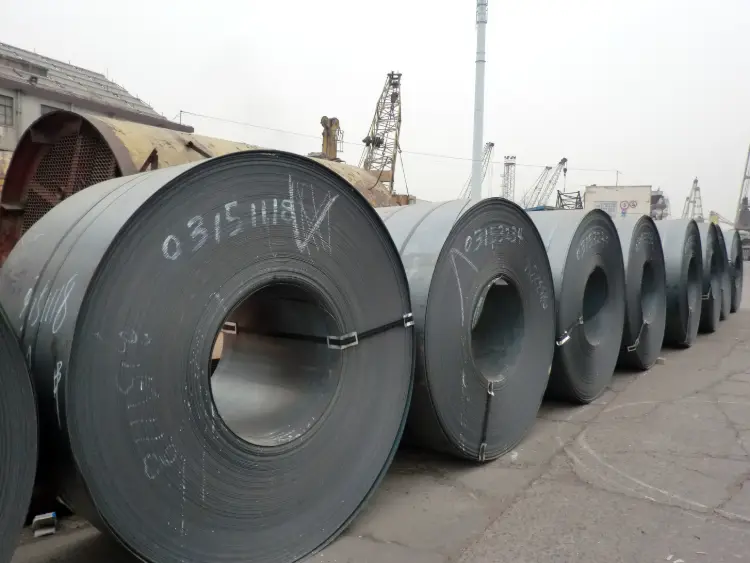
Q295NH Weather Resistant Steel Coil
Q295NH Weather Resistant Steel Coil: GB/T 4171 Atmospheric Corrosion Resistant Steel
Q295NH weathering steel coil under GB/T 4171 provides enhanced atmospheric corrosion resistance through alloying of Cu, Cr, Ni, ideal for bridges, buildings, and containers.
Hot rolling, cold rolling, welding, bending, cutting, forming
- Phone : +8618037372205
- Email : [email protected]
- WhatsApp: Contact via Whtsapp
- WeChat: +8618037372205
Q295NH Weather Resistant Steel Coil Introduction
Q295NH is a high-strength, weather-resistant structural steel grade defined in Chinese standard GB/T 4171. It is designed for welded, bolted, and riveted structures exposed to atmospheric corrosion. Compared to ordinary carbon steel, Q295NH achieves significantly improved corrosion resistance by adding small amounts of alloying elements such as copper, chromium, and nickel, which promote the formation of a dense, protective rust layer ("patina"). This self-protecting characteristic reduces or eliminates the need for painting, lowering maintenance costs throughout the service life.
- Minimum yield strength 295 MPa (thickness ≤16 mm) and tensile strength 430–560 MPa, ensuring good load-bearing capacity.
- Excellent toughness with Charpy impact energy ≥27 J at 0 °C, suitable for low-temperature environments.
- Good weldability and formability, allowing practical fabrication processes.
- Typical applications include steel structures in bridges, buildings, railway rolling stock, containers, and transmission towers.
Q295NH Weather Resistant Steel Coil Chemical Composition
The chemical composition of Q295NH is balanced to provide atmospheric corrosion resistance and mechanical strength. Copper (Cu), chromium (Cr), and nickel (Ni) are the key alloying elements that enable the formation of a protective rust layer. Other elements are controlled to ensure weldability and toughness. The values listed below are in accordance with GB/T 4171 standard.
| Element | Standard Value (wt%) | Remarks |
|---|---|---|
| Carbon (C) | ≤0.15 | |
| Silicon (Si) | ≤0.50 | |
| Manganese (Mn) | 0.25~0.80 | |
| Phosphorus (P) | ≤0.030 | |
| Sulfur (S) | ≤0.030 | |
| Copper (Cu) | 0.25~0.50 | Critical for weather resistance |
| Chromium (Cr) | 0.40~0.80 | Critical for weather resistance |
| Nickel (Ni) | ≤0.60 | Enhances toughness and corrosion resistance |
| Nitrogen (N) | ≤0.012 | Optional requirement |
| Other grain refiners | As agreed | e.g., Nb, V, Ti; total ≤0.12% |
Q295NH Weather Resistant Steel Coil Thermal and Electrical Physical Properties
Physical properties of Q295NH are similar to those of common low-alloy structural steels. The data provided here are typical reference values at room temperature unless otherwise indicated. These values can be used for engineering calculations such as thermal stress analysis, heat transfer, and electrical resistance estimation.
| Property | Typical Value | Unit | Test Condition |
|---|---|---|---|
| Density (ρ) | 7.85 | g/cm³ | 20 °C |
| Modulus of Elasticity (E) | 200~210 | GPa | 20 °C |
| Shear Modulus (G) | 80 | GPa | 20 °C |
| Poisson's Ratio (ν) | 0.3 | — | — |
| Thermal Expansion Coefficient (α) | 11.5×10⁻⁶ | K⁻¹ | 20~100 °C |
| Thermal Conductivity (λ) | 35 | W/(m·K) | 20 °C |
| Specific Heat Capacity | 480 | J/(kg·K) | 20 °C |
| Electrical Resistivity (ρ_e) | 0.15~0.25 | μΩ·m | 20 °C |
Q295NH Weather Resistant Steel Coil Mechanical Properties
Mechanical properties of Q295NH are guaranteed at room temperature after delivery condition (hot-rolled, normalized, or TMCP). The values vary with product thickness. Minimum values for yield strength, tensile strength, elongation, and impact toughness are shown below, together with bend test requirements. All tests shall be performed in accordance with the relevant GB/T standards.
| Property | Specified Value | Unit | Test Condition |
|---|---|---|---|
| Yield Strength (ReH) | ≥295 | MPa | Thickness ≤16 mm |
| Yield Strength (ReH) | ≥285 | MPa | Thickness >16~40 mm |
| Yield Strength (ReH) | ≥275 | MPa | Thickness >40~60 mm |
| Yield Strength (ReH) | ≥255 | MPa | Thickness >60~100 mm |
| Tensile Strength (Rm) | 430~560 | MPa | All thicknesses |
| Elongation (A) | ≥24 | % | Thickness ≤16 mm, gauge length L0=5.65√S0 |
| Elongation (A) | ≥23 | % | Thickness >16~40 mm |
| Elongation (A) | ≥22 | % | Thickness >40~60 mm |
| Elongation (A) | ≥22 | % | Thickness >60~100 mm |
| Bend Test (180° bending) | d=2a | — | Thickness ≤16 mm |
| Bend Test (180° bending) | d=3a | — | Thickness >16~100 mm |
| Impact Energy (KV2, longitudinal) | ≥27 | J | 0 °C, standard V-notch specimen |
Q295NH Weather Resistant Steel Coil Fully Equivalent Material Standards and Substitutable Grades
| Country/Region | Standard | Grade | Remarks |
|---|---|---|---|
| China | GB/T 4171 | Q295NH | Identical grade — the original and complete standard specification. |
Q295NH Weather Resistant Steel Coil Application Introduction
Thanks to its balanced strength, excellent corrosion resistance, and good weldability, Q295NH is widely used in load-bearing structures exposed to the atmosphere. It is particularly advantageous where long-term maintenance-free service is desired. The following provides an overview of typical industries, products, and specific components.
Product Applications: Weather-resistant bridge girders and trusses, Outdoor steel frameworks and facades, Railway freight car bodies and hoppers, Shipping containers and intermodal boxes, Chimney stacks and ducting, Highway guardrails and sound barriers
Processed into products: I‑beams, H‑beams, angles, and channels, Welded box girders and plate girders, Column and beam connections, Stiffened panels and decks, Brackets, gussets, and base plates, Flanges and bolted splice plates
Application industries: Bridge Construction, Building & Infrastructure, Railway Rolling Stock, Container Manufacturing, Power Transmission & Telecom Towers, Outdoor Sculpture & Architectural Metals, Shipbuilding (non-marine structural parts)
Q295NH Weather Resistant Steel Coil Similar / Alternative Material Recommendations
| Country/Region | Standard | Grade | Remarks |
|---|---|---|---|
| Europe | EN 10025-5 | S235J2W | Lower yield strength (~235 MPa) but similar atmospheric corrosion resistance; may be used if static design allows. |
| USA | ASTM A588/A588M | Grade A | Higher strength (~345 MPa yield) weathering steel; suitable for heavier loads, with comparable weldability. |
| Japan | JIS G3125 | SPA-H | High weather resistance with yield strength ~355 MPa; commonly used in containers and rolling stock. |
| International | ISO 4952 | Fe 235W C | Lower strength grade with similar atmospheric corrosion resistance; can substitute in low‑stress parts. |
Notes:
Q295NH develops a stable, adherent patina under alternating wet/dry atmospheric cycles. To fully exploit its corrosion resistance, design details should avoid water traps, crevices, and galvanic corrosion with dissimilar metals. For aggressive industrial or marine environments, supplementary protective coatings may still be necessary. Always refer to the latest revision of GB/T 4171 for up-to-date requirements and permitted thickness ranges.
- Share



