
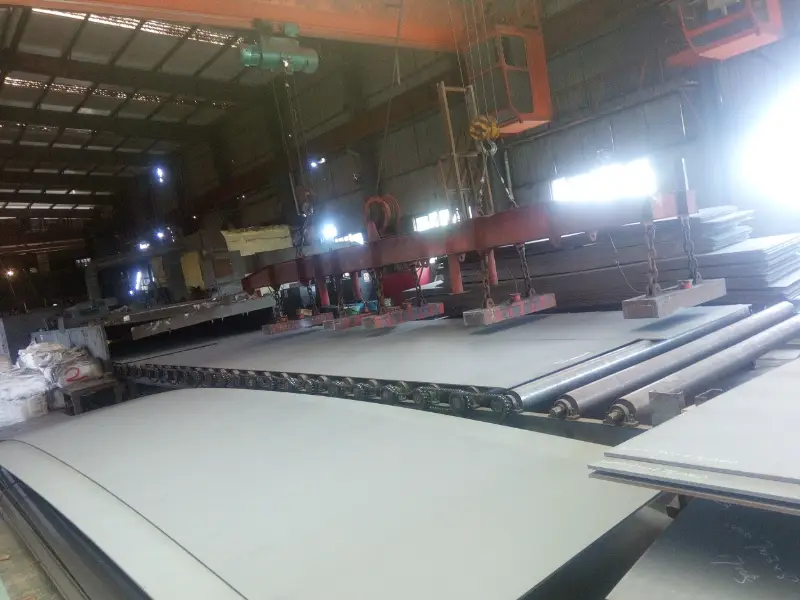
Q355NH Weather Resistant Steel
Q355NH Weather Resistant Steel: GB/T 4171 Analysis & Equivalents for Structural Longevity
Detailed analysis of Q355NH structural steel under GB/T 4171, including chemical composition, mechanical properties, and thermal data for atmospheric corrosion resistance.
Hot Rolling, Cold Forming, Welding, Machining
- Phone : +8618037372205
- Email : [email protected]
- WhatsApp: Contact via Whtsapp
- WeChat: +8618037372205
Q355NH Weather Resistant Steel Introduction
Q355NH is a high-strength low-alloy structural steel specifically designed for enhanced atmospheric corrosion resistance, defined under the Chinese standard GB/T 4171. By alloying with elements such as copper, chromium, and nickel, it develops a dense, adherent oxide patina upon exposure to the atmosphere, which significantly slows down further corrosion, often eliminating the need for protective painting. Key characteristics include a minimum yield strength of 355 MPa, excellent weldability, and superior toughness compared to plain carbon steel. It is widely used for long-life structural applications directly exposed to the elements, offering a combination of high strength, durability, and economic maintenance
Q355NH Weather Resistant Steel Chemical Composition
The chemical composition of Q355NH steel is carefully balanced to ensure both mechanical strength and atmospheric corrosion resistance. Alloying elements like copper, chromium, and nickel are key to forming a protective patina. Phosphorus can also contribute to weathering resistance but is controlled to maintain toughness. The values below are based on GB/T 4171 for thicknesses ≤ 16mm.
| Element | Standard Value (wt%) | Remarks |
|---|---|---|
| Carbon (C) | ≤ 0.16 | Max limit ensures weldability |
| Silicon (Si) | ≤ 0.50 | Deoxidizer, contributes to strength |
| Manganese (Mn) | 0.50 ~ 1.50 | Key strength and toughness enhancer |
| Phosphorus (P) | ≤ 0.030 | Controlled for toughness; aids corrosion resistance in some grades |
| Sulfur (S) | ≤ 0.030 | Kept low for ductility and weld quality |
| Copper (Cu) | 0.25 ~ 0.55 | Essential for atmospheric corrosion resistance |
| Chromium (Cr) | 0.40 ~ 0.80 | Synergistic effect with Cu for passivating layer |
| Nickel (Ni) | ≤ 0.65 | Improves toughness and corrosion resistance in acidic environments |
| Nitrogen (N) | ≤ 0.012 | Controlled to prevent strain aging |
Q355NH Weather Resistant Steel Thermal and Electrical Physical Properties
Physical properties of Q355NH, such as thermal expansion and conductivity, are essential for engineering calculations involving thermal processing and structural design under temperature variations. These values are typical for weathering steel of this composition class and may vary slightly with specific heat treatment and microstructure. The data serves as a general engineering guide.
| Property | Typical Value | Unit | Test Condition / Reference |
|---|---|---|---|
| Density (ρ) | 7.85 | g/cm³ | At 20°C |
| Elastic Modulus (E) | 206 | GPa | At 20°C |
| Shear Modulus (G) | 79.3 | GPa | At 20°C (Calculated approx.) |
| Poisson's Ratio (ν) | 0.30 | – | At 20°C (Typical) |
| Thermal Expansion Coefficient (α) | 11.5 ~ 12.0 | 10⁻⁶/K | 20°C to 100°C |
| Thermal Expansion Coefficient (α) | 12.5 ~ 13.0 | 10⁻⁶/K | 20°C to 200°C |
| Thermal Conductivity (λ) | 42 ~ 48 | W/(m·K) | At 20°C to 100°C |
| Specific Heat Capacity | 460 ~ 480 | J/(kg·K) | At 20°C to 100°C |
| Electrical Resistivity (ρ_e) | 0.25 ~ 0.30 | μΩ·m | At 20°C |
Q355NH Weather Resistant Steel Mechanical Properties
The mechanical properties of Q355NH are guaranteed for delivery condition and pertain to transverse test pieces. The minimum yield strength is 355 MPa for thicknesses ≤ 16mm, decreasing slightly for thicker sections. Excellent Charpy impact toughness is a key requirement, ensuring structural integrity in cold climates and dynamic loading conditions. A bend test confirms the material's formability.
| Property | Standard Requirement Value | Unit | Test Condition / Thickness (t, mm) |
|---|---|---|---|
| Yield Strength (ReH) | ≥ 355 | MPa | t ≤ 16 |
| Yield Strength (ReH) | ≥ 345 | MPa | 16 < t ≤ 40 |
| Yield Strength (ReH) | ≥ 335 | MPa | 40 < t ≤ 63 |
| Tensile Strength (Rm) | 490 ~ 630 | MPa | t ≤ 100 |
| Elongation after Fracture (A) | ≥ 22 | % | t ≤ 16 (Gauge 5.65√So) |
| Elongation after Fracture (A) | ≥ 22 | % | 16 < t ≤ 40 |
| Elongation after Fracture (A) | ≥ 21 | % | 40 < t ≤ 63 |
| Impact Energy (KV2) | ≥ 34 | J | Longitudinal, 0°C |
| Bend Test (D= Mandrel dia; a= specimen thickness) | D=2a | No cracks | 180° Bending, t ≤ 16 |
| Bend Test (D=3a) | D=3a | No cracks | 180° Bending, t > 16 |
Q355NH Weather Resistant Steel Recommended Complete Equivalent Materials and Standards
| Country/Region | Standard | Designation | Remarks |
|---|---|---|---|
| Europe | EN 10025-5 | S355J2W (1.8965) | Closest chemical and mechanical equivalent. Mandatory impact energy of 27J at -20°C may exceed Q355NH's 0°C requirement. |
| International | ISO 4952 | S355W | Standard for improved atmospheric corrosion resistance structural steels; properties align closely with Q355NH. |
| USA | ASTM A588/A588M | Grade K | Chemical composition (Cr-Ni-Cu) is analogous. Mechanical properties are highly comparable. |
| Japan | JIS G3114 | SMA570W | Designed for welded structures with high weathering resistance. Equivalent strength grade with similar alloying concepts. |
Q355NH Weather Resistant Steel Application Introduction
Q355NH steel is engineered for structures where long-term durability with minimal maintenance is critical. Its self-protecting patina makes it ideal for unpainted applications, though it can be painted if desired. The key to successful application is cyclic wetting and drying to allow the protective oxide layer to form properly. It is not recommended for continuous immersion or buried conditions without additional protection. The steel is easily fabricated using standard workshop practices for welding, cutting, and forming.
Product Applications: Highway and railway bridges, Weatherproof shipping containers, Structural frames for exposed industrial buildings, Railway passenger and freight cars, Transmission line towers and poles, Artistic architectural cladding and roof panels
Processed into products: Bridge box girders and I-beams, Container corner posts and side panels, Welded crane booms and heavy machinery frames, Truck frames and chassis components, Flue-gas stacks and chimney liners, Permanent shuttering for concrete
Application industries: Bridge Engineering, Railway Vehicle Manufacturing, Container and Port Machinery, Power Transmission and Telecommunications, Architecture and Construction (Facades, Sculptures), Road Infrastructure (Guardrails, Sign Gantries)
Q355NH Weather Resistant Steel Recommendations for Similar/Alternative Materials
| Country/Region | Standard | Designation | Remarks |
|---|---|---|---|
| Europe | EN 10025-5 | S355J0W (1.8959) | Similar strength and corrosion resistance, but has a higher impact transition temperature (0°C) compared to J2W variant. |
| USA | ASTM A242/A242M | Type 1 | Older standard for high-strength low-alloy structural steel with enhanced atmospheric corrosion resistance. Base strength can be lower. |
| USA | ASTM A588/A588M | Grade A | A widely available weathering steel grade. Yield strength (≥345 MPa) is slightly lower than Q355NH. |
| China | GB/T 4171 | Q355GNH | A high-phosphorus weathering steel variant (GNH). Offers superior corrosion resistance but requires careful welding practice. |
Notes:
For optimal performance of Q355NH in the unpainted 'weathering' condition, the design must consider drainage and avoidance of crevices where moisture can be trapped. The formation of a stable patina can take 6 months to 2 years depending on the climatic exposure. During welding, matching chemistry weathering electrodes or wires (e.g., AWS E7018-W or equivalent gas-shielded flux-cored wires) should be used to ensure the weld zone has equivalent corrosion resistance to the base metal. Preheating may be required for thick sections.
- Share



