
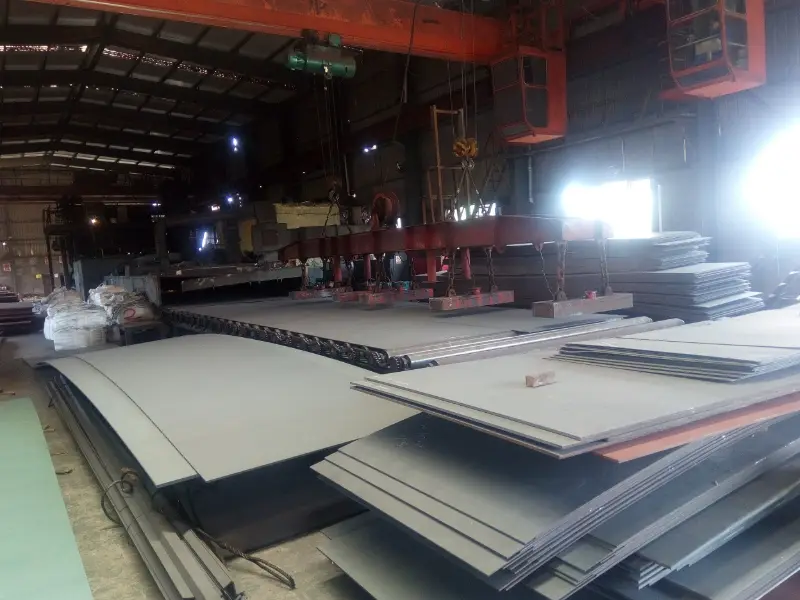
GB/T 4171 Q235NH Weathering Steel
GB/T 4171 Q235NH Weathering Steel: Superior Atmospheric Corrosion Resistance for Structural Applications
In-depth analysis of Q235NH weathering steel under GB/T 4171 standard, covering chemical composition, mechanical and thermal properties, international equivalents, and application guidelines for construction and engineering.
Hot Rolling, Cold Forming, Welding, Cutting, Bending
- Phone : +8618037372205
- Email : [email protected]
- WhatsApp: Contact via Whtsapp
- WeChat: +8618037372205
GB/T 4171 Q235NH Weathering Steel Introduction
Q235NH is a high-strength low-alloy structural steel grade specified in the Chinese standard GB/T 4171 for welded weathering steel structures. Renowned for its improved atmospheric corrosion resistance compared to plain carbon steel, it achieves this through the controlled addition of alloying elements such as copper, chromium, and nickel, forming a dense, adherent protective oxide layer over time. This steel offers a minimum yield strength of 235 MPa and exhibits good weldability and toughness, making it suitable for use in the bare condition without painting. Its typical applications include bridges, railway vehicles, containers, and architectural facades, where long-term durability and reduced maintenance are critical. The material is supplied in various forms including hot-rolled plates, sheets, strips, and coils.
GB/T 4171 Q235NH Weathering Steel Chemical Composition
The chemical composition of Q235NH is precisely balanced to achieve its weathering characteristics and mechanical properties. Strict limits on phosphorus and sulfur ensure good weldability and toughness. The addition of Cu, Cr, and Ni is fundamental for enhancing atmospheric corrosion resistance by promoting the formation of a stable, protective rust layer. The carbon equivalent (CEV) is controlled to guarantee excellent weldability.
| Element | Standard Value (Max, unless range) | Remarks |
|---|---|---|
| Carbon (C) | ≤ 0.16 | Key for strength |
| Silicon (Si) | 0.15 - 0.50 | Deoxidizer |
| Manganese (Mn) | 0.50 - 1.50 | Enhances strength and hardenability |
| Phosphorus (P) | ≤ 0.030 | Controlled for toughness |
| Sulfur (S) | ≤ 0.030 | Controlled for weldability |
| Copper (Cu) | 0.25 - 0.55 | Primary element for corrosion resistance |
| Chromium (Cr) | 0.40 - 0.80 | Enhances protective oxide layer |
| Nickel (Ni) | ≤ 0.65 | Improves toughness and resistance |
| Carbon Equivalent (CEV) | ≤ 0.44 | For weldability assessment |
GB/T 4171 Q235NH Weathering Steel Thermal and Electrical Physical Properties
These physical properties are typical for Q235NH low-alloy steel and are essential for design and engineering calculations involving thermal loads, heat transfer, or electrical conductivity. Values such as density, specific heat capacity, and thermal expansion are relatively consistent across weathering steel grades, while thermal conductivity decreases slightly with temperature. These properties are provided as approximate reference values.
| Property | Standard Value (Typical) | Unit | Test Condition |
|---|---|---|---|
| Density (ρ) | 7.85 | g/cm³ | At 20 °C |
| Young's Modulus (E) | 206 | GPa | At 20 °C |
| Shear Modulus (G) | 79.3 | GPa | At 20 °C |
| Poisson's Ratio (ν) | 0.30 | - | At 20 °C |
| Thermal Expansion Coefficient (α) | 11.8 | x10⁻⁶/K | 20 - 100 °C |
| Thermal Expansion Coefficient (α) | 12.8 | x10⁻⁶/K | 20 - 200 °C |
| Thermal Expansion Coefficient (α) | 13.9 | x10⁻⁶/K | 20 - 400 °C |
| Thermal Conductivity (λ) | 42 - 50 | W/(m·K) | At 20 °C |
| Specific Heat Capacity (c) | 470 - 480 | J/(kg·K) | At 20 °C |
| Electrical Resistivity (ρ_e) | 0.20 - 0.25 | Ω·mm²/m | At 20 °C |
GB/T 4171 Q235NH Weathering Steel Mechanical Properties
The mechanical properties of Q235NH steel are guaranteed at room temperature and are dependent on the product thickness. Testing is typically performed on transverse specimens according to relevant GB/T standards. The minimum yield strength is 235 MPa for thinner sections, with specified tensile strength, elongation, and excellent cold-bending characteristics. Impact toughness is guaranteed at specified low temperatures, ensuring structural integrity in frigid environments.
| Property | Standard Required Value | Unit | Test Condition / Thickness (mm) |
|---|---|---|---|
| Yield Strength (ReH) | ≥ 235 | MPa | t ≤ 16 |
| Yield Strength (ReH) | ≥ 225 | MPa | 16 < t ≤ 40 |
| Yield Strength (ReH) | ≥ 215 | MPa | 40 < t ≤ 60 |
| Tensile Strength (Rm) | 360 - 510 | MPa | t ≤ 16 |
| Tensile Strength (Rm) | 360 - 510 | MPa | 16 < t ≤ 40 |
| Tensile Strength (Rm) | 360 - 510 | MPa | 40 < t ≤ 60 |
| Elongation after Fracture (A) | ≥ 25 | % | t ≤ 16 |
| Elongation after Fracture (A) | ≥ 24 | % | 16 < t ≤ 40 |
| Elongation after Fracture (A) | ≥ 23 | % | 40 < t ≤ 60 |
| Bend Test (Diameter 'd', Thickness 'a') | d = a | 180° Bend, t ≤ 16 | |
| Bend Test (Diameter 'd', Thickness 'a') | d = 2a | 180° Bend, 16 < t ≤ 100 | |
| Impact Energy (KV2) | ≥ 27 | J | Longitudinal, 0 °C |
| Impact Energy (KV2) | ≥ 27 | J | Longitudinal, -20 °C (Optional) |
GB/T 4171 Q235NH Weathering Steel Full Equivalent Material Standards and Replaceable Designations
| Country/Region | Standard | Designation | Remarks |
|---|---|---|---|
| International | ISO 4952 | Fe355W-1A | Comparable chemistry and mechanical properties, designed for similar weathering applications. |
| Europe | EN 10025-5 | S355J0W (1.8959) | A direct equivalent with matching yield strength and weathering characteristics. |
| USA | ASTM A588 / A588M | Grade A | Closely equivalent in terms of atmospheric corrosion resistance and strength. |
| Japan | JIS G3125 | SPA-H | High weather resistance hot-rolled steel strip/plate, widely used as a direct substitute. |
GB/T 4171 Q235NH Weathering Steel Application Introduction
Q235NH weathering steel is engineered for structural applications where the combined benefits of moderate strength, weldability, and excellent atmospheric corrosion resistance are valued. Its self-protecting oxide layer eliminates the need for painting in many environments, reducing lifecycle costs. To ensure proper patina formation, the steel must undergo natural wet-dry cycles. It is critical to avoid prolonged ponding or burial, as this can lead to accelerated corrosion. The material is supplied as hot-rolled coils, plates, and sections, and can be readily fabricated using standard metalworking techniques, provided the weld consumables are matched to the weathering characteristics.
Product Applications: Pedestrian and Highway Bridge Girders, Railway Freight and Passenger Car Bodes, ISO Dry Cargo Shipping Containers, Architectural Weathering Steel Panels and Louvers, High-Voltage Transmission Line Lattice Towers, Exterior Weathering Steel Sculptures and Water Features
Processed into products: Welded structural beams and columns, Cold-formed purlins and girts for building envelopes, Flanged boiler and pressure vessel components for non-cryogenic service, Cut and welded heavy plates for machinery frames, Stamped and pressed parts for automotive underbodies and railcar components, Perforated facades and solar shading elements
Application industries: Bridge Construction, Railway Rolling Stock & Infrastructure, Maritime Container Manufacturing, Architecture, Building & Construction (Cladding, Facades), Power Transmission & Utility (Towers, Poles), Landscape Architecture and Public Art (Sculptures)
GB/T 4171 Q235NH Weathering Steel Recommendations for Similar/Closely Related Substitute Materials
| Country/Region | Standard | Designation | Remarks |
|---|---|---|---|
| China | GB/T 4171 | Q295NH | A higher strength variant (min yield 295 MPa) with comparable weathering performance. Suitable for heavier load-bearing structures. |
| China | GB/T 4171 | Q355NH | Offers significantly higher yield strength (min 355 MPa) while maintaining good atmospheric corrosion resistance for weight-optimized designs. |
| Europe | EN 10025-5 | S355J2W+N (1.8965) | Similar strength but with guaranteed impact properties at a lower temperature (-20°C) for more demanding cold climate applications. |
| USA | ASTM A242 | Type 1 | An older specification for high-strength low-alloy weathering steel, suitable with a slightly different alloy composition. |
Notes:
Welding considerations: Matching weathering steel filler metals (e.g., AWS ER80S-G or equivalent) should be used to ensure the weldment's corrosion resistance matches that of the base metal. For non-structural aesthetic applications, austenitic stainless steel fillers can be used. Patina formation: The development of the protective oxide patina is highly dependent on the environmental conditions and can take several months to years. An initial flash rusting period is normal.
- Share



