
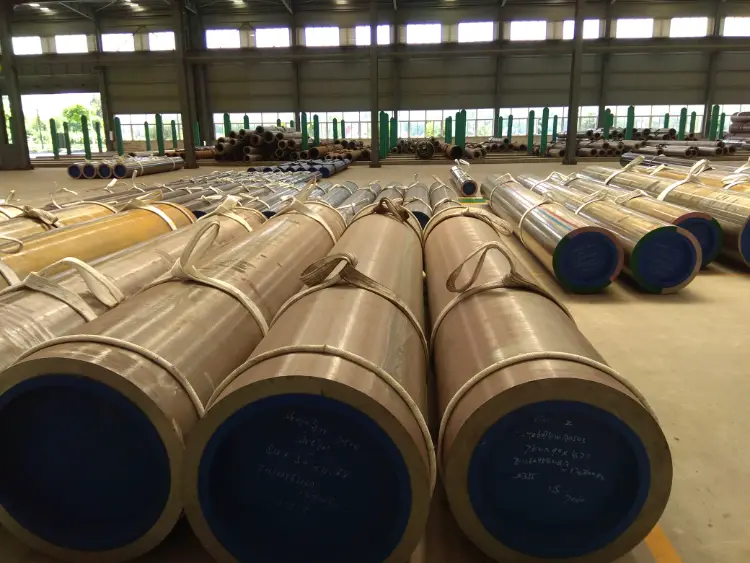
Q235D Steel Grade SSAW Pipe
Q235D Steel Grade Technical Data for SSAW Pipe - GBT700 Standard
Comprehensive technical analysis of Q235D carbon structural steel under Chinese standard GBT700, used in SSAW pipes.
Welding, Bending, Stamping, Machining, and Hot/Cold Forming
- Phone : +8618037372205
- Email : [email protected]
- WhatsApp: Contact via Whtsapp
- WeChat: +8618037372205
Q235D Steel Grade SSAW Pipe Introduction
Q235D is a carbon structural steel grade defined in the Chinese standard GB/T 700. It offers good comprehensive mechanical properties, including decent strength, plasticity, and weldability. The 'D' designation indicates guaranteed impact properties at a low temperature of -20°C, making it suitable for structures with low-temperature toughness requirements. This grade has a relatively low carbon content, which ensures excellent formability and weldability, commonly used for welded structural components like SSAW (Spiral Submerged Arc Welded) pipes. It exhibits a yield strength of 235 MPa and is widely utilized in building structures, bridges, and general engineering applications. Its balance of cost-effectiveness and reliable performance makes it a fundamental material in the construction and manufacturing industries.
Q235D Steel Grade SSAW Pipe Chemical Composition
The chemical composition of Q235D is strictly defined by GB/T 700 to ensure its mechanical properties and weldability. The low carbon content is key to its excellent weldability and formability, while manganese provides solid solution strengthening. Phosphorus and sulfur are strictly controlled to a low level to guarantee the -20°C impact toughness and avoid hot shortness during welding.
| Element | Standard Value | Remarks |
|---|---|---|
| Carbon (C) | ≤ 0.17 | Maximum value |
| Silicon (Si) | ≤ 0.35 | Maximum value |
| Manganese (Mn) | ≤ 1.40 | Maximum value |
| Phosphorus (P) | ≤ 0.035 | Maximum value |
| Sulfur (S) | ≤ 0.035 | Maximum value |
| Nitrogen (N) | Not specified | The standard does not define a limit, but it is typically controlled in modern steelmaking. |
| Residual Elements (Cr, Ni, Cu) | Residual content ≤ 0.30 each | Total combined residual elements Cr+Ni+Cu shall not exceed 0.60%. |
Q235D Steel Grade SSAW Pipe Physical and Thermal Properties
These physical and thermal properties are typical reference values at room temperature unless otherwise specified. These data are crucial for engineering calculations such as structural design, thermal analysis, and weight estimation. Slight variations can occur depending on the exact processing and heat treatment history.
| Property | Standard Requirement Value | Unit | Test Condition |
|---|---|---|---|
| Density (ρ) | 7.85 | g/cm³ | At 20°C |
| Modulus of Elasticity (E) | 200 - 210 | GPa | At 20°C |
| Shear Modulus (G) | 79 - 81 | GPa | At 20°C |
| Poisson's Ratio (ν) | 0.28 - 0.33 | At room temperature | |
| Thermal Expansion Coefficient (α) | 12.0 | 10⁻⁶/K | At 20 - 100°C |
| Thermal Expansion Coefficient (α) | 12.8 | 10⁻⁶/K | At 20 - 200°C |
| Thermal Expansion Coefficient (α) | 13.6 | 10⁻⁶/K | At 20 - 400°C |
| Thermal Conductivity (λ) | 54 - 56 | W/(m·K) | At 20°C |
| Specific Heat Capacity (c) | 460 - 480 | J/(kg·K) | At 20 - 100°C |
| Electrical Resistivity (ρ_e) | 0.15 - 0.20 | Ω·mm²/m | At 20°C |
Q235D Steel Grade SSAW Pipe Mechanical Properties
The mechanical properties for Q235D are specified based on the nominal thickness of the steel product. The guaranteed yield and tensile strengths decrease as the material thickness increases. The most critical feature of the 'D' quality grade is the guaranteed minimum impact energy of 27 Joules at a low temperature of -20°C, ensuring resistance to brittle fracture in cold environments.
| Property | Standard Requirement Value | Unit | Test Condition |
|---|---|---|---|
| Yield Strength (ReH) | ≥ 235 | MPa | Thickness ≤ 16 mm |
| Yield Strength (ReH) | ≥ 225 | MPa | 16 mm < Thickness ≤ 40 mm |
| Yield Strength (ReH) | ≥ 215 | MPa | 40 mm < Thickness ≤ 60 mm |
| Tensile Strength (Rm) | 370 - 500 | MPa | Thickness ≤ 60 mm |
| Elongation after fracture (A) | ≥ 26 | % | Longitudinal, Thickness ≤ 60 mm, using a gauge length of L0=5.65√S0 |
| Impact Energy (KV2) | ≥ 27 | J | Test temperature -20°C, Longitudinal, Standard Charpy V-notch specimen |
| Bend Test (Core Diameter) | d = a | Test sample bent 180°. Thickness direction: 'a' is sample thickness. |
Q235D Steel Grade SSAW Pipe Exact Equivalent Material Standards and Substitutable Grades
| Country/Region | Standard | Grade | Remarks |
|---|---|---|---|
| China | GB/T 700 | Q235D | Original standard and grade. Base material for SSAW pipe. |
Q235D Steel Grade SSAW Pipe Application Introduction
Q235D is a versatile workhorse material in heavy industry. Its excellent weldability, good low-temperature toughness, and low cost make it the primary choice for large welded structures. The SSAW pipe produced from Q235D is critical for long-distance, large-diameter pipelines where structural integrity in various climates is non-negotiable.
Product Applications: SSAW (Spiral Submerged Arc Welded) pipes, LSAW (Longitudinally Submerged Arc Welded) pipes, Steel structural frames for high-rise buildings, Bridge trusses and support beams, Industrial plant workshops, Transmission towers and telecommunication poles
Processed into products: Long-distance oil and gas pipeline segments, Piling pipes for bridge and dock foundations, Ventilation ducts and dust collection pipes, Structural columns, beams, and braces, Truck chassis frames and train underframes, Motor housings and large machine bases
Application industries: Oil and Gas Transportation, Construction and Civil Engineering, Water Supply and Drainage Systems, Bridge Building, Shipbuilding (secondary structures), Machinery Manufacturing
Q235D Steel Grade SSAW Pipe Similar/Comparable Substitute Material Recommendations
| Country/Region | Standard | Grade | Remarks |
|---|---|---|---|
| European Union | EN 10025-2 | S235J2 (1.0117) | Closest international equivalent. Guarantees 27 J impact energy at -20°C. |
| United States | ASTM A283/A283M | Grade D | Comparable carbon steel with similar strength. Impact properties are not an inherent guarantee, must be specified as supplementary requirement S5. |
| Japan | JIS G3101 | SS400 | Comparable strength level. However, SS400 does not guarantee specific chemistry or low-temperature impact toughness. Suitable for less demanding applications. |
| International | ISO 630-2 | S235D | Structurally identical in property requirements to S235J2. Part of the globally recognized ISO standard for structural steels. |
Notes:
The properties for Q235D SSAW pipe must also conform to specific pipe manufacturing standards, such as SY/T 5037 for ordinary fluid transportation pipelines. The base metal analysis relates to the coil or plate used for pipe forming. The weld seam's mechanical properties, including tensile and bend tests, are separately verified during pipe mill production. It is essential to ensure that the finished pipe meets the required hydrostatic test and non-destructive examination (NDE) standards.
- Share



