
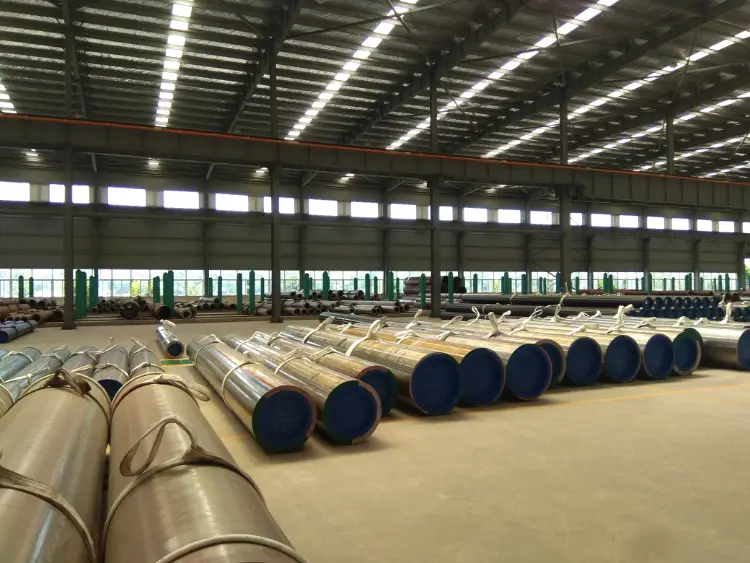
Q275 Carbon Structural Steel for SSAW Pipe
Q275 Carbon Structural Steel for SSAW Pipe - Composition, Properties & Equivalents
Comprehensive technical data for Q275 steel according to GB/T 700, typically used in spiral submerged arc welded (SSAW) pipes for structural and fluid transmission applications. Includes chemical composition, mechanical and physical properties, international equivalents, and application guidance.
Hot rolling, cold forming, spiral welding (SAW), cutting, beveling
- Phone : +8618037372205
- Email : [email protected]
- WhatsApp: Contact via Whtsapp
- WeChat: +8618037372205
Q275 Carbon Structural Steel for SSAW Pipe Introduction
Q275 is a carbon structural steel grade defined in Chinese standard GB/T 700-2006. It offers a minimum yield strength of 275 MPa (for thickness ≤16 mm) and good weldability, making it suitable for manufacturing spiral submerged arc welded (SSAW) pipes. The steel is widely used in structural engineering, water and oil transmission pipelines, and piling projects.
- Good combination of strength and toughness
- Excellent formability for cold bending and welding
- Available in multiple quality grades (B, C, D) for different impact requirements
- Cost-effective solution for large-diameter welded pipes
SSAW pipes made from Q275 are produced by spirally forming hot-rolled steel coils and welding with submerged arc process, offering high dimensional accuracy and uniform mechanical properties.
Q275 Carbon Structural Steel for SSAW Pipe Chemical Composition
The chemical composition complies with GB/T 700-2006 for Q275 steel. Values represent ladle analysis. The grade has several quality levels (B, C, D) with different phosphorus and sulfur limits. For Q275B: P ≤ 0.045%, S ≤ 0.045%; for Q275C: P ≤ 0.040%, S ≤ 0.040%; for Q275D: P ≤ 0.035%, S ≤ 0.035%. Residual elements Cr, Ni, Cu are each ≤ 0.30% unless otherwise agreed. Carbon content increases with section thickness.
| Element | Value (wt%) | Remarks |
|---|---|---|
| Carbon (C) | ≤0.24 (thickness ≤40 mm); ≤0.28 (40–100 mm) | Quality grades B, C, D |
| Silicon (Si) | ≤0.35 | All grades |
| Manganese (Mn) | ≤1.50 | All grades |
| Phosphorus (P) | ≤0.045 (B); ≤0.040 (C); ≤0.035 (D) | Depends on quality grade |
| Sulfur (S) | ≤0.045 (B); ≤0.040 (C); ≤0.035 (D) | Depends on quality grade |
| Chromium (Cr) | ≤0.30 | Residual element |
| Nickel (Ni) | ≤0.30 | Residual element |
| Copper (Cu) | ≤0.30 | Residual element |
Q275 Carbon Structural Steel for SSAW Pipe Physical Properties
The following physical properties are typical for carbon structural steels similar to Q275. These values are not certified requirements of GB/T 700 but are commonly used for engineering calculations and are based on published data for low-carbon steel. The data apply at room temperature except where noted.
- Density: 7.85 g/cm³
- Modulus of elasticity: approximately 200 GPa
- Thermal conductivity around 50 W/(m·K)
- Specific heat capacity ~460 J/(kg·K)
| Property | Value | Unit | Condition |
|---|---|---|---|
| Density (ρ) | 7.85 | g/cm³ | 20 °C |
| Modulus of elasticity (E) | 200–210 | GPa | 20 °C |
| Shear modulus (G) | ~79 | GPa | 20 °C |
| Poisson's ratio (ν) | 0.3 | - | 20 °C |
| Thermal expansion coefficient (α) | 11.5 | 10⁻⁶/K | 20–100 °C |
| Thermal expansion coefficient (α) | 12.5 | 10⁻⁶/K | 20–200 °C |
| Thermal expansion coefficient (α) | 13.0 | 10⁻⁶/K | 20–300 °C |
| Thermal expansion coefficient (α) | 13.5 | 10⁻⁶/K | 20–400 °C |
| Thermal conductivity (λ) | ~52 | W/(m·K) | 20 °C |
| Thermal conductivity (λ) | ~48 | W/(m·K) | 100 °C |
| Thermal conductivity (λ) | ~42 | W/(m·K) | 300 °C |
| Specific heat capacity (cp) | ~460 | J/(kg·K) | 20 °C |
| Electrical resistivity (ρe) | ~0.15–0.20 | μΩ·m | 20 °C |
Q275 Carbon Structural Steel for SSAW Pipe Mechanical Properties
Mechanical properties according to GB/T 700-2006 for Q275 steel are thickness dependent. Yield strength and elongation are measured on longitudinal test pieces. Impact energy values are given for quality grade B (20 °C), C (0 °C) and D (-20 °C). Bending test requires 180° bend without cracks on the outside surface.
- Yield strength ≥275 MPa for ≤16 mm thickness
- Tensile strength 410–560 MPa (≤40 mm)
- Minimum elongation 22% (≤40 mm)
- Impact test KV ≥27 J at specified temperatures
| Property | Value | Unit | Test Condition |
|---|---|---|---|
| Upper yield strength (ReH) | ≥275 | MPa | Thickness ≤16 mm |
| Upper yield strength (ReH) | ≥265 | MPa | Thickness 16–40 mm |
| Upper yield strength (ReH) | ≥255 | MPa | Thickness 40–63 mm |
| Upper yield strength (ReH) | ≥245 | MPa | Thickness 63–80 mm |
| Upper yield strength (ReH) | ≥235 | MPa | Thickness 80–100 mm |
| Tensile strength (Rm) | 410–560 | MPa | Thickness ≤40 mm |
| Tensile strength (Rm) | 400–540 | MPa | Thickness 40–63 mm |
| Tensile strength (Rm) | 400–540 | MPa | Thickness 63–80 mm |
| Tensile strength (Rm) | 400–540 | MPa | Thickness 80–100 mm |
| Elongation after fracture (A) | ≥22 | % | ≤40 mm, longitudinal |
| Elongation after fracture (A) | ≥21 | % | 40–63 mm, longitudinal |
| Elongation after fracture (A) | ≥20 | % | 63–100 mm, longitudinal |
| Bend test (180°) | d=a | - | Thickness ≤16 mm; d = bend diameter, a = specimen thickness |
| Bend test (180°) | d=1.5a | - | Thickness >16–100 mm |
| Impact energy (KV₂) Q275B | ≥27 | J | +20 °C, longitudinal |
| Impact energy (KV₂) Q275C | ≥27 | J | 0 °C, longitudinal |
| Impact energy (KV₂) Q275D | ≥27 | J | -20 °C, longitudinal |
Q275 Carbon Structural Steel for SSAW Pipe Complete Equivalent Standards and Substitutable Grades
Based on comparable chemical composition and mechanical properties, the following international grades can be considered as equivalents to Q275 for general structural applications. Note that exact equivalence may require verification of specific thickness ranges and impact requirements.
| Region | Standard | Grade | Remarks |
|---|---|---|---|
| International | ISO 630-1 | E275 (Fe430D) | E275B/E275C/E275D match quality grades B/C/D |
| Europe | EN 10025-2 | S275JR / S275J0 / S275J2 | S275JR comparable to Q275B; J0 and J2 for higher toughness |
| Japan | JIS G3101 | SS490 | Closest yield strength class; verify chemical composition |
| USA | ASTM A283 / A36 | Grade D (A283) / A36 | Analogous strength; Q275 slightly higher min yield |
Q275 Carbon Structural Steel for SSAW Pipe Application Introduction
Q275 SSAW pipes are widely utilized in projects requiring medium strength, good weldability, and cost efficiency. The spiral submerged arc welding process allows production of large-diameter pipes (up to 3000 mm or more) with long lengths, ideal for infrastructure and energy projects.
Product Applications: Spiral submerged arc welded (SSAW) pipes, Large-diameter structural pipes, Steel pipe piles, Penstock pipes for hydropower stations, Drainage and sewage pipes, Bridge structural tubes
Processed into products: Pipe flanges and fittings, Welded tubular columns and beams, Casing pipes for wells, Ventilation and exhaust ducts, Pipe spools and manifolds
Application industries: Oil & Gas Transmission, Water Treatment and Supply, Structural and Civil Engineering, Piling and Foundation Engineering, Mining and Slurry Transport, Agricultural Irrigation Systems
Q275 Carbon Structural Steel for SSAW Pipe Similar or Close Alternative Material Recommendations
The following materials have mechanical properties similar to Q275 but differ slightly in chemical composition or standard requirements. They can be used as alternatives in many non-critical structural applications with engineering assessment.
| Region | Standard | Grade | Remarks |
|---|---|---|---|
| China | GB/T 700 | Q235B/C/D | Lower strength; commonly used when lower yield stress is acceptable |
| China | GB/T 1591 | Q345B/C/D | Higher strength low-alloy steel; offers better toughness |
| Europe | EN 10025-2 | S235JR/J0/J2 | Yield ~235 MPa; may be used when strength requirement is lower |
| USA | ASTM A572 | Grade 42, 50 | High-strength low-alloy; grade 42 similar to Q275, grade 50 similar to Q345 |
| Russia | GOST 380 | St3ps / St3sp | Common structural carbon steel, analogous strength level |
Notes:
- For SSAW pipe applications, the base material (coil/plate) usually complies with GB/T 700 Q275, while the finished pipe may be certified according to GB/T 9711 or API Spec 5L with possible supplementary requirements.
- When ordering Q275 SSAW pipe, the quality grade (B, C, D) and impact test temperature must be specified according to service conditions.
- Post-weld heat treatment (PWHT) may be required for thick-walled pipes or when improved toughness is needed.
- For sour service or low-temperature environments, Q275 may not be suitable unless demonstrated by hardness testing and HIC/SSC evaluation; consider higher grades like Q345 or special pipeline steels.
- All values provided are based on the official GB/T 700-2006 standard; actual properties can vary within allowed tolerances.
- Share



