
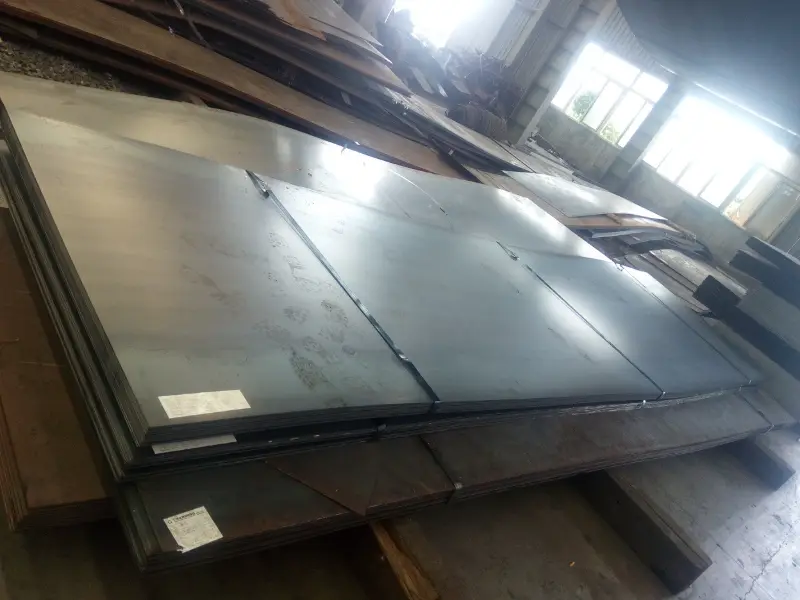
Q235C Carbon Structural Steel
Q235C Carbon Structural Steel - GB/T 700 Grade for SSAW Pipe & General Structures
Q235C is a Chinese carbon structural steel with guaranteed impact properties at 0°C, widely used in welded pipes (especially SSAW), buildings, bridges and general metal structures. It offers good weldability, moderate strength and cost-effectiveness.
Welding (SMAW, SAW, GMAW), hot/cold forming, machining, galvanizing, painting
- Phone : +8618037372205
- Email : [email protected]
- WhatsApp: Contact via Whtsapp
- WeChat: +8618037372205
Q235C Carbon Structural Steel Introduction
Q235C is a carbon structural steel defined in Chinese standard GB/T 700. It is characterized by a minimum yield strength of 235 MPa (for thickness ≤16 mm), tensile strength of 370–500 MPa and guaranteed Charpy V-notch impact energy of at least 27 J at 0 °C. Compared to Q235A and Q235B, Q235C provides better low-temperature toughness, making it suitable for welded structures, including spiral submerged arc welded (SSAW) pipes, pressure vessels and components exposed to ambient sub-zero conditions. The steel exhibits excellent weldability and formability with ordinary welding methods, and is typically delivered in hot-rolled condition. Its balanced composition of low carbon (<0.17%) and moderate manganese ensures reliable mechanical performance across a broad range of sections.
Q235C Carbon Structural Steel Chemical Composition according to GB/T 700-2006
The chemical composition of Q235C ensures good weldability and toughness. Tight controls on sulfur and phosphorus contribute to cleanliness and ductility. The carbon and manganese levels are balanced for strength and formability. The table lists the maximum limits unless a range is given.
| Element | Standard Requirement (%) | Remarks |
|---|---|---|
| C | ≤0.17 | Ladle analysis; product analysis may be slightly higher per standard |
| Mn | ≤1.40 | May be controlled to lower values based on thickness and deoxidation practice |
| Si | ≤0.35 | Depending on deoxidation method (rimmed, capped, killed); typical for killed steel 0.12–0.35 |
| P | ≤0.035 | Ensures good toughness and weldability |
| S | ≤0.035 | Controls sulphide inclusions; lower values improve transverse properties |
| N | ≤0.008 | For nitrogen; only required when normalizing is specified |
| Cu, Ni, Cr, others | Residual elements; not explicitly limited but may exist up to 0.30% each | When specified, Cu ≤0.30%, Ni ≤0.30%, Cr ≤0.30%, Mo ≤0.08% |
Q235C Carbon Structural Steel Thermal and Electrical Physical Properties
These physical properties are typical values for carbon structural steel similar to Q235C. They are not mandatory in GB/T 700 but are essential for design calculations. Actual values may vary slightly depending on the exact composition and microstructure. Data are valid at room temperature unless stated otherwise.
| Property | Typical Value | Unit | Test Condition / Remarks |
|---|---|---|---|
| Density (ρ) | 7.85 | g/cm³ | At 20 °C |
| Modulus of elasticity (E) | 200–210 | GPa | Room temperature |
| Shear modulus (G) | ~80 | GPa | Room temperature |
| Poisson's ratio (ν) | 0.3 | - | Elastic range |
| Thermal expansion coefficient (α) | 11.5–12.5 | 10⁻⁶/K | Range 20–100 °C |
| Thermal conductivity (λ) | 50–60 | W/(m·K) | At 0–100 °C |
| Specific heat capacity | 460–480 | J/(kg·K) | At 20 °C |
| Electrical resistivity (ρₑ) | 0.15–0.20 | μΩ·m | At 20 °C |
Q235C Carbon Structural Steel Mechanical Properties per GB/T 700
Mechanical properties vary with product thickness. Q235C requires impact testing at 0 °C. For flat products (plates, strips) the tensile test direction is normally transverse; for long products (bars, sections) it is longitudinal unless agreed otherwise. The table presents the standard requirements for hot-rolled products in delivery condition.
| Property | Standard Requirement | Unit | Test Condition |
|---|---|---|---|
| Upper yield strength (ReH) | ≥235 | MPa | Thickness ≤ 16 mm |
| Upper yield strength (ReH) | ≥225 | MPa | Thickness > 16 ≤ 40 mm |
| Upper yield strength (ReH) | ≥215 | MPa | Thickness > 40 ≤ 60 mm |
| Upper yield strength (ReH) | ≥215 | MPa | Thickness > 60 ≤ 100 mm |
| Ultimate tensile strength (Rm) | 370–500 | MPa | Thickness ≤ 100 mm |
| Elongation after fracture (A, 5.65√S₀) | ≥26 | % | Thickness ≤ 40 mm, transverse test piece |
| Elongation after fracture (A, 5.65√S₀) | ≥25 | % | Thickness > 40 ≤ 60 mm, transverse |
| Elongation after fracture (A, 5.65√S₀) | ≥24 | % | Thickness > 60 ≤ 100 mm, transverse |
| Charpy V-notch impact (KV₂) | ≥27 | J | Longitudinal test, 0 °C |
| Bend test (180°) | d = 1.5a | - | Thickness ≤ 16 mm, specimen width = thickness (a=thickness) |
| Bend test (180°) | d = 2.5a | - | Thickness > 16 ≤ 100 mm |
Q235C Carbon Structural Steel Fully Equivalent Material Standards and Substitutable Grades
| Country/Region | Standard | Grade | Remarks |
|---|---|---|---|
| China | GB/T 700 | Q235C | Original grade, guaranteed impact at 0 °C |
| International | ISO 630-2 | Fe360C | Former designation E235C, yield ≥235 MPa, impact 27 J at 0 °C |
| European Union | EN 10025-2 | S235J0 (1.0114) | Same yield strength and impact (27 J at 0 °C, longitudinal). Chemical composition may differ slightly (C ≤0.17, Mn ≤1.40) |
| Japan | JIS G3101 | SS400 | Mechanically equivalent but no impact requirements; substitute when impact not required |
| USA | ASTM A36 / A36M | A36 | Similar strength, no guaranteed 0 °C impact; supplementary requirement S5 can specify impact |
| USA | ASTM A283 / A283M | Grade C | Lower carbon, yield 205 MPa, tensile 380–515 MPa; impact not standard |
Q235C Carbon Structural Steel Application Introduction
Q235C is a versatile structural steel with guaranteed 0 °C impact toughness, making it ideal for welded structures subject to mild sub-zero temperatures. Its excellent weldability allows the production of large-diameter spiral submerged arc welded (SSAW) pipes used in long-distance oil, gas and water transmission. In construction, it is used in load-bearing beams, columns, trusses and bridge components. The steel can be easily cut, drilled and formed into various parts.
Product Applications: SSAW (spiral submerged arc welded) pipes, LSAW (longitudinal submerged arc welded) pipes, Hot-rolled structural steel plates and coils, Open sections (H-beam, I-beam, channel, angle), Cold-formed hollow sections, Welded structural components, Storage tanks and pressure vessels (limited service conditions)
Processed into products: Pipe piles and foundation casings, Transmission line towers and telecom masts, Structural brackets, stiffeners and gussets, Automotive chassis parts and trailers, Container frames and earth-moving equipment attachments, Pipe flanges, pipe fittings and manholes, General machinery bases and pedestals
Application industries: Oil & gas transmission (SSAW pipe lines), Water supply and sewage engineering, Civil engineering and construction (buildings, stadiums), Bridge and highway infrastructure, Shipbuilding (internal non-critical structures), Machinery manufacturing (frames, supports), Agricultural and forestry equipment
Q235C Carbon Structural Steel Closely Related / Similar Substitute Materials
| Country/Region | Standard | Grade | Remarks |
|---|---|---|---|
| China | GB/T 700 | Q235B | Lower toughness requirement (20 °C). Often used when 0 °C impact is not needed; more economical. |
| China | GB/T 700 | Q235D | Higher toughness (-20 °C). Suitable for colder environments, slightly more alloying. |
| European Union | EN 10025-2 | S235JR (1.0038) | Room temperature impact (20 °C). Not direct equivalent for Q235C, but widely used. |
| Russia | GOST 380 | St3sp/St3ps | General structural carbon steel, impact properties depend on deoxidation and test temperature. |
Notes:
- For SSAW pipe production, Q235C plates or coils are typically used with a thickness range of 6–25 mm and can be supplied as hot-rolled or thermo-mechanically controlled processed (TMCP) for improved toughness.
- When ordering, it is recommended to specify the impact test temperature (0 °C) and the required notch toughness (27 J minimum), as per GB/T 700. Supplementary requirements for Z-direction tensile testing (through-thickness properties) may be required for demanding structural applications.
- Welding consumables should be selected to match or slightly overmatch the base metal strength; low-hydrogen electrodes (E43 series) are typical for manual arc welding.
- The steel is not intended for high-temperature service above 400 °C, as its strength diminishes. For medium-temperature applications, consider Q235B or higher grades.
- Share



