
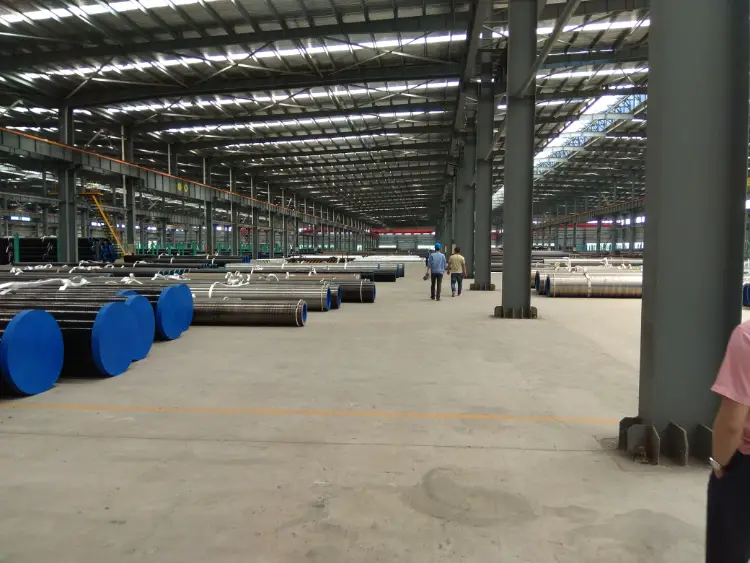
GB/T 700 Q235B SSAW Pipe
GB/T 700 Q235B SSAW Pipe: Comprehensive Material Data and Analysis
In-depth material analysis for Q235B steel used in SSAW pipes according to GB/T 700, including chemical composition, mechanical properties, thermal/electrical performance, international equivalents, and application guidance.
Spiral submerged arc welding (SSAW), electric resistance welding (ERW), LSAW, hot/cold forming, machining, bending, and stamping
- Phone : +8618037372205
- Email : [email protected]
- WhatsApp: Contact via Whtsapp
- WeChat: +8618037372205
GB/T 700 Q235B SSAW Pipe Introduction
Q235B is a carbon structural steel defined in Chinese standard GB/T 700. With a minimum yield strength of 235 MPa, it offers good weldability, formability, and moderate strength. As a grade B steel, it guarantees impact toughness at 20 °C (≥27J). When formed into SSAW (Spiral Submerged Arc Welded) pipes, Q235B serves as a cost-effective material for transmission pipelines, water systems, and structural piling. It is typically delivered in hot-rolled condition and exhibits reliable performance in general engineering applications.
GB/T 700 Q235B SSAW Pipe Chemical Composition
Based on GB/T 700-2006 for Q235B. The steel is a low-carbon grade with controlled sulfur and phosphorus levels. Residual elements are limited to ensure welding reliability. Actual mill certificates may show tighter ranges for internal quality control.
| Element | Standard Value (max, unless range) | Remarks |
|---|---|---|
| Carbon (C) | ≤ 0.20 % | Key strength and weldability element |
| Manganese (Mn) | ≤ 1.40 % | Deoxidizer and strength enhancer |
| Silicon (Si) | ≤ 0.35 % | Deoxidizer; higher Si may affect surface quality |
| Phosphorus (P) | ≤ 0.045 % | Detrimental to toughness and cold bending |
| Sulfur (S) | ≤ 0.045 % | Causes hot shortness; controlled for weldability |
| Chromium (Cr) | ≤ 0.30 % | Residual element; not intentionally added |
| Nickel (Ni) | ≤ 0.30 % | Residual element |
| Copper (Cu) | ≤ 0.30 % | Residual element; can be higher if specified for atmospheric corrosion resistance |
| Nitrogen (N) | ≤ 0.012 % | Ladle analysis, if required by agreement |
| Iron (Fe) | Balance |
GB/T 700 Q235B SSAW Pipe Thermal and Electrical Physical Properties
The following values are typical for Q235B carbon structural steel at room temperature unless otherwise noted. They are not mandated by GB/T 700 but are widely used for design calculations. These data apply to SSAW pipe base material; slight variations may occur due to manufacturing processes.
| Property | Typical Value | Unit | Test Condition |
|---|---|---|---|
| Density (ρ) | 7.85 | g/cm³ | At 20 °C |
| Modulus of elasticity (E) | 200 – 210 | GPa | At 20 °C |
| Shear modulus (G) | 79 – 81 | GPa | At 20 °C |
| Poisson's ratio (ν) | 0.30 | – | At 20 °C |
| Thermal expansion coefficient (α) | 12.0 | 10⁻⁶/K | 20–100 °C |
| Thermal expansion coefficient (α) | 12.9 | 10⁻⁶/K | 20–200 °C |
| Thermal expansion coefficient (α) | 13.7 | 10⁻⁶/K | 20–400 °C |
| Thermal conductivity (λ) | 53.6 | W/(m·K) | At 100 °C |
| Thermal conductivity (λ) | 47.0 | W/(m·K) | At 300 °C |
| Specific heat capacity (c) | 486 | J/(kg·K) | At 20–100 °C |
| Specific heat capacity (c) | 519 | J/(kg·K) | At 20–400 °C |
| Electrical resistivity (ρₑ) | 0.16 – 0.22 | 10⁻⁶ Ω·m | At 20 °C |
GB/T 700 Q235B SSAW Pipe Mechanical Properties
Values are from GB/T 700-2006 for Q235B (thickness ≤ 100 mm, tested at ambient temperature). Impact energy is guaranteed only for grade B at +20 °C. For SSAW pipes, properties refer to the base plate/coil before forming and welding; pipe body strength may be affected by the Bauschinger effect, but is generally certified to match or exceed the coil properties.
| Property | Standard Requirement | Unit | Test Condition / Thickness |
|---|---|---|---|
| Yield strength (ReH) | ≥ 235 | MPa | Thickness ≤ 16 mm |
| Yield strength (ReH) | ≥ 225 | MPa | Thickness > 16–40 mm |
| Yield strength (ReH) | ≥ 215 | MPa | Thickness > 40–60 mm |
| Yield strength (ReH) | ≥ 215 | MPa | Thickness > 60–100 mm |
| Tensile strength (Rm) | 370 – 500 | MPa | All thicknesses |
| Elongation after fracture (A) | ≥ 26 | % | Thickness ≤ 40 mm |
| Elongation after fracture (A) | ≥ 25 | % | Thickness > 40–60 mm |
| Elongation after fracture (A) | ≥ 24 | % | Thickness > 60–100 mm |
| Bend test (mandrel diameter) | d = a | – | Specimen thickness a, ≤ 60 mm, 180° bending |
| Bend test (mandrel diameter) | d = 2a | – | Specimen thickness a, > 60–100 mm, 180° bending |
| Impact energy (KV₂, longitudinal) | ≥ 27 | J | At +20 °C (Charpy V-notch) |
GB/T 700 Q235B SSAW Pipe Fully Equivalent Material Standards and Replaceable Grades
| Country/Region | Standard | Grade | Remarks |
|---|---|---|---|
| China | GB/T 700-2006 | Q235B | Base grade for SSAW pipe |
| International | ISO 630-2:2011 | Fe360B | Equivalent structural steel |
| USA | ASTM A283/A283M | Grade C | Similar strength level, but impact test not mandatory in all editions; verify toughness requirements |
| USA | ASTM A36/A36M | – | Most common structural steel; Charpy test optional unless specified; comparable for non-critical sections |
| EU | EN 10025-2:2019 | S235JR | JR quality – impact at +20 °C; near identical mechanical properties |
| Japan | JIS G3101:2015 | SS400 | No mandatory impact; SS400 tends to slightly lower yield but widely used as replacement in non-impact applications |
| India | IS 2062:2011 | E250 B | Fe 410 as per old designation; guaranteed impact at +20 °C; good match |
| Australia/New Zealand | AS/NZS 3678:2016 | Grade 250 | Minimum yield 250 MPa; impact properties can be agreed to match Q235B |
GB/T 700 Q235B SSAW Pipe Application Introduction
Q235B SSAW pipes are widely employed in medium and low-pressure fluid transportation, civil engineering piling, and general structural fabrication. Their balanced cost, weldability, and mechanical properties make them a go-to choice for large-diameter pipelines and heavy structural works. Due to grade B impact guarantee at ambient temperature, they are suitable for regions with mild winter conditions; for sub-zero environments, Q235C or Q235D should be evaluated.
Product Applications: Spiral submerged arc welded pipes (SSAW), Longitudinal submerged arc welded pipes (LSAW), ERW pipes (small to medium diameter), Structural H-beams, I-beams, channels, angles, Plates for building construction and shipbuilding, Boiler and pressure vessel supports, Transmission tower angles and plates, Storage tank shells and roofs
Processed into products: Pipe spools and fittings (elbows, reducers, tees), Welded built-up beams and columns, Bracing members and gusset plates, Flanges and blind flanges, Support brackets and saddles, Anchor and tie rods, Casing pipes for bored piles, Manhole rings and covers
Application industries: Oil & Gas (flowlines, gathering lines, water injection), Water Supply & Sewage Treatment (municipal and industrial), Civil Engineering (piling, bridge casings, culverts), Building Construction (structural columns, trusses, scaffolding), Mining (slurry transport, dewatering pipes), Agricultural Irrigation (main and distribution pipes), Shipbuilding (non-critical structural components), Wind Power (tower internals, basic frames)
GB/T 700 Q235B SSAW Pipe Similar / Approximate Replacement Materials
| Country/Region | Standard | Grade | Remarks |
|---|---|---|---|
| China | GB/T 700-2006 | Q235A | No impact requirement; lower cost, suitable for static loading only |
| China | GB/T 700-2006 | Q235C | Impact at 0 °C (≥27J); better toughness than Q235B |
| China | GB/T 700-2006 | Q235D | Impact at -20 °C; excellent low-temperature performance |
| China | GB/T 1591-2008 | Q345B | Higher strength low-alloy steel (yield 345 MPa); not direct substitute but used for higher loads when strength governs |
| USA | ASTM A570 | Grade 36 | Obsolete standard, replaced by A1011 SS Grade 36; similar carbon steel for formed products |
| EU | EN 10025-2:2019 | S235J0 | Impact at 0 °C; slightly higher toughness than S235JR but still close to Q235B when applied above 0 °C |
| Japan | JIS G3106 | SM400A/B | Weldable structural steel with similar strength; SM400B has impact test at +20 °C |
| Russia | GOST 380-2005 | St3sp/St3ps | Approximate; verify chemical and impact requirements |
Notes:
- When ordering Q235B SSAW pipe, specify standard (e.g., GB/T 9711-2017 PSL1 or ISO 3183, or SY/T 5037 for general fluid service) and required impact test temperature.
- Welding consumables for Q235B: common matching electrodes include E43 series (AWS E6013, E7016 for higher strength).
- Corrosion protection: SSAW pipes are often coated with 3LPE, FBE, or coal-tar enamel depending on service environment.
- For structures subjected to dynamic loading or fatigue, ensure the notch toughness is adequate; Q235B at +20 °C is normally sufficient, but consider higher grades if the lowest service temperature nears or falls below 0 °C.
- Certification: typically EN 10204 type 3.1 or 3.2 mill certificate with chemical analysis and mechanical tests.
- Share



