
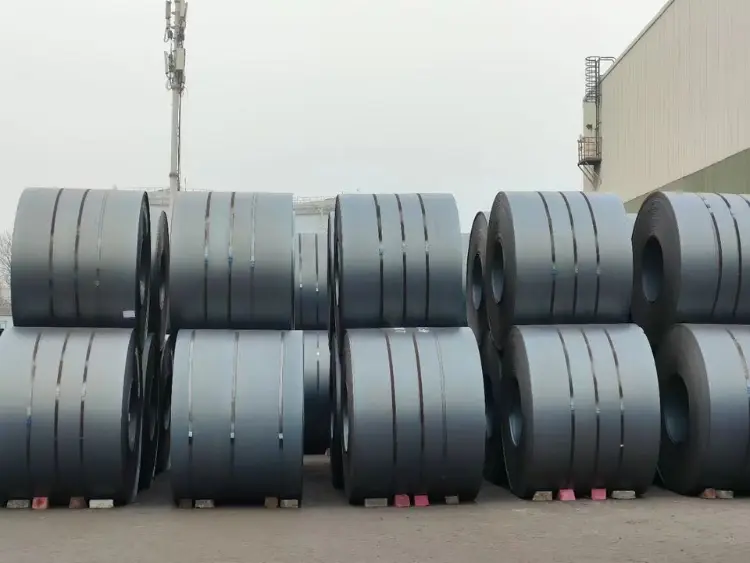
Q235B Carbon Structural Steel Coil
Q235B Carbon Structural Steel: GB/T 700 Standard Properties and Global Equivalents
Comprehensive technical data for Q235B steel under GB/T 700, including chemical composition, mechanical properties, physical properties, international equivalents, and recommended applications.
Hot rolling, cold bending, stamping, welding, bolting, riveting, cutting, drilling, and hot-dip galvanizing.
- Phone : +8618037372205
- Email : [email protected]
- WhatsApp: Contact via Whtsapp
- WeChat: +8618037372205
Q235B Carbon Structural Steel Coil Introduction
Q235B is a carbon structural steel defined in Chinese standard GB/T 700. It features moderate strength, excellent weldability, and good plastic deformation capacity. The grade designation indicates a minimum yield strength of 235 MPa and quality level B (+20°C impact test). Widely employed in general structures, construction, bridges, vehicles, and machinery, it is typically supplied in the hot-rolled or as-rolled condition. Its balanced composition ensures reliable performance for bolted, riveted, and welded structures at ambient and moderately low temperatures.
Q235B Carbon Structural Steel Coil Chemical Composition
Chemical requirements for Q235B per GB/T 700-2006. Maximum limits for carbon, manganese, silicon, sulfur, and phosphorus are controlled to ensure weldability and ductility. Residual elements such as Cr, Ni, and Cu are permitted up to 0.30% each but are not intentionally added. Nitrogen content is limited to 0.008% (if present) to avoid strain aging. All values are ladle analysis.
| Element | Standard Value | Remarks |
|---|---|---|
| C (Carbon) | ≤0.20% | Maximum; lower carbon improves weldability |
| Mn (Manganese) | ≤1.40% | Maximum; contributes to strength |
| Si (Silicon) | ≤0.35% | Maximum; deoxidizer |
| S (Sulfur) | ≤0.045% | Maximum; controlled for ductility |
| P (Phosphorus) | ≤0.045% | Maximum; limited to avoid brittleness |
| Residual Cr, Ni, Cu | ≤0.30% each | Total ≤0.60%; not intentional additions |
| N (Nitrogen) | ≤0.008% | If present; tied to aluminum content |
| Others | - | No deliberate additions; product analysis permitted with tolerances per standard |
Q235B Carbon Structural Steel Coil Thermal and Electrical Physical Properties
Physical properties for low-carbon structural steel typical of Q235B. Reference data are measured at room temperature (20°C) unless otherwise stated. Values are indicative and may vary slightly with processing condition. Thermal conductivity and specific heat are given for ambient and elevated temperature ranges.
| Property | Typical Value | Unit | Test Condition / Temperature |
|---|---|---|---|
| Density (ρ) | 7.85 | g/cm³ | 20°C |
| Modulus of Elasticity (E) | 200 – 210 | GPa | 20°C, tension |
| Shear Modulus (G) | 79 – 81 | GPa | 20°C, calculated from E and ν |
| Poisson's Ratio (ν) | 0.27 – 0.30 | – | Elastic range, 20°C |
| Thermal Expansion Coefficient (α) | 11.5 – 12.5 | 10&supmin;&sup6;/K | 20 – 100°C |
| Thermal Expansion Coefficient (α) | 12.5 – 13.5 | 10&supmin;&sup6;/K | 20 – 200°C |
| Thermal Conductivity (λ) | 45 – 55 | W/(m·K) | 20°C |
| Thermal Conductivity (λ) | 40 – 45 | W/(m·K) | 200°C |
| Specific Heat Capacity (cp) | 460 – 500 | J/(kg·K) | 20 – 100°C |
| Electrical Resistivity (ρe) | 0.15 – 0.20 | Ω·mm²/m | 20°C |
Q235B Carbon Structural Steel Coil Mechanical Properties
Mechanical properties according to GB/T 700-2006 for Q235B quality level. Yield strength depends on thickness; tensile strength range is 370–500 MPa. Elongation after fracture is measured on gauge length L0=5.65√S0 (or 200 mm gauge for thickness >3 mm). Impact energy (Charpy V-notch) guaranteed at +20°C. Bending test at room temperature provides cold formability assessment.
| Property | Required Value | Unit | Test Condition |
|---|---|---|---|
| Yield Strength (ReH) | ≥235 | MPa | Thickness ≤16 mm |
| Yield Strength (ReH) | ≥225 | MPa | Thickness >16 mm and ≤40 mm |
| Yield Strength (ReH) | ≥215 | MPa | Thickness >40 mm and ≤60 mm |
| Yield Strength (ReH) | ≥205 | MPa | Thickness >60 mm and ≤100 mm |
| Yield Strength (ReH) | ≥195 | MPa | Thickness >100 mm and ≤200 mm |
| Tensile Strength (Rm) | 370 – 500 | MPa | All thicknesses |
| Elongation after fracture (A) | ≥26 | % | Thickness ≤40 mm, L0=5.65√S0 |
| Elongation after fracture (A) | ≥25 | % | Thickness >40 mm and ≤60 mm |
| Elongation after fracture (A) | ≥24 | % | Thickness >60 mm and ≤100 mm |
| Elongation after fracture (A) | ≥23 | % | Thickness >100 mm and ≤200 mm |
| Charpy V-notch Impact Energy (KV2) | ≥27 | J | Longitudinal, +20°C, single minimum |
| Bending Test (180° bend) | d = a | – | Thickness ≤60 mm; bend diameter equals specimen thickness |
| Bending Test (180° bend) | d = 2a | – | Thickness >60 mm and ≤100 mm |
| Bending Test (180° bend) | d = 2.5a | – | Thickness >100 mm and ≤200 mm |
Q235B Carbon Structural Steel Coil Internationally Matching Grades – Direct Equivalents and Substitutes
| Country / Region | Standard | Grade | Remarks |
|---|---|---|---|
| China | GB/T 700 | Q235B | Original grade; minimum impact work at +20°C |
| International (ISO) | ISO 630-2 | E235B | Closest match; S=235 MPa min; impact test at 0°C |
| European Union | EN 10025-2 | S235JR | Yield 235 MPa; impact test at +20°C (JR quality); similar chemistry |
| USA | ASTM A36/A36M | A36 | Yield 250 MPa (36 ksi); widely substituted; slight strength difference |
| Japan | JIS G3101 | SS400 | Yield typically ~245 MPa; impact not mandatory, but widely interchangeable |
| Russia | GOST 380 | St3sp | Yield 235–245 MPa; calm steel; close carbon-manganese match |
| Australia/New Zealand | AS/NZS 3678 | 250 | Yield 250 MPa; similar carbon structural grade |
Q235B Carbon Structural Steel Coil Application Introduction
Q235B is one of the most commonly used structural steels for general fabrication. It is suitable for welded, bolted, and riveted connections. The steel performs reliably in ambient and moderately cold environments, but is not intended for severe sub-zero service. Its good formability allows it to be processed into a wide variety of shapes and components.
Product Applications: Structural frames for buildings and industrial sheds, Bridge girders and decks, Vehicle chassis and frames, Ship hulls and bulkheads (non-classed), Storage silos, tanks, and hoppers, Highway guardrails and sign structures, Pipe piles and foundation steel, Railway wagon components
Processed into products: Welded H-beams, I-beams, and box columns, Angle brackets, channels, and flat bars, Hot-rolled plates and chequered plates, Cold-formed C/Z purlins and girts, Welded pipes and tubes for structural use, Stamped brackets, flanges, and connectors, Ducting and ventilation channels, Bolted roof trusses and space frames
Application industries: Civil engineering and construction, Bridge building, Automotive and transportation, Shipbuilding (non-critical structures), Container and storage tank fabrication, Machinery manufacturing, Transmission towers and poles, General metal structures
Q235B Carbon Structural Steel Coil Near-Equivalent and Comparable Grades for Reference
| Country / Region | Standard | Grade | Remarks |
|---|---|---|---|
| China | GB/T 700 | Q235A | Lower quality; no guaranteed impact energy; slightly less demanding S/P |
| China | GB/T 700 | Q235C | Higher toughness; impact test at 0°C (≥27J) |
| China | GB/T 700 | Q235D | Better low-temp performance; impact test at -20°C (≥27J) |
| European Union | EN 10025-2 | S235J0 | Impact test at 0°C; close to Q235C |
| European Union | EN 10025-2 | S235J2 | Impact test at -20°C; fine grain steel, similar to Q235D |
| USA | ASTM A283/A283M | Grade C | Yield 205 MPa; lower strength, but used for structural applications |
| Japan | JIS G3101 | SS330 | Yield ~205 MPa; lower strength alternative |
| Russia | GOST 380 | St3kp | Rimmed steel; slightly lower toughness, otherwise chemically similar |
Notes:
For thicknesses above 200 mm, consult the manufacturer as the standard does not cover mechanical properties. Q235B is typically supplied with mill test certificates (EN 10204 type 2.2 or 3.1) showing chemical and mechanical results. For critical welded structures subject to dynamic loads, consider Q235C or D grades. Surface protection (painting, galvanizing) is recommended for outdoor exposure. The steel is fully recyclable and complies with common international environmental regulations.
- Share



