
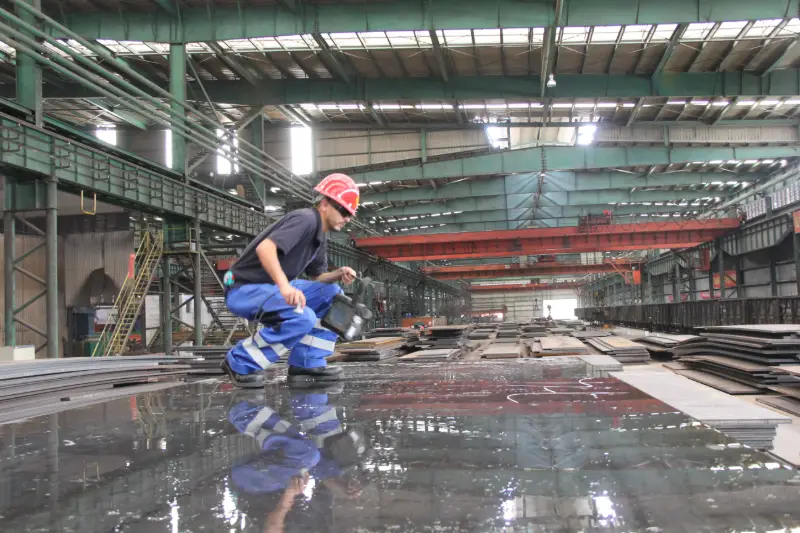
GB/T 700 Q235C Carbon Structural Steel
GB/T 700 Q235C Carbon Structural Steel: Properties, Equivalents & Application Data
Explore the comprehensive datasheet of Q235C steel to GB/T 700, including chemical composition, mechanical properties (yield, tensile, elongation, impact), thermal and electrical performance, international equivalents, and typical applications in construction and engineering.
Hot rolling, cold forming, welding, machining, punching, shearing, bending
- Phone : +8618037372205
- Email : [email protected]
- WhatsApp: Contact via Whtsapp
- WeChat: +8618037372205
GB/T 700 Q235C Carbon Structural Steel Introduction
Q235C is a Chinese carbon structural steel grade defined in GB/T 700-2006 (Carbon structural steels). It belongs to the Q235 series with a minimum yield strength of 235 MPa. The suffix "C" indicates guaranteed impact energy of at least 27 J at 0°C, providing reliable toughness for structural applications in moderate cold environments.
Key features:
- Good combination of strength, ductility and weldability
- Excellent formability for bending, stamping and rolling
- Widely used in building frames, bridges, vehicles and general engineering
- Supplied as hot-rolled coils, plates, bars and sections
GB/T 700 Q235C Carbon Structural Steel Chemical Composition
The chemical composition of Q235C steel in accordance with GB/T 700-2006. The values are ladle analysis limits. The steel is fully killed or semi-killed. Key points:
- Low carbon content ensures good weldability and formability.
- Strict control of sulfur and phosphorus improves ductility and toughness.
- C-grade requires a finer grain structure to meet 0°C impact energy.
| Element | Standard Value (max %) | Remarks |
|---|---|---|
| C | ≤ 0.17 | For thickness > 16 mm, max C may be increased to 0.20% by agreement |
| Mn | ≤ 1.40 | Higher Mn contributes to strength and deoxidation |
| Si | ≤ 0.35 | Deoxidation element, limit remains same for all thicknesses |
| S | ≤ 0.035 | Low sulfur for improved toughness and hot workability |
| P | ≤ 0.035 | Low phosphorus for cold brittleness resistance |
| Cr, Ni, Cu (residual) | Each ≤ 0.30 | Total residual elements ≤ 0.60%, if required by purchaser |
| N | ≤ 0.012 | Limit for nitrogen to prevent strain ageing |
| O | Not specified | Controlled by deoxidation practice |
| Others | As per agreement | May contain trace amounts of other elements not intentionally added |
GB/T 700 Q235C Carbon Structural Steel Thermal and Electrical Physical Properties
Physical properties are typical for carbon structural steels of this composition. Values are not specified in GB/T 700 but serve as practical reference data. Note:
- Density, modulus and thermal parameters are room-temperature values unless stated otherwise.
- Properties may vary slightly with actual chemical composition and processing history.
| Property | Typical Value | Unit | Test Conditions / Remarks |
|---|---|---|---|
| Density (ρ) | 7.85 | g/cm³ | At 20°C |
| Elastic modulus (E) | 200 – 210 | GPa | At 20°C, tension |
| Shear modulus (G) | 80 – 84 | GPa | At 20°C, calculated from E and ν |
| Poisson's ratio (ν) | 0.28 – 0.30 | — | At 20°C |
| Thermal expansion coefficient (α) | 11.5 – 12.0 | 10⁻⁶/K | 20 – 100°C; slightly higher at 20–200°C (12.2–12.7) |
| Thermal expansion coefficient (α) | 12.5 – 13.5 | 10⁻⁶/K | 20 – 300°C |
| Thermal conductivity (λ) | 45 – 50 | W/(m·K) | At 20°C |
| Thermal conductivity (λ) | 42 – 48 | W/(m·K) | At 200°C |
| Thermal conductivity (λ) | 38 – 43 | W/(m·K) | At 400°C |
| Specific heat capacity | 460 – 480 | J/(kg·K) | At 20°C |
| Electrical resistivity (ρe) | 0.15 – 0.20 | μΩ·m | At 20°C; 0.15 typical for low-carbon steel |
GB/T 700 Q235C Carbon Structural Steel Mechanical Properties
The mechanical properties of Q235C are dependent on the nominal thickness (t). The data below complies with GB/T 700-2006. Note:
- Tensile test pieces are taken in the transverse direction for strips/plates.
- Impact test uses Charpy V-notch specimens at 0°C, minimum average energy 27 J.
- Bending test: 180° bend over a mandrel of specified diameter, no cracks on the outside of the bent portion.
| Property | Requirements (for thickness ranges) | Unit | Test Conditions / Remarks |
|---|---|---|---|
| Yield strength (ReH, upper) | t ≤ 16 mm: ≥ 235 | MPa | Ambient temperature; transverse test piece |
| Yield strength (ReH, upper) | 16 < t ≤ 40 mm: ≥ 225 | MPa | Same as above |
| Yield strength (ReH, upper) | 40 < t ≤ 60 mm: ≥ 215 | MPa | Same as above |
| Yield strength (ReH, upper) | 60 < t ≤ 100 mm: ≥ 205 | MPa | Same as above |
| Yield strength (ReH, upper) | 100 < t ≤ 150 mm: ≥ 195 | MPa | Same as above |
| Yield strength (ReH, upper) | 150 < t ≤ 200 mm: ≥ 185 | MPa | Same as above |
| Tensile strength (Rm) | t ≤ 40 mm: 370 – 500 | MPa | For thicker sections the range may be adjusted by agreement |
| Tensile strength (Rm) | 40 < t ≤ 100 mm: 370 – 500 | MPa | Same as above |
| Tensile strength (Rm) | 100 < t ≤ 150 mm: 360 – 500 | MPa | Same as above |
| Tensile strength (Rm) | 150 < t ≤ 200 mm: 350 – 500 | MPa | Same as above |
| Elongation after fracture (A) | t ≤ 40 mm: ≥ 26% | % | Gauge length L0 = 5.65√S0 (A5); transverse test piece |
| Elongation after fracture (A) | 40 < t ≤ 60 mm: ≥ 25% | % | Same as above |
| Elongation after fracture (A) | 60 < t ≤ 100 mm: ≥ 24% | % | Same as above |
| Elongation after fracture (A) | 100 < t ≤ 150 mm: ≥ 22% | % | Same as above |
| Elongation after fracture (A) | 150 < t ≤ 200 mm: ≥ 21% | % | Same as above |
| Bending test (180°) | Mandrel diameter = 1.5a (for t ≤ 60 mm) | — | a = thickness of test piece; no cracks allowed |
| Bending test (180°) | Mandrel diameter = 2a (for 60 < t ≤ 100 mm) | — | Same as above |
| Impact energy (KV2, longitudinal) | ≥ 27 J (average of 3 tests) | J | 0°C; Charpy V-notch; individual value ≥ 70% of 27 J (18.9 J) |
GB/T 700 Q235C Carbon Structural Steel Exactly Equivalent Material Standards & Substitute Grades
| Country / Region | Standard | Grade | Remarks |
|---|---|---|---|
| China | GB/T 700-2006 | Q235C | Original grade; required 0°C impact ≥27 J |
| International | ISO 630-2 | S235B | ISO grade with guaranteed impact energy at 0°C, directly equivalent |
| EU | EN 10025-2 | S235J0 | J0 denotes 0°C impact 27 J, identical property requirements |
| Germany (obs.) | DIN 17100 | St37-3 U | Previously used grade with 0°C impact, equivalent to Q235C |
| Japan | JIS G3106 | SM400B | Welding structural steel; impact at 0°C ≥27 J, similar chemical/physical properties |
| USA | ASTM A283/A283M | Grade C | No mandatory impact but chemistry and tensile properties closely match; impact can be additional requirement |
| USA | ASTM A36/A36M | — | Common structural steel; can be upgraded to meet 0°C impact by supplementary requirement S5 |
GB/T 700 Q235C Carbon Structural Steel Application Introduction
Q235C is ideal for welded, bolted and riveted structures, especially where moderate temperature toughness is essential. It can be used in atmospheric and slightly corrosive environments after protective coating.
Typical processing capabilities:
- Cold forming: bending, drawing, stamping (suitable for parts up to moderate complexity)
- Welding: all common methods (SMAW, GMAW, SAW) without preheating for sections up to ~30 mm (consult welding codes)
- Machining: good machinability in normalized or hot-rolled condition
- Hot-dip galvanizing: compatible with usual practice
Product Applications: Steel coils and sheets: 1.2 mm – 25.4 mm thick, for stamping and welding, Hot-rolled plates: 6 mm – 200 mm, for structural fabrications, Steel bars and rods: for reinforcement and machined parts, Structural sections: H-beams, I-beams, channels, angles, Welded pipes and hollow sections: for fluid transport and structural use, Forgings: simple shapes for machinery parts
Processed into products: Building columns and beams, Bridge girders and stiffeners, Truck frames and cross members, Wind turbine tower sections, Storage tank shells and roofs, Conveyor frames and supports, Agricultural machinery draws and hitches, Container corner castings and rails, Welded base plates and machine beds
Application industries: Construction and infrastructure (building frames, bridges, transmission towers), Transportation (railway wagons, truck chassis, ship hull components), Energy (wind turbine towers, pipelines, storage tanks), Machinery manufacturing (frames, bases, brackets, simple gears), Agricultural equipment (trailers, tillage tools), Container and packaging (shipping containers, drums)
GB/T 700 Q235C Carbon Structural Steel Similar / Substitute Materials
| Country / Region | Standard | Grade | Remarks |
|---|---|---|---|
| China | GB/T 700 | Q235B | Same strength, but impact tested at +20°C (27 J). Suitable for less demanding toughness applications. |
| China | GB/T 700 | Q235D | Higher toughness grade with impact at -20°C, ideal for colder service. |
| China | GB/T 3274 | Q235C | Same Q235C delivered as hot-rolled plates/sheets for general structural use. |
| EU | EN 10025-2 | S235JR | Impact at +20°C, slightly lower toughness than Q235C; may be used if 0°C impact is not required. |
| International | ISO 630-2 | S235A | No impact requirement; lower toughness but can substitute in non-critical structures. |
| Russia | GOST 380 | St3sp3 | Killed carbon steel with guaranteed impact at -20°C, slightly higher toughness than Q235C. |
| India | IS 2062 | E250 B | 0°C impact guaranteed; close to Q235C in strength and chemistry. |
Notes:
Additional information:
- Q235C can be supplied with optional normalized or controlled rolling for improved homogeneity. Impact test must be specified on the order.
- When used in welded structures subject to fatigue, proper design and fabrication practices per relevant codes (e.g., ANSI/AISC 360, EN 1993) should be followed.
- The steel is not intended for heat treatment quenching and tempering; however, stress relieving at 550–650°C is possible after heavy welding.
- For thicknesses above 100 mm, through-thickness properties (Z-quality) are available by agreement (e.g., Z15, Z25).
- Equivalent grades from other standards may have slight variations in silicon or manganese limits; verify complete compliance before substitution.
- Share



