
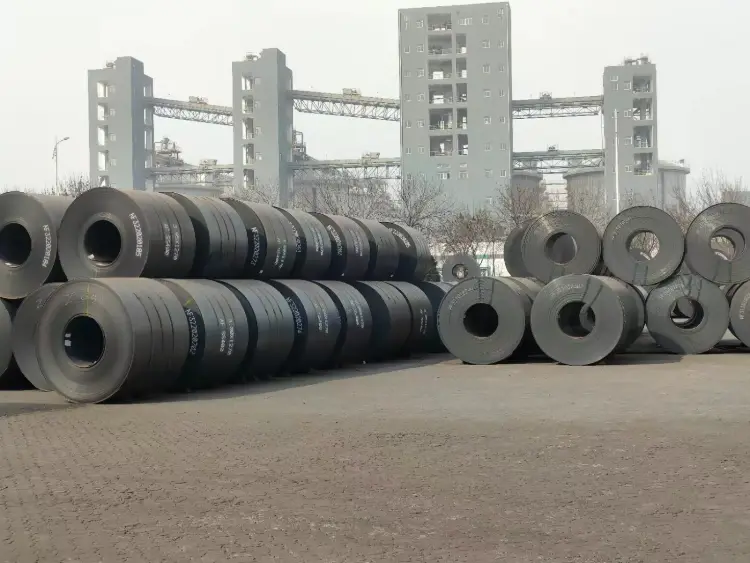
Q235D Carbon Structural Steel Coil per GB/T 700
Q235D Carbon Structural Steel Coil per GB/T 700: 235 MPa Yield with -20°C Toughness
Complete technical reference for Q235D carbon structural steel, including chemistry, mechanical properties, and international equivalents.
Hot rolling, cold rolling, cutting, bending, welding, forming
- Phone : +8618037372205
- Email : [email protected]
- WhatsApp: Contact via Whtsapp
- WeChat: +8618037372205
Q235D Carbon Structural Steel Coil per GB/T 700 Introduction
Q235D is a carbon structural steel grade defined by China's GB/T 700 standard. It features a minimum yield strength of 235 MPa and guaranteed Charpy V-notch impact energy of at least 27 J at -20°C, making it suitable for construction and engineering applications in low-temperature environments. As a hot-rolled coil product, Q235D offers good weldability, formability, and machinability, typical of low-carbon steels. Key attributes:
- Low carbon content for excellent weldability
- Consistent mechanical properties down to -20°C
- Widely used in structural frameworks, bridges, and machinery
Q235D Carbon Structural Steel Coil per GB/T 700 Chemical Composition
Chemical composition per GB/T 700-2006. Residual elements Cr, Ni, Cu are not deliberately added; their limits are given to ensure cleanliness of the steel. Aluminum may be used for deoxidation but no specific requirement applies.
- All values are maximum unless a range is shown.
- Carbon equivalent (CEV) is typically ≤0.38% for this grade, guaranteeing weldability.
| Chemical Element | Standard Value (wt%) | Remark |
|---|---|---|
| Carbon, C | ≤0.17 | |
| Silicon, Si | ≤0.35 | |
| Manganese, Mn | ≤1.40 | |
| Phosphorus, P | ≤0.035 | |
| Sulfur, S | ≤0.035 | |
| Chromium, Cr | ≤0.30 | Residual element |
| Nickel, Ni | ≤0.30 | Residual element |
| Copper, Cu | ≤0.30 | Residual element |
Q235D Carbon Structural Steel Coil per GB/T 700 Thermal and Electrical Physical Properties
Physical properties of Q235D are typical of low-carbon steels. Values are given at room temperature unless otherwise noted. Thermal properties influence welding preheat and heat treatment, while electrical resistivity is relevant for conductance and induction applications.
- Properties vary slightly with chemical composition and processing history.
- Thermal conductivity decreases with increasing temperature.
| Property | Typical Value | Unit | Test Condition |
|---|---|---|---|
| Density, ρ | 7.85 | g/cm³ | 20°C |
| Elastic modulus, E | 200–210 | GPa | 20°C |
| Shear modulus, G | 80–85 | GPa | 20°C |
| Poisson's ratio, ν | 0.27–0.30 | – | 20°C |
| Thermal expansion coefficient, α | 10.8–12.2×10−⁷ | K−¹ | 20–100°C |
| Thermal conductivity, λ | 50–52 | W/(m·K) | 20°C |
| Specific heat capacity, c | 460–480 | J/(kg·K) | 20°C |
| Electrical resistivity, ρe | 0.16–0.22 | μΩ·m | 20°C |
Q235D Carbon Structural Steel Coil per GB/T 700 Mechanical Properties
Mechanical properties per GB/T 700-2006 for as-rolled condition. Impact test is mandatory for Q235D; specimens are taken in longitudinal direction. Bend test: 180° bend with bend diameter d according to thickness.
- Yield and tensile values depend on product thickness.
- Elongation is based on a gauge length of 5.65√So (A5) for thickness ≤40 mm.
| Property | Standard Requirement | Unit | Test Condition |
|---|---|---|---|
| Yield Strength, ReH | ≥235 | MPa | Thickness ≤16 mm |
| Yield Strength, ReH | ≥225 | MPa | Thickness 16–40 mm |
| Yield Strength, ReH | ≥215 | MPa | Thickness 40–60 mm |
| Yield Strength, ReH | ≥205 | MPa | Thickness 60–100 mm |
| Yield Strength, ReH | ≥195 | MPa | Thickness 100–150 mm |
| Yield Strength, ReH | ≥185 | MPa | Thickness 150–200 mm |
| Tensile Strength, Rm | 370–500 | MPa | Thickness ≤100 mm |
| Tensile Strength, Rm | 350–480 | MPa | Thickness 100–150 mm |
| Tensile Strength, Rm | 330–480 | MPa | Thickness 150–200 mm |
| Elongation after fracture, A | ≥26 | % | Thickness ≤40 mm, A5 |
| Elongation after fracture, A | ≥25 | % | Thickness 40–60 mm, A5 |
| Elongation after fracture, A | ≥24 | % | Thickness 60–100 mm, A5 |
| Elongation after fracture, A | ≥22 | % | Thickness 100–150 mm, A5 |
| Elongation after fracture, A | ≥21 | % | Thickness 150–200 mm, A5 |
| Charpy V-notch impact energy, KV | ≥27 | J | Longitudinal, -20°C |
| Bend test | d = a | – | Thickness ≤16 mm, 180° bend, specimen width B=2a |
| Bend test | d = 2a | – | Thickness 16–100 mm, 180° bend, B=2a |
| Bend test | d = 2a | – | Thickness 100–200 mm, 180° bend, B=2a |
Q235D Carbon Structural Steel Coil per GB/T 700 Exactly Equivalent Material Standards and Substitutable Grade Recommendations
| Country/Region | Standard | Grade | Remark |
|---|---|---|---|
| China | GB/T 700 | Q235D | Original specification |
| European Union | EN 10025-2 | S235J2 | Identical impact requirement (27J at -20°C); fully equivalent |
| International | ISO 630-2 | S235J2 | Identical technical delivery conditions; fully equivalent |
| USA | ASTM A36 / A572 Gr.50 | A36 / Gr.50 | Requires supplementary Charpy V-notch at -20°C to match Q235D toughness |
| Japan | JIS G3101 | SS400 | Strength and composition overlap, but impact toughness not guaranteed in standard; must be specially agreed |
Q235D Carbon Structural Steel Coil per GB/T 700 Application Introduction
Q235D is widely used for general structural purposes, especially where moderate strength and guaranteed toughness at low ambient temperatures are required. Its excellent weldability and formability allow it to be converted into numerous engineering components. Typical fields include:
- Building and civil engineering structures exposed to winter conditions
- Machinery and transport equipment enduring dynamic loads
- Ship hulls and port facilities where toughness prevents brittle fracture
Product Applications: Hot-rolled steel plates and coils, Structural H-beams, I-beams, channels, angles, Welded pipes and hollow sections, Cold-formed profiles, Pressed and stamped parts
Processed into products: Building frameworks and columns, Bridge decks and girders, Ship hull plates and decks, Crane booms, Automotive chassis and truck frames, Earthmoving machinery buckets and arms, Storage tanks and pressure vessels (moderate duty), Agricultural implements
Application industries: Construction, Bridge engineering, Shipbuilding, Machinery manufacturing, Automotive, Railway vehicles, Agricultural equipment, Energy (wind towers, pipelines)
Q235D Carbon Structural Steel Coil per GB/T 700 Similar / Alternative Material Recommendations
| Country/Region | Standard | Grade | Remark |
|---|---|---|---|
| China | GB/T 700 | Q235B | Impact test at +20°C; lower toughness, otherwise similar |
| China | GB/T 700 | Q235C | Impact test at 0°C; intermediate toughness |
| European Union | EN 10025-2 | S235JR | Impact tested at +20°C; less demanding low-temperature requirement |
| European Union | EN 10025-2 | S235J0 | Impact tested at 0°C; good alternative if -20°C is not required |
| USA | ASTM A36 | A36 | No mandatory impact test; often dual-certified with A572 Gr.50; closest American counterpart after toughness agreement |
| Japan | JIS G3106 | SM400A/B | Welded structural steel with optional Charpy tests; SM400B at 0°C may be procured with -20°C by agreement |
Notes:
Q235D may be supplied with fine-grain practice (Al-killed) to improve toughness. For welded structures in cold climates, supplementary testing such as CTOD might be requested by purchasers. When ordering, the product thickness range should be specified as it influences mechanical properties. Surface quality and dimensional tolerances are per GB/T 709 or as agreed. Heat treatment (normalizing) can further homogenize properties. The material is fully recyclable.
- Share



