
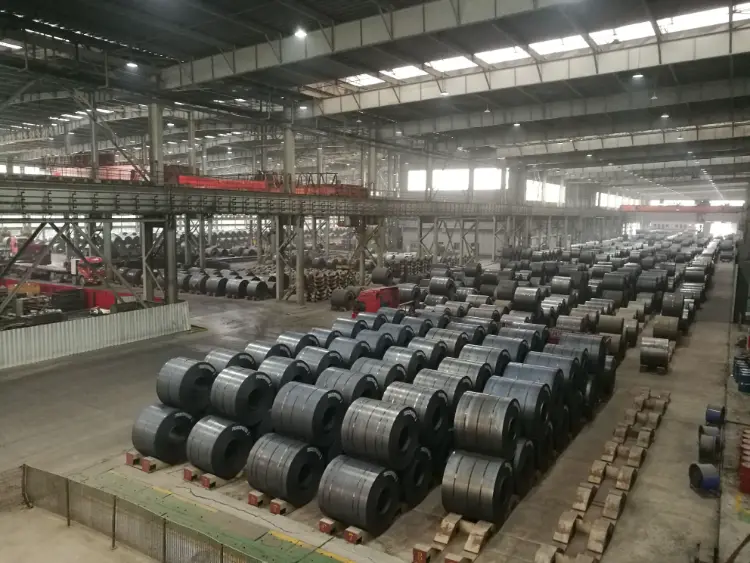
Q235A Carbon Structural Steel Coil
Q235A Carbon Structural Steel Coil: Composition, Properties & Global Equivalents
Detailed material data for Q235A carbon structural steel coil according to GB/T 700. Includes chemical composition, mechanical & physical properties, international equivalents, and application guidance.
Hot rolling, cold forming, welding, cutting, stamping, bending, punching
- Phone : +8618037372205
- Email : [email protected]
- WhatsApp: Contact via Whtsapp
- WeChat: +8618037372205
Q235A Carbon Structural Steel Coil Introduction
Q235A is a Chinese standard carbon structural steel widely supplied as hot-rolled coils, plates, and sections. It falls under GB/T 700 and is equivalent to common international grades such as ASTM A36, EN S235JR, and JIS SS400. The designation u201cQ235Au201d indicates a minimum yield strength of 235 MPa and quality level A, which does not require impact testing. This steel offers good plasticity, weldability, and formability, making it suitable for general structural applications where heavy loads and impact toughness are not critical. Its relatively high sulfur and phosphorus limits reflect a standard non-sour service steel. Typical delivery condition is as-rolled (AR), enabling cost-effective fabrication.
Q235A Carbon Structural Steel Coil Chemical Composition
Chemical composition limits in accordance with GB/T 700-2006 for Q235A. Elements not listed are residual and normally do not exceed standard limits.
- Carbon and manganese provide basic strength.
- Silicon acts as a deoxidizer.
- Sulfur and phosphorus are controlled at moderate levels typical for structural quality A.
| Element | Standard Value (max, %) | Remarks |
|---|---|---|
| Carbon (C) | 0.22 | Max |
| Manganese (Mn) | 1.40 | Max |
| Silicon (Si) | 0.35 | Max |
| Sulfur (S) | 0.050 | Max |
| Phosphorus (P) | 0.045 | Max |
| Nitrogen (N) | 0.008 | For reference, not specified in standard |
| Copper (Cu) | 0.30 | Residual element, max recommended |
| Chromium (Cr) | 0.30 | Residual element, max recommended |
| Nickel (Ni) | 0.30 | Residual element, max recommended |
Q235A Carbon Structural Steel Coil Thermal and Electrical Physical Properties
Physical properties at room temperature unless otherwise stated. These values are typical for carbon structural steel and are applicable to Q235A. They are derived from general material handbooks and may vary slightly with production conditions.
| Property | Typical Value | Unit | Test Condition / Remarks |
|---|---|---|---|
| Density (ρ) | 7.85 | g/cmu00b3 | 20 °C |
| Modulus of elasticity (E) | 200 | GPa | 20 °C; tension / compression |
| Shear modulus (G) | 80 | GPa | 20 °C; calculated from E and ν |
| Poissonu2019s ratio (ν) | 0.30 | - | Elastic range |
| Thermal expansion coefficient (α) | 12.0 | 10⁻⁶/K | 20 – 100 °C |
| Thermal expansion coefficient (α) | 12.5 | 10⁻⁶/K | 20 – 200 °C |
| Thermal expansion coefficient (α) | 13.5 | 10⁻⁶/K | 20 – 400 °C |
| Thermal conductivity (λ) | 50 | W/(m·K) | 20 °C |
| Specific heat capacity (c) | 480 | J/(kg·K) | 20 °C |
| Electrical resistivity (ρ_e) | 0.15 – 0.20 | Ω·mm²/m (×10⁻⁶ Ω·m) | 20 °C |
Q235A Carbon Structural Steel Coil Mechanical Properties
Tensile test properties according to GB/T 700-2006 for the as-rolled condition. Upper yield strength (ReH) and elongation (A) depend on specimen thickness. Q235A does not require impact testing. Bending test is performed with 180u00b0 bend according to the standard.
| Property | Standard Requirement Value | Unit | Test Condition |
|---|---|---|---|
| Yield Strength (ReH) | ≥235 | MPa | Thickness ≤16 mm |
| Yield Strength (ReH) | ≥225 | MPa | 16 mm < thickness ≤40 mm |
| Yield Strength (ReH) | ≥215 | MPa | 40 mm < thickness ≤60 mm |
| Yield Strength (ReH) | ≥215 | MPa | 60 mm < thickness ≤100 mm |
| Yield Strength (ReH) | ≥195 | MPa | 100 mm < thickness ≤150 mm |
| Yield Strength (ReH) | ≥185 | MPa | 150 mm < thickness ≤200 mm |
| Tensile Strength (Rm) | 370 – 500 | MPa | All thicknesses |
| Elongation after fracture (A) | ≥26 | % | Thickness ≤40 mm, gauge length 5.65√S₀ |
| Elongation after fracture (A) | ≥25 | % | 40 mm < thickness ≤60 mm |
| Elongation after fracture (A) | ≥24 | % | 60 mm < thickness ≤100 mm |
| Elongation after fracture (A) | ≥22 | % | 100 mm < thickness ≤150 mm |
| Elongation after fracture (A) | ≥21 | % | 150 mm < thickness ≤200 mm |
| Bend test (180°) | d = a | - | Thickness ≤60 mm, specimen width B=2a, longitudinal |
| Bend test (180°) | d = 2a | - | Thickness >60 – 100 mm, specimen width B=2a, longitudinal |
| Bend test (180°) | d = 2.5a | - | Thickness >100 – 200 mm, specimen width B=2a, longitudinal |
Q235A Carbon Structural Steel Coil Full Equivalent Standards & Replaceable Grades
| Country / Region | Standard | Grade | Remarks |
|---|---|---|---|
| China | GB/T 700 | Q235A | Original grade |
| USA | ASTM A36/A36M | A36 | Very similar carbon structural steel, widely interchangeable |
| European Union | EN 10025-2 | S235JR | Closest match; S235JR provides guaranteed impact energy at +20°C (optional) which Q235A does not |
| Japan | JIS G3101 | SS400 | Tensile range 400-510 MPa vs 370-500 MPa; generally accepted substitute |
| International | ISO 630-2 | E235A | Based on yield strength 235 min; similar composition limits |
| Russia | GOST 380 | St3sp | Equivalent structural carbon steel |
| India | IS 2062 | E250A | Yield 250 MPa min; slightly higher strength but compatible |
Q235A Carbon Structural Steel Coil Application Introduction
Q235A steel is widely used in general structural and non-critical engineering applications due to its cost-effectiveness and adequate strength.
- It is suitable for welding, bolting, and riveting.
- Not recommended for low-temperature or dynamic impact services unless additional testing is performed.
- Commonly supplied as hot-rolled coil and then fabricated into various structural components.
Product Applications: Hot-rolled steel plates and sheets, Welded H-beams and I-beams, Cold-formed steel sections (C, Z, U profiles), Steel pipes and hollow sections, Corrugated sheets and roofing, Scaffolding and formwork systems, Metal containers and enclosures
Processed into products: Structural beams and columns, Bracing and struts, Base plates and anchor plates, Welded frames and brackets, Flanges and stiffeners, Walkway gratings and handrails, Tube support clips, Automotive underbody parts
Application industries: Building construction (frames, columns, beams), Bridge engineering (non-critical members), Automotive (chassis, brackets), Machinery manufacturing (frames, supports), Storage tanks and pressure vessels (ambient temperature), Transmission towers and telecom structures, Shipbuilding (secondary structures), Furniture and hardware
Q235A Carbon Structural Steel Coil Similar / Closely Related Material Grades
| Country / Region | Standard | Grade | Remarks |
|---|---|---|---|
| China | GB/T 700 | Q235B | Same base composition but requires impact test at +20°C (≥27 J); better toughness |
| China | GB/T 700 | Q235C | Improves impact requirement to 0°C |
| China | GB/T 700 | Q235D | Impact test at -20°C; low temperature service |
| China | GB/T 1591 | Q345A | Higher strength low-alloy steel; offers better mechanical properties when needed |
| European Union | EN 10025-2 | S235J0 | Similar to S235JR but impact at 0°C; can replace Q235B/C |
| European Union | EN 10025-2 | S235J2 | Impact at -20°C; similar to Q235D |
Notes:
Q235A is the most basic quality level within the Q235 family. It is often replaced by Q235B in modern projects because B grade adds impact testing at 20°C with only a minimal cost increase. When ordering, the purchaser should specify dimensions, delivery condition, and any supplementary technical requirements (e.g., desulfurization, fine grain practice). Welding consumables should be selected according to the base metal strength (E43XX series electrodes for manual arc welding). The steel can be painted or galvanized for corrosion protection. It is not intended for sour service or low-temperature applications unless explicitly tested.
- Share



