
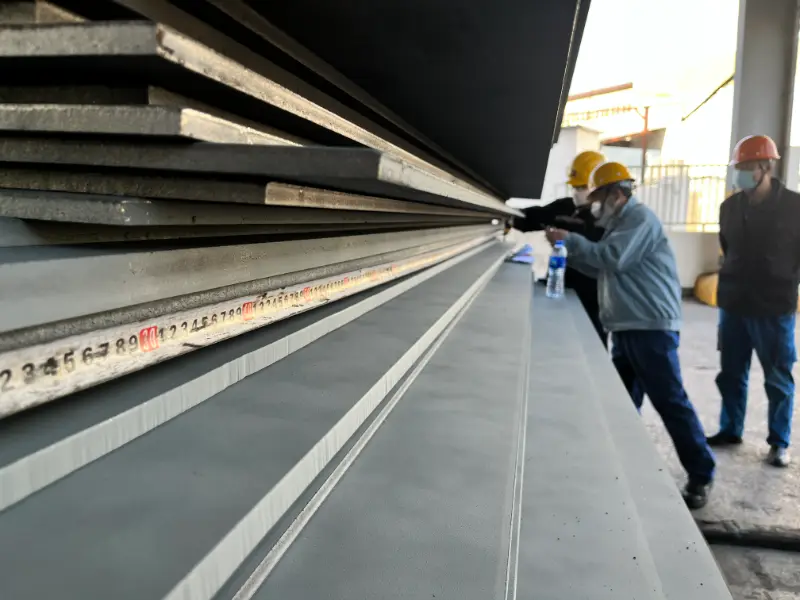
Q235B+304L Clad Steel Plate
Q235B+304L Clad Steel Plate: Technical Data, Properties & Equivalent Grades
Comprehensive technical data for Q235B+304L clad steel plate, including chemical composition, mechanical & physical properties, international equivalents, and application guide. Conforms to NB/T 47002.1 standard.
Explosive bonding, hot rolling, hot rolling + explosive bonding, cold forming, welding, machining
- Phone : +8618037372205
- Email : [email protected]
- WhatsApp: Contact via Whtsapp
- WeChat: +8618037372205
Q235B+304L Clad Steel Plate Introduction
Q235B+304L clad steel plate is a bimetallic composite material manufactured by explosion bonding or roll bonding, combining a carbon steel base layer (Q235B) with a corrosion-resistant austenitic stainless steel cladding layer (304L). This product offers an optimal balance of cost-effectiveness and high performance: the Q235B base provides structural strength and formability, while the 304L cladding ensures excellent resistance to intergranular corrosion, pitting, and oxidizing environments. Typical cladding thickness ranges from 1.5 mm to 6 mm over a total plate thickness from 6 mm to 200 mm. It is widely used in pressure vessels, heat exchangers, and storage tanks in the chemical, petrochemical, and food processing industries. The composite plate conforms to the Chinese standard NB/T 47002.1-2019 "Explosion welded clad plate for pressure vessels – Part 1: Stainless steel-steel clad plate", guaranteeing reliable bonding strength and mechanical integrity.
Q235B+304L Clad Steel Plate Chemical Composition
The chemical composition data are specified separately for the base layer (Q235B) according to GB/T 700-2006 and for the cladding layer (304L) according to GB/T 24511-2017. The values are typical ladle analysis. The clad plate guarantees corrosion resistance of the cladding side while the base provides strength.
| Element | Base Layer Q235B (wt%) | Cladding 304L (wt%) | Remarks |
|---|---|---|---|
| C (Carbon) | ≤ 0.20 | ≤ 0.030 | Maximum for base; low carbon in cladding for intergranular corrosion resistance |
| Si (Silicon) | ≤ 0.35 | ≤ 1.00 | Deoxidizer |
| Mn (Manganese) | 0.30 - 1.40 | ≤ 2.00 | Increases strength and hardenability |
| P (Phosphorus) | ≤ 0.045 | ≤ 0.045 | Maximum for both layers |
| S (Sulfur) | ≤ 0.045 | ≤ 0.030 | Lower sulfur in cladding improves corrosion resistance |
| Cr (Chromium) | – | 18.00 - 20.00 | Key element for stainless passivation |
| Ni (Nickel) | – | 8.00 - 12.00 | Stabilizes austenitic structure |
| N (Nitrogen) | – | ≤ 0.10 | Residual in 304L |
Q235B+304L Clad Steel Plate Thermal and Electrical Physical Properties
The physical properties of the clad plate are approximately the weighted average of the two components, but strongly depend on the layer thickness ratio. Typical values at room temperature are given for a composite with 3mm 304L cladding and 10mm Q235B base. For design purposes, more detailed data should be calculated according to the actual cladding/base thickness ratio and temperature.
| Property | Standard Required Value | Unit | Test Condition |
|---|---|---|---|
| Density (ρ) | 7.87 – 7.92 | g/cm³ | At 20°C; approximate weighted average |
| Elastic Modulus (E) | 195 – 205 (approx.) | GPa | At 20°C; typical value ~200 GPa, dominated by base layer |
| Shear Modulus (G) | 75 – 80 (approx.) | GPa | At 20°C |
| Poisson's Ratio (ν) | 0.30 | – | At 20°C; typical for both carbon and stainless steels |
| Thermal Expansion Coefficient (α) | 12.0 (average base contribution) | 10-6/K | Between 20 and 100°C; can vary from 11.5 (Q235B) to 16.0 (304L) depending on cladding thickness |
| Thermal Conductivity (λ) | 30 – 45 (effective) | W/(m·K) | At 20°C; much lower than pure Q235B (~50) due to stainless cladding (~15); value depends on layering |
| Specific Heat Capacity | 470 – 500 (approx.) | J/(kg·K) | At 20°C |
| Electrical Resistivity (ρe) | 0.25 – 0.45 (composite effective) | μΩ·m | At 20°C; influenced by 304L cladding resistivity (~0.72) and Q235B (~0.15) |
Q235B+304L Clad Steel Plate Mechanical Properties
Mechanical properties depend on the combined thickness and the base layer grade. The values listed are minimum requirements for clad plates with Q235B base and 304L cladding in delivery condition. Yield strength and tensile strength refer to the full composite thickness. Shear strength of the bond interface must be ≥210 MPa. Bend tests are performed with cladding in tension or compression depending on the test orientation. Impact properties follow base metal requirements (Q235B).
| Property | Standard Required Value | Unit | Test Condition |
|---|---|---|---|
| Yield Strength (ReH) | ≥ 235 | MPa | For base thickness ≤16 mm (Q235B requirement) |
| Yield Strength (ReH) | ≥ 225 | MPa | For base thickness >16 mm and ≤40 mm |
| Yield Strength (ReH) | ≥ 215 | MPa | For base thickness >40 mm and ≤60 mm |
| Tensile Strength (Rm) | 370 - 500 | MPa | Full composite; based on Q235B range for all thicknesses |
| Elongation (A) | ≥ 26 | % | For base thickness ≤40 mm (Q235B, gauge length 5.65√S0) |
| Elongation (A) | ≥ 25 | % | For base thickness >40 mm and ≤60 mm |
| Shear Strength (τb) | ≥ 210 | MPa | Bond interface, at room temperature |
| Bend Test (D = 2a, 180°) | No cracks or delamination | – | B1 class clad plate; D=mandrel diameter, a=specimen thickness; cladding in tension or compression |
| Impact Energy (KV2, 20°C) | ≥ 27 | J | Longitudinal, full-size specimen, base metal requirement |
Q235B+304L Clad Steel Plate Full Equivalent Material Standards and Replaceable Grades
| Country/Region | Standard | Grade | Remarks |
|---|---|---|---|
| China | NB/T 47002.1-2019 | Q235B+304L | Original standard; explosive welding clad plate for pressure vessels |
| USA | ASTM A264 | 304L clad on SA-36 | Roll-bonded or explosion-bonded; base SA-36 comparable to Q235B |
| Japan | JIS G3601 | SUS304L/SS400 | Clad steel; SS400 base is similar to Q235B |
| Europe (EN) | EN 13445-4 / EN 10028 (base) | X2CrNi19-11 (1.4306) clad on P265GH | P265GH is a pressure vessel steel with min. yield 265 MPa, slightly higher than Q235B; may require redesign |
| India | IS 3044 (Clad Plate) | 304L clad on IS 2062 E250 | E250 base similar to Q235B |
Q235B+304L Clad Steel Plate Application Introduction
Q235B+304L clad steel is an economical solution for equipment that requires corrosion resistance only on the medium-contacting surface.
- Pressure vessels: often used for columns, reactors, and storage tanks handling mildly corrosive fluids up to 300°C.
- Heat exchangers: tube sheets and shells where one side is exposed to corrosive media.
- Desalination and water treatment: evaporator bodies, brine piping.
- FGD systems: absorber towers and ducting in coal-fired power plants.
- Food and pharmaceutical: storage silos and processing vessels requiring cleanability without full stainless construction.
When forming, special care is needed to avoid delamination; hot forming should be followed by solution annealing to restore corrosion resistance of the 304L cladding.
Product Applications: Pressure vessels and storage tanks, Heat exchanger shells and channels, Reactor columns and distillation towers, Clad pipe and fittings (welded from plate), Lining plates for chimneys and stacks, Fermentation tanks and aseptic containers
Processed into products: Shell courses and heads of pressure vessels, Tube sheets (clad side facing corrosive fluid), Flanges and nozzles (explosion clad inserts), Transition joints (for welding carbon steel to stainless piping), Large diameter pipes (rolled from clad plate), Stiffeners and internal attachments (stainless-clad side exposed to medium)
Application industries: Chemical and Petrochemical Processing, Oil & Gas (offshore platforms, refinery equipment), Power Generation (FGD, nuclear waste containers), Desalination and Water Treatment, Food and Beverage, Pharmaceutical, Shipbuilding (cargo tanks, hull plates in aggressive environments)
Q235B+304L Clad Steel Plate Similar/Alternative Material Recommendations
| Country/Region | Standard | Grade | Remarks |
|---|---|---|---|
| China | NB/T 47002.1-2019 | Q235B+316L | Improved pitting/crevice corrosion resistance with Mo-containing cladding; all other properties similar |
| China | NB/T 47002.1-2019 | Q345R+304L | Higher strength vessel steel base; commonly used when design stress exceeds Q235B limits |
| China | NB/T 47002.2-2019 | Q245R+304L | Boiler steel base with slightly better elevated temperature properties than Q235B |
| International | ASTM A264 | 316L clad on SA-516 Gr.70 | Combination for higher strength and enhanced corrosion resistance, frequently used in refinery equipment |
Notes:
- The cladded side thickness shall be specified separately; typically 2–4 mm for most service conditions.
- Non-destructive examination (NDE) per NB/T 47002.1 requires 100% ultrasonic testing for bond integrity; no unbonded area exceeding prescribed limits is allowed.
- Welding of clad plates requires matched filler metals for both base and cladding; procedure qualification (PQR/WPS) should include corrosion testing of the clad weld overlay.
- For cyclic service or cryogenic applications, low-temperature impact properties of the base metal (Q235B) may be inadequate; consider using Q345R or normalized steel as the base layer.
- Share



