
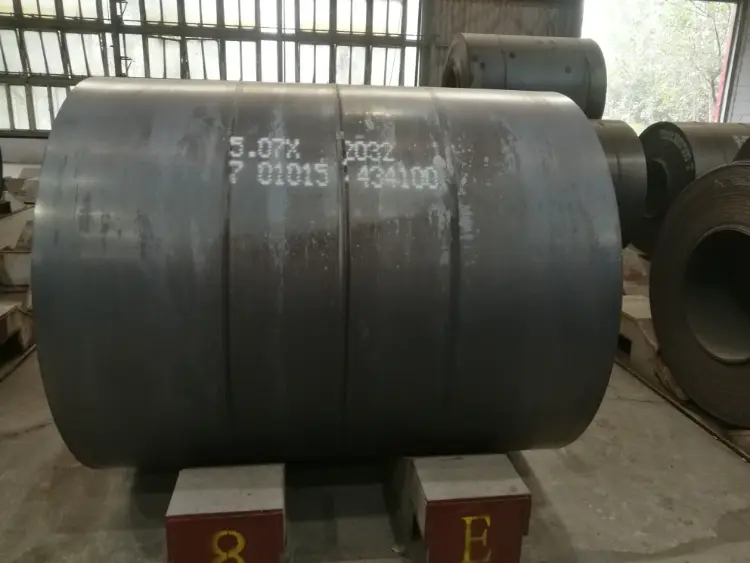
NK F56 Shipbuilding Steel Coil
NK F56 Shipbuilding Steel Coil - High Strength Arctic-Grade Marine Steel
Detailed material data for NK F56 (KF56) high-strength shipbuilding steel coil, including chemical composition, mechanical properties, thermal properties, international equivalents, and application guidelines.
Thermo-Mechanical Controlled Processing (TMCP), Quenching and Tempering (Q&T)
- Phone : +8618037372205
- Email : [email protected]
- WhatsApp: Contact via Whtsapp
- WeChat: +8618037372205
NK F56 Shipbuilding Steel Coil Introduction
NK F56, also designated KF56, is a high-strength hull structural steel grade defined by the Nippon Kaiji Kyokai (ClassNK) rules. It offers a minimum yield strength of 56 kgf/mm² (550 MPa) and is primarily used in demanding marine and offshore applications requiring excellent toughness at low temperatures down to -60°C (F-grade). The steel is typically supplied as coils or plates in the thermo-mechanically controlled processed (TMCP) or quenched and tempered (Q&T) condition. Its high strength and superior weldability make it suitable for critical structural components in icebreakers, Arctic vessels, and offshore platforms.
NK F56 Shipbuilding Steel Coil Chemical Composition
The chemical composition of NK F56 is controlled to achieve high strength and low-temperature toughness. The following table provides typical ladle analysis values meeting ClassNK requirements. Nb, V, Ti are added singly or in combination for grain refinement. Carbon equivalent (CEV) is limited to ensure weldability. Actual values depend on thickness and manufacturing route.
| Element | Typical Requirement (wt%) | Remarks |
|---|---|---|
| Carbon (C) | ≤0.18 | Max |
| Silicon (Si) | 0.10 – 0.55 | |
| Manganese (Mn) | 0.90 – 1.60 | |
| Phosphorus (P) | ≤0.025 | Max |
| Sulfur (S) | ≤0.010 | Max; low S for toughness |
| Aluminum (Al_total) | ≥0.020 | Min acid-soluble |
| Niobium (Nb) | ≤0.05 | Optional grain refiner |
| Vanadium (V) | ≤0.10 | Optional grain refiner |
| Titanium (Ti) | ≤0.02 | Optional grain refiner |
| Copper (Cu) | ≤0.35 | Residual |
| Nickel (Ni) | ≤0.40 | Residual or added for toughness |
| Chromium (Cr) | ≤0.20 | Residual |
| Molybdenum (Mo) | ≤0.08 | Residual |
| Nitrogen (N) | ≤0.012 | Max |
NK F56 Shipbuilding Steel Coil Thermal and Electrical Physical Properties
The following physical properties are indicative for NK F56 steel at room temperature (20°C) unless otherwise stated. These values are typical for medium-carbon low-alloy structural steels and may vary slightly with composition and heat treatment.
| Property | Typical Value | Unit | Test Condition |
|---|---|---|---|
| Density (ρ) | 7.85 | g/cm³ | 20°C |
| Young's Modulus (E) | 210 | GPa | 20°C |
| Shear Modulus (G) | 81 | GPa | 20°C |
| Poisson's Ratio (ν) | 0.30 | — | 20°C |
| Thermal Expansion Coefficient (α) | 12.0 × 10⁻⁶ | /K | 20 – 100°C |
| Thermal Conductivity (λ) | ~52 | W/(m·K) | 20°C |
| Specific Heat Capacity | ~460 | J/(kg·K) | 20°C |
| Electrical Resistivity (ρe) | ~0.25 × 10⁻⁶ | Ω·m | 20°C |
NK F56 Shipbuilding Steel Coil Mechanical Properties
Minimum mechanical properties for NK F56 (KF56) steel in the TMCP or Q&T delivery condition. Testing is performed on transverse specimens unless otherwise noted. Impact tests are carried out at -60°C in both longitudinal and transverse directions. Values apply to thicknesses typically ≤50 mm; for greater thicknesses, some reduction may be allowed according to ClassNK rules.
| Property | Required Value | Unit | Test Condition |
|---|---|---|---|
| Yield Strength (ReH) | ≥550 | MPa | Transverse, t ≤ 50 mm |
| Tensile Strength (Rm) | 670 – 830 | MPa | Transverse |
| Elongation (A5) | ≥16 | % | Gauge length 5.65√S₀ |
| Charpy Impact (KV) at -60°C | ≥27 | J | Longitudinal, 10×10 mm specimen |
| Charpy Impact (KV) at -60°C | ≥20 | J | Transverse, 10×10 mm specimen |
| Bend Test (180°) | d = 3a | — | t ≤ 50 mm; a = specimen thickness |
NK F56 Shipbuilding Steel Coil Fully Equivalent Material Standards and Replacement Grades
NK F56 (KF56) is defined by ClassNK rules. Equivalent grades exist under other major classification societies, all of which stipulate a minimum yield strength of 56 kgf/mm² (550 MPa) and an F-grade (-60°C) impact toughness requirement.
| Country/Region | Standard / Classification Society | Equivalent Grade | Remarks |
|---|---|---|---|
| International | Lloyd's Register (LR) | FH56 | Same strength and toughness level |
| Norway/Germany | DNV | F56 | DNV rules |
| France | Bureau Veritas (BV) | FH56 | Identical requirements |
| USA | American Bureau of Shipping (ABS) | FH56 | ABS grade |
| China | China Classification Society (CCS) | F56 | CCS equivalent |
| South Korea | Korean Register (KR) | FH56 | KR equivalent |
| Italy | RINA | FH56 | RINA equivalent |
NK F56 Shipbuilding Steel Coil Application Introduction
NK F56 steel is primarily used in the construction of ships and offshore structures where high strength combined with exceptional low-temperature toughness is essential. It is suitable for the most demanding environmental conditions, including Arctic and sub-Arctic service. The steel can be formed, welded, and machined using standard procedures, but due to its high strength, preheating and controlled heat input may be required during welding. Typical applications include:
Product Applications: Hulls of icebreakers and ice-going vessels, Deck structures and superstructures of large container ships, Jack-up rig legs and spudcans, Heavy-lift crane booms and pedestals, Offshore platform modules and helidecks, Pressure hulls of submarines and submersibles (special approval required)
Processed into products: Shell plates (side and bottom), Strength decks and hatch coamings, Bulkhead plates, Longitudinal stiffeners and frames, Bracket plates and floors, Fatigue-critical nodes in offshore structures
Application industries: Marine & Shipbuilding, Offshore Oil & Gas, Arctic Engineering, Heavy-Lift & Transport, Port & Harbor Equipment
NK F56 Shipbuilding Steel Coil Similar / Alternative Materials with Close Properties
| Country/Region | Standard / Classification Society | Grade | Remarks |
|---|---|---|---|
| Japan (ClassNK) | NK Rules | KF46 / FH46 | Lower yield strength (460 MPa), same F-grade toughness; often a substitute when full 550 MPa is not required |
| Japan (ClassNK) | NK Rules | KF40 / FH40 | Yield ≥390 MPa; suitable for less demanding applications |
| International | EN 10025-6 / IACS UR W31 | S690QL / S690QL1 | Quenched and tempered steel with yield ≥690 MPa; higher strength but careful welding needed |
| International | ClassNK / Others | EH46 / FH46 | 550 MPa strength class but with E-grade (-40°C) or F-grade toughness; may match for some designs |
| International | API 2W / 2Y | API 2W-60 / 2Y-60 | Offshore structural steel with 60 ksi yield; slightly lower toughness requirements |
Notes:
- For thicknesses above 50 mm, mechanical property values may be subject to reduction as per ClassNK rules.
- Weldability: CEV typically ≤0.45% (depending on thickness) to ensure crack-free welding.
- Steel must be produced using a fine-grain practice and delivered with appropriate mill certificates.
- Surface condition and dimensional tolerances shall comply with NK or the purchaser's specifications.
- Austenite grain size shall be ASTM No. 5 or finer.
- Share



