
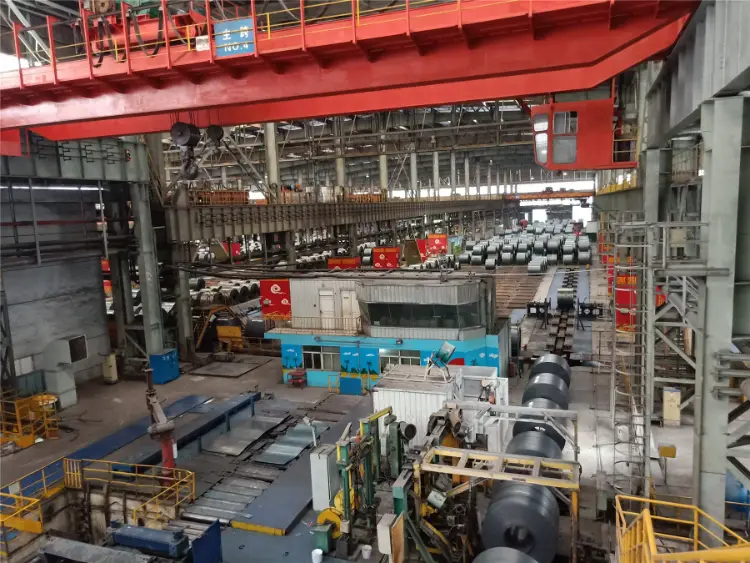
NK EH550 (E56) Shipbuilding Steel Coil
NK EH550 (E56) Shipbuilding Steel Coil - High Strength Marine & Offshore Structural Grade
Detailed material data for NK EH550 (commercially referred as NK E56) shipbuilding steel coil, including chemical composition, mechanical & thermal properties, international equivalent grades, and application guide.
Hot rolling, controlled rolling, TMCP, normalizing, quenching and tempering
- Phone : +8618037372205
- Email : [email protected]
- WhatsApp: Contact via Whtsapp
- WeChat: +8618037372205
NK EH550 Shipbuilding Steel Coil Introduction
NK EH550 (also known as NK E56) is a high-strength, low-alloy shipbuilding steel grade certified by Nippon Kaiji Kyokai (ClassNK). It belongs to the extra-high strength hull structural steel family, offering a minimum yield strength of 550 MPa and excellent notch toughness down to -40°C (E-grade). The steel is typically supplied in normalized, thermo-mechanically controlled processed (TMCP) or quenched and tempered condition. Its microalloying with Nb, V, Ti ensures fine grain structure and superior welding characteristics.
- High strength-to-weight ratio for weight reduction in ship and offshore structures.
- Good cold bending and welding performance.
- Suitable for critical stress areas such as main decks, shell plating, and topside modules.
NK EH550 Shipbuilding Steel Coil Chemical Composition
Chemical composition according to NK approved standard for EH550, equivalent to GB 712-2011 EH550. Elements are controlled to ensure high strength and good low-temperature toughness.
- Microalloying elements (Nb, V, Ti) are added for grain refinement and precipitation strengthening.
- Low carbon equivalent (CEV) to improve weldability.
- Phosphorus and sulfur are strictly limited for cleanliness.
| Element | Nominal Value (%) | Remarks |
|---|---|---|
| Carbon (C) | ≤0.18 | - |
| Silicon (Si) | ≤0.50 | - |
| Manganese (Mn) | 0.90 - 1.60 | - |
| Phosphorus (P) | ≤0.025 | - |
| Sulfur (S) | ≤0.025 | - |
| Nickel (Ni) | ≤0.80 | Optional, for toughness |
| Chromium (Cr) | ≤0.25 | - |
| Molybdenum (Mo) | ≤0.08 | - |
| Copper (Cu) | ≤0.35 | - |
| Niobium (Nb) | 0.02 - 0.05 | Grain refinement |
| Vanadium (V) | 0.05 - 0.10 | Precipitation strengthening |
| Titanium (Ti) | ≤0.02 | Grain refinement |
| Aluminium (Al total) | ≥0.015 | Grain refining, deoxidation |
| Nitrogen (N) | ≤0.012 | - |
NK EH550 Shipbuilding Steel Coil Thermal and Electrical Physical Properties
Physical properties are representative for low-alloy HSLA steel in the quenched and tempered or TMCP condition. Slight variations may occur depending on exact composition and heat treatment.
- Density, elastic constants, and thermal expansion are similar to other high-strength constructional steels.
- Thermal conductivity and resistivity are typical for ferritic-pearlitic/bainitic microstructures.
| Property | Typical Value | Unit | Condition / Temperature |
|---|---|---|---|
| Density (ρ) | 7.85 | g/cm³ | At room temperature |
| Young's Modulus (E) | 206 | GPa | Ambient, static |
| Shear Modulus (G) | 80 | GPa | Calculated from E and ν |
| Poisson's Ratio (ν) | 0.30 | - | Ambient |
| Coefficient of Thermal Expansion (α) | 12.0 | 10⁻⁶/K | 0 – 100 °C |
| Coefficient of Thermal Expansion (α) | 13.0 | 10⁻⁶/K | 0 – 200 °C |
| Coefficient of Thermal Expansion (α) | 14.0 | 10⁻⁶/K | 0 – 400 °C |
| Thermal Conductivity (λ) | 48 | W/(m·K) | At 20 °C |
| Specific Heat Capacity (cp) | 460 | J/(kg·K) | At 20 °C |
| Electrical Resistivity (ρe) | 0.23 | μΩ·m | At 20 °C |
NK EH550 Shipbuilding Steel Coil Mechanical Properties
Mechanical properties determined from transverse test pieces, unless otherwise specified, for thickness range 10–50 mm. EH550 offers high strength with sufficient ductility and excellent impact toughness at -40°C.
- Tensile testing performed in accordance with ISO 6892-1 or ASTM A370.
- Charpy V-notch impact tests conducted at prescribed temperature.
- Bend test provides indication of formability.
| Property | Requirement | Unit | Test Condition |
|---|---|---|---|
| Yield Strength (ReH) | ≥550 | MPa | Transverse, t ≤ 50 mm |
| Yield Strength (ReH) | ≥530 | MPa | Transverse, 50 < t ≤ 100 mm |
| Tensile Strength (Rm) | 670 - 830 | MPa | Transverse, t ≤ 50 mm |
| Tensile Strength (Rm) | 660 - 820 | MPa | Transverse, 50 < t ≤ 100 mm |
| Elongation (A) | ≥16 | % | Gauge length 5.65√So, t ≤ 50 mm |
| Elongation (A) | ≥15 | % | Gauge length 5.65√So, 50 < t ≤ 100 mm |
| Bend Test (Dia = 3t) | No cracks | - | 180° bending, t = specimen thickness |
| Charpy Impact (KV2) | ≥50 (longitudinal) / ≥34 (transverse) | J | -40°C, 10x10 mm specimen |
| Charpy Impact (KV2) | ≥40 (longitudinal) / ≥27 (transverse) | J | -40°C, 10x7.5 mm subsize |
NK EH550 Shipbuilding Steel Coil Equivalent Grades – International Standards for Direct Substitution
| Country/Region | Standard | Grade/Designation | Remarks |
|---|---|---|---|
| China | CCS (China Classification Society) | EH550 | Chemical & mechanical properties equivalent |
| Norway/Germany | DNV GL | E550 | Now DNV, formerly NV E550 |
| USA | ABS (American Bureau of Shipping) | EH550 | ABS Grade EH550, identical performance |
| UK | LR (Lloyd's Register) | EH550 | LR EH550, same yield & impact class |
| France | BV (Bureau Veritas) | EH550 | BV EH550, fully compatible |
| South Korea | KR (Korean Register) | EH550 | KR EH550, same specification |
| Italy | RINA (Registro Italiano Navale) | EH550 | RINA EH550, equivalent |
| International | ISO 24314 / IACS UR W11 | EH550 | Common IACS material grade |
NK EH550 Shipbuilding Steel Coil Application Introduction
NK EH550 (E56) steel coils and plates are designed for weight-critical, high-stress components in marine and offshore environments. The combination of high strength, excellent low-temperature toughness, and good weldability makes it a first choice for modern shipbuilding.
- Typical applications cover primary structural members where high load and severe service conditions exist.
- Can be processed by cold forming, machining, and all common welding techniques (SMAW, SAW, FCAW, GMAW) with appropriate low-hydrogen consumables.
- Preheating may be recommended for thick sections or when welding at low ambient temperatures.
Product Applications: Hull plates (side shell, bottom, strength deck), Deck stringer plates and sheer strakes, Transverse web frames and girders, Hatch coamings and corner castings, Offshore platform columns and braces, Subsea structural components
Processed into products: Brackets and stiffeners, Padeyes and lifting lugs, Pin connections and forged ends, High-tensile bolts and fasteners (when machined from plate), Repair patches and insert plates
Application industries: Commercial Shipbuilding (container ships, bulk carriers, tankers), Naval Vessels (frigates, patrol boats), Offshore Oil & Gas Platforms (jackets, topsides), Offshore Wind Turbine Foundations (monopiles, transition pieces), Heavy Lifting Equipment (ship cranes, A-frames), Marine Engineering (lock gates, docks, piers)
NK EH550 Shipbuilding Steel Coil Similar / Alternative Materials for Comparable Service
| Country/Region | Standard | Grade | Remarks / Analysis |
|---|---|---|---|
| Japan | NK | EH47 | Lower yield strength (≥460 MPa) but excellent toughness; suitable where weight savings are less critical. |
| Japan | NK | EH620 | Higher strength (≥620 MPa) for extreme loading, but may require preheating and special welding. |
| China | GB/T 16270 | Q550E | High strength structural steel, similar mechanical properties but without specific marine classification unless certified. |
| Germany | EN 10025-6 | S550QL | Quenched and tempered structural steel, yield 550 MPa, but not normally classed for shipbuilding; acceptable for offshore accessories. |
| USA | ASTM A514 / A517 | Grade B/H | High yield strength (≥690 MPa) quenched & tempered plate for structural applications; may replace EH550 with careful design and approval. |
| Japan | JIS G 3106 | SM570 | Rolled steel for welded structures, yield ≥460 MPa; often used as an alternative in shipbuilding with supplementary impact testing. |
Notes:
Certification: All NK EH550 (E56) deliveries must be accompanied by NK material certificates (Form K) with stamp. Weldability: Carbon equivalent Ceq ≤ 0.45% (typically) and Pcm ≤0.24% for good weldability. NDT: Ultrasonic testing according to EN 10160 or equivalent is often specified for thicknesses above 20 mm. Forging equivalent: For forged components of similar strength, refer to NK EH550 forgings (Part K, Section 5).
- Share



