
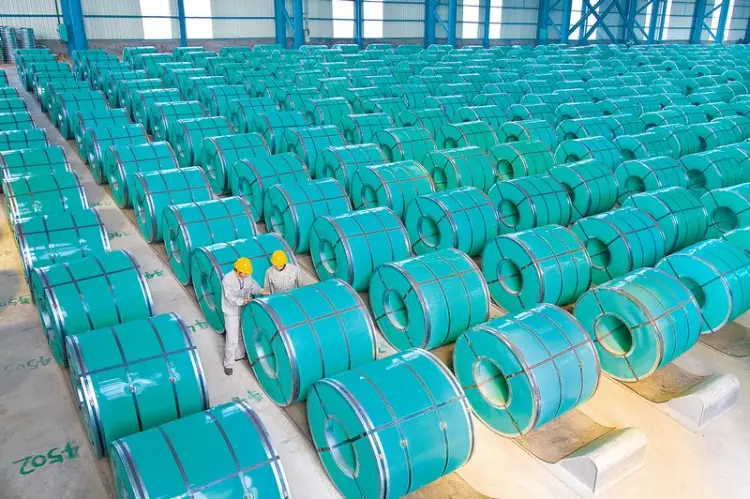
NK D56 Shipbuilding Steel Coil
NK D56 Shipbuilding Steel Coil: High Strength Hull Structural Steel for Arctic and Heavy Marine Applications
NK D56 (DH56) is a high-strength hull structural steel grade certified by Nippon Kaiji Kyokai (ClassNK) with a minimum yield strength of 560 MPa. Ideal for heavy-duty ship hulls, offshore structures, and critical components in cold-climate environments, ensuring excellent weldability and toughness at -20°C.
Hot rolling (controlled rolling or TMCP), normalizing, cutting, forming, welding
- Phone : +8618037372205
- Email : [email protected]
- WhatsApp: Contact via Whtsapp
- WeChat: +8618037372205
NK D56 Shipbuilding Steel Coil Introduction
NK D56 steel is a high-strength hull structural steel grade certified by Nippon Kaiji Kyokai (ClassNK), designated for marine and offshore applications. As a D-grade steel with a minimum yield strength of 560 MPa, it offers an optimal balance of high strength, excellent weldability, and guaranteed impact toughness at -20°C. The material is produced through thermo-mechanical controlled processing (TMCP) or normalized rolling, ensuring uniform fine grain microstructure.
- Yield strength: ≥560 MPa
- Tensile strength: 610-780 MPa
- Excellent low-temperature toughness: minimum KV₂ ≥34 J at -20°C longitudinal
- Good weldability: low carbon equivalent, suitable for conventional welding processes
- Corrosion resistance in marine atmospheres
Normally supplied as hot-rolled coils, plates, and sheets, it is extensively used for hull structures, deck plating, and offshore platform components.
NK D56 Shipbuilding Steel Coil Chemical Composition
The chemical composition of NK D56 (DH56) is strictly defined by ClassNK to balance high strength with good weldability. Maximum carbon content is 0.18%, with manganese up to 1.60%. Micro-alloying elements like Nb, V, and Ti are added singly or in combination to refine grain structure and enhance precipitation hardening. Low sulfur and phosphorus levels improve ductility and resistance to brittle fracture. The carbon equivalent (CEV) is typically controlled below 0.43% to ensure excellent weldability without preheating for moderate thicknesses.
| Element | Standard Value (max, unless range) | Remarks |
|---|---|---|
| C | ≤0.18 | Ladle analysis |
| Si | ≤0.55 | |
| Mn | 0.90 – 1.60 | |
| P | ≤0.035 | Low phosphorus for ductility |
| S | ≤0.035 | Low sulfur for toughness |
| Al (total) | ≥0.015 | Grain refining |
| Nb | 0.02 – 0.05 | Single or combined addition; sum Nb+V+Ti ≤0.12% |
| V | 0.05 – 0.10 | Single or combined; if alone ≤0.10% |
| Ti | 0.007 – 0.05 | Single or combined |
| Cu | ≤0.35 | |
| Cr | ≤0.20 | |
| Ni | ≤0.40 | Optional for toughness improvement |
| Mo | ≤0.08 | |
| CEV* | ≤0.43 (typical) | C+Mn/6+(Cr+Mo+V)/5+(Ni+Cu)/15 |
NK D56 Shipbuilding Steel Coil Physical Properties
These physical properties are typical for low-alloy high-strength shipbuilding steel in the 560 MPa yield class. Values may vary slightly with exact chemical composition and heat treatment. Thermal expansion is consistent with most structural steels; thermal conductivity is moderate. Electrical resistivity is typical for steel. Data are provided for engineering calculations in ship and offshore design.
| Property | Typical Value | Unit | Test Condition / Remarks |
|---|---|---|---|
| Density (ρ) | 7.85 | g/cm³ | Ambient temperature |
| Modulus of Elasticity (E) | 205 | GPa | Room temperature |
| Shear Modulus (G) | 80 | GPa | Calculated from E and ν=0.29 |
| Poisson's Ratio (ν) | 0.29 | - | Elastic range |
| Thermal Expansion Coefficient (α) | 12.0 × 10⁻⁶ | /K | 20–100°C |
| Thermal Conductivity (λ) | 45 – 50 | W/(m·K) | At 20°C, typical for low alloy steel |
| Specific Heat Capacity (cp) | 460 – 500 | J/(kg·K) | At 20°C |
| Electrical Resistivity (ρₑ) | 0.20 – 0.25 | Ω·mm²/m | At 20°C |
NK D56 Shipbuilding Steel Coil Mechanical Properties
Mechanical tests are carried out on longitudinal specimens from flat products in delivery condition (controlled rolled or normalized). The steel guarantees minimum yield strength of 560 MPa and tensile strength between 610–780 MPa. High elongation ensures formability, and the Charpy V-notch impact energy at -20°C confirms suitability for cold-climate marine environments. Properties are valid for thickness ≤50 mm; for greater thickness, values may be slightly reduced according to ClassNK rules.
| Property | Standard Requirement Value | Unit | Test Condition |
|---|---|---|---|
| Yield Strength (ReH) | ≥560 | MPa | Transverse / longitudinal, thickness ≤50 mm |
| Tensile Strength (Rm) | 610 – 780 | MPa | Room temperature |
| Elongation (A) | ≥18 | % | Gauge length 5.65√So, longitudinal, t≤50 mm |
| Bend Test (mandrel diameter) | 3t (bending 180°) | mm | No cracks – t = specimen thickness |
| Charpy V-notch Impact (KV₂) | ≥34 (longitudinal) | J | -20°C, longitudinal |
| Charpy V-notch Impact (KV₂) | ≥24 (transverse) | J | -20°C, transverse |
NK D56 Shipbuilding Steel Coil Fully Equivalent Material Standards and Substitutable Grades
| Country / Region | Standard | Grade | Remarks |
|---|---|---|---|
| Japan | ClassNK (NK) | DH56 | ClassNK certified D-grade 560 MPa yield |
| Norway / Germany | DNV | D560 | DNV grade D with 560 MPa yield |
| France | BV | DH56 | Bureau Veritas equivalent |
| USA | ABS | DH56 | American Bureau of Shipping |
| United Kingdom | LR | DH56 | Lloyd's Register |
| China | CCS | DH56 | China Classification Society |
| South Korea | KR | DH56 | Korean Register |
| Italy | RINA | DH56 | Registro Italiano Navale |
NK D56 Shipbuilding Steel Coil Application Introduction
NK D56 steel is specifically designed for highly stressed structural parts in ships and offshore units operating in cold waters. Its high strength allows weight reduction without sacrificing safety, while the guaranteed low-temperature toughness assures integrity in ambient temperatures down to -20°C. The material is readily weldable using standard shipyard procedures and can be formed into complex shapes.
- Hull and deck plating for large container ships and bulk carriers.
- Offshore platform topsides and jackets in cold regions.
- Ice-strengthened structures for Arctic vessels.
It is also suitable for heavy machinery components where a combination of high strength and weldability is required.
Product Applications: Container ships, bulk carriers, oil tankers hulls, Icebreakers and ice-class vessels, Offshore platform decks and leg structures, Floating production storage and offloading (FPSO) units, Submarine pipelines (pipe plates), Heavy-duty port and shipyard structures
Processed into products: Main deck and bottom plating, Side shell and longitudinal stiffeners, Bulkhead plates and web frames, Hatch coamings and coaming stays, Rudder horn and rudder stock plates, Crane pedestal and heavy-lift attachment plates, Offshore module beams and columns, Cold-room structural parts
Application industries: Shipbuilding and ship repair, Offshore oil & gas (platforms, FPSO), Marine engineering (port cranes, mooring equipment), Renewable energy (offshore wind turbine foundations), Pressure vessel manufacturing (low-temperature service)
NK D56 Shipbuilding Steel Coil Similar / Alternative Material Recommendations
| Country / Region | Standard | Grade | Remarks |
|---|---|---|---|
| Japan | NK | EH56 | E-grade with -40°C impact toughness, otherwise similar strength and chemistry |
| Japan | NK | DH550 | 550 MPa yield class; slightly lower strength but same application range |
| Japan | NK | DH62 | 620 MPa yield; higher strength alternative with stricter metallurgy |
| Japan | NK | DH36 | 360 MPa yield; lower strength, widely used in general shipbuilding |
| European | EN 10025-6 | S550QL | Quenched and tempered steel with minimum yield 550 MPa; not fully classed for marine but used in offshore structures |
| China | GB 712 | DH56 | CCS certified 560 MPa class hull steel |
Notes:
ClassNK DH56 steel may also be supplied under the alternative designation D56. Ordering typically requires specifying the NK Rules edition, delivery condition, and thickness range. Welding consumables should be low-hydrogen type with matched strength. For thick plates (≥50 mm), a more detailed examination of internal soundness (ultrasonic testing) is recommended. Controlled rolling with accelerated cooling (TMCP) is commonly used to meet property requirements while keeping carbon equivalent low. Material certificates according to EN 10204 3.1/3.2 are issued by approved mills.
- Share



