
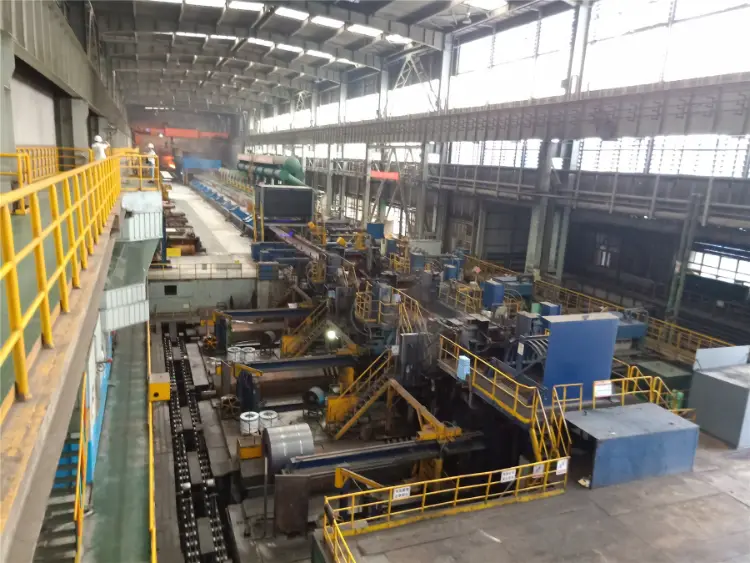
NK A56 Shipbuilding Steel Coil
NK A56 Shipbuilding Steel Coil – High Strength Hull Structural Steel for Marine Applications
Comprehensive data sheet for NK A56 steel coil: chemical composition, mechanical and thermal properties, international equivalents, similar grades, and application guide.
Hot rolling, TMCP (Thermo-Mechanical Controlled Processing), normalizing, or quenching and tempering; suitable for welding, cold forming, and machining
- Phone : +8618037372205
- Email : [email protected]
- WhatsApp: Contact via Whtsapp
- WeChat: +8618037372205
NK A56 Shipbuilding Steel Coil Introduction
NK A56 is a high-strength hull structural steel coil certified by ClassNK (Nippon Kaiji Kyokai) primarily for use in shipbuilding and offshore constructions. The designation 'A' indicates an impact test temperature of 0°C, while '56' refers to a minimum yield strength of 560 MPa. This grade belongs to the family of thermo-mechanically controlled processed (TMCP) or normalized steels with excellent weldability, good toughness at low temperatures, and high strength-to-weight ratio. NK A56 is typically supplied in coil form and used for critical structural members such as decks, bottom shells, and longitudinal stiffeners in large container vessels, bulk carriers, and offshore platforms, where weight reduction and high load-bearing capacity are essential.
NK A56 Shipbuilding Steel Coil Chemical Composition
The chemical composition of NK A56 steel is optimized to achieve high strength and excellent weldability while maintaining good low-temperature toughness. Key elements include carbon for hardenability, manganese and silicon for deoxidation and strength, and microalloying elements such as niobium, vanadium, and titanium for grain refinement and precipitation strengthening. The phosphorus and sulfur levels are strictly controlled to ensure isotropic properties and resistance to brittle fracture. Precise limits may vary slightly according to product thickness and manufacturer's practice but comply with NK and IACS requirements.
| Element | Requirement (max unless range given) | Notes |
|---|---|---|
| C | ≤ 0.18% | For higher strength; can be lower for improved weldability |
| Si | ≤ 0.55% | Deoxidizer and strength contributor |
| Mn | 0.90 – 1.70% | Enhances hardenability and strength |
| P | ≤ 0.025% | Low level for toughness |
| S | ≤ 0.025% | Low level for ductility |
| Al (acid soluble) | ≥ 0.015% | Grain refinement; for fine grained practice |
| Nb (Niobium) | ≤ 0.05% | Microalloying element for strength and toughness |
| V (Vanadium) | ≤ 0.10% | Optional microalloying element |
| Ti (Titanium) | ≤ 0.02% | Grain refinement and nitrogen fixation |
| Cr (Chromium) | ≤ 0.25% (or per supplier) | May be present from scrap |
| Ni (Nickel) | ≤ 0.40% (or per supplier) | May be present from scrap; improves toughness |
| Mo (Molybdenum) | ≤ 0.08% (or per supplier) | Residual element |
| Cu (Copper) | ≤ 0.35% (or per supplier) | May be present from scrap |
| N (Nitrogen) | ≤ 0.012% | Typically controlled by Ti/Al addition |
NK A56 Shipbuilding Steel Coil Thermal and Electrical Physical Properties
The following physical properties are typical for high-strength low-alloy steels similar to NK A56. They are not part of the mandatory specification but are useful for design calculations. These values apply at ambient temperature unless noted otherwise. Young's modulus (E), shear modulus (G), and Poisson's ratio (ν) are essentially constant across this steel category. Thermal conductivity and specific heat vary with temperature; the values given below are approximate at 20°C.
| Property | Typical Value | Unit | Test Condition |
|---|---|---|---|
| Density (ρ) | 7850 | kg/m³ | At 20°C |
| Young's Modulus (Elastic Modulus, E) | 210 | GPa | At RT |
| Shear Modulus (G) | 81 | GPa | Calculated from E and ν |
| Poisson's Ratio (ν) | 0.3 | - | At RT |
| Thermal Expansion Coefficient (α) | 11.7 – 12.3 | 10⁻⁶ /K | Range 20–100°C |
| Thermal Conductivity (λ) | 45 – 48 | W/(m·K) | At 20°C |
| Specific Heat Capacity (cp) | 460 – 500 | J/(kg·K) | At 20°C |
| Electrical Resistivity (ρe) | 0.20 – 0.28 | µΩ·m | At 20°C |
NK A56 Shipbuilding Steel Coil Mechanical Properties
Mechanical properties are determined in accordance with ClassNK Rules Part K and IACS UR W11. The following table summarizes the minimum values for yield strength (ReH), tensile strength (Rm), and elongation (A) along with Charpy impact energy and bend test requirements. Properties depend on product thickness; data given here covers the most common thickness range for shipbuilding coils (typically ≤ 50 mm). For thicker products, the specification may change slightly.
| Property | Standard Requirement | Unit | Test Condition |
|---|---|---|---|
| Yield Strength (ReH) | ≥ 560 | MPa | Transverse, RT; plate thickness ≤ 100 mm |
| Tensile Strength (Rm) | 610 – 770 | MPa | Transverse, RT |
| Elongation after fracture (A5) | ≥ 16 | % | Gauge length 5.65√So, transverse, RT |
| Charpy impact energy (KV₂) | ≥ 31 (average), ≥ 22 (single) | J | Longitudinal, test temperature 0°C (A-grade) |
| Bend test (bend diameter) | 3a (180°) | - | a = specimen thickness; no cracks |
| Hardness (HV10) | ≤ 300 (typical) | HV | For information |
NK A56 Shipbuilding Steel Coil Fully Equivalent International Grades and Standards
The table below lists ship classification society grades that are recognized as fully equivalent to NK A56, all based on the IACS UR W11 requirements for a minimum yield strength of 550/560 MPa and impact test temperature of 0°C. Chemical and mechanical requirements are harmonized; direct substitution is generally possible after verification of consistent delivery condition.
| Country/Region | Standard/Society | Equivalent Grade | Remarks |
|---|---|---|---|
| International | IACS UR W11 | A550 | Exact equivalent – yield strength 550 MPa (560 MPa also covered by agreement) |
| Norway / Germany | DNV | A550 | DNV 550 grade, identical specification |
| USA | ABS | A550 | ABS grade A550 |
| UK | Lloyd's Register (LR) | A550 | LR grade AH550 |
| France | Bureau Veritas (BV) | A550 | BV A550 |
| China | China Classification Society (CCS) | A550 | CCS A550 |
| Korea | Korean Register (KR) | A550 | KR A550 |
| Italy | RINA | A550 | RINA A550 |
| Russia | RMRS | A550 | RMRS hull steel, equivalent strength class |
| India | IRS | A550 | IRS A550 |
NK A56 Shipbuilding Steel Coil Application Introduction
NK A56 steel coil is specifically designed for structural applications where high strength, excellent low-temperature toughness, and good weldability are required. It is extensively used in modern shipbuilding and offshore engineering to reduce steel weight and increase payload. The coil form enables efficient processing and fabrication of various structural components.
Product Applications: Hulls and superstructures of large container ships and bulk carriers, Deck plates and bottom shell plates, Longitudinal stiffeners and frames, Offshore platform legs, braces, and nodes, Ship-to-shore (STS) crane booms, Wind turbine foundations (monopiles, transition pieces) in marine environments, Heavy-duty pressure vessel shells
Processed into products: Plates and coils further cut into strips for ship hulls, Welded beams and T-sections for ship frames, Flanges and webs for heavy girders, Crane beams and lifting lugs, Hatch covers and coamings, Bulkhead plates
Application industries: Shipbuilding (merchant vessels, container ships, bulk carriers, tankers), Offshore oil & gas platforms and rigs, Marine equipment (cranes, winches, davits), Bridge construction (particularly for large spans), Pressure vessels and storage tanks (with appropriate certification), Heavy machinery and structural engineering
NK A56 Shipbuilding Steel Coil Similar / Nearby Grades for Substitution
In addition to fully equivalent grades, the following steels offer comparable mechanical properties and may be considered as substitutes, though careful evaluation of weldability, toughness, and delivery condition is required. These grades share the same impact test temperature class (0°C) but have different minimum yield strength levels.
| Country/Region | Standard | Grade | Remarks |
|---|---|---|---|
| International | IACS / Classification Societies | A460 | Lower yield strength (≥ 460 MPa); suitable for less demanding structural applications; higher ductility |
| International | IACS / Classification Societies | A500 | Yield ≥ 500 MPa; slightly lower strength compared to A550; often used for weight-critical designs |
| International | IACS / Classification Societies | A620 | Yield ≥ 620 MPa; higher strength, more challenging to weld; requires precise heat input control |
| International | IACS / Classification Societies | A690 | Yield ≥ 690 MPa; highest strength class, used in specialized offshore and crane structures |
| Japan | JIS G 3128 | HYD 550 equivalent (e.g., SHY685) | Quenched and tempered high strength steel; comparable strength but different production route |
Notes:
For maximized weldability and toughness, NK A56 is often produced via TMCP process with controlled rolling and accelerated cooling. Preheating may be required depending on plate thickness and hydrogen potential. Post-weld heat treatment (PWHT) is generally not needed for this grade within normal thickness ranges. All deliveries must come with a ClassNK surveyor certificate attesting to compliance with the rules. Design engineers should consult the latest NK Rules and IACS guidelines for thickness-dependent property adjustments and fabrication recommendations.
- Share



