
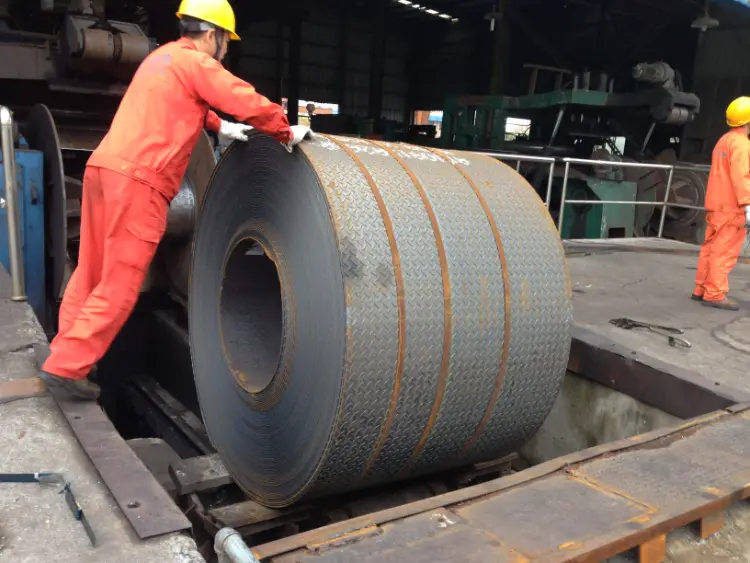
NK F51 (UNS S31803) Duplex Stainless Steel Shipbuilding Coil
NK F51 (UNS S31803) Duplex Stainless Steel Shipbuilding Coil – Comprehensive Material Data
Complete material profile of NK F51 duplex stainless steel coil for shipbuilding, featuring chemical composition, mechanical properties, thermal & electrical characteristics, international equivalents, similar grade alternatives, and application guidance.
Hot rolling, cold rolling, forming, welding, machining (with appropriate tools for duplex steels)
- Phone : +8618037372205
- Email : [email protected]
- WhatsApp: Contact via Whtsapp
- WeChat: +8618037372205
NK F51 Duplex Stainless Steel Shipbuilding Coil Introduction
NK F51 is a duplex stainless steel grade certified by Nippon Kaiji Kyokai (ClassNK) for shipbuilding applications. It corresponds to UNS S31803 (commonly known as 2205), a nitrogen-enhanced 22% chromium duplex stainless steel. The microstructure comprises approximately equal proportions of austenite and ferrite, delivering an outstanding combination of high strength, excellent corrosion resistance (particularly to stress corrosion cracking, pitting, and crevice corrosion), and good weldability. This material is frequently supplied in coil form for the construction of chemical tankers, offshore platforms, and other marine structures exposed to aggressive environments. Its yield strength is about twice that of standard austenitic stainless steels such as 304L, allowing for weight reduction and cost savings. The NK F51 designation ensures compliance with classification society rules for marine service, including low-temperature impact toughness requirements.
NK F51 Duplex Stainless Steel Shipbuilding Coil Chemical Composition
The chemical composition of NK F51 corresponds to UNS S31803 as specified in ASTM A240 and EN 10088-2, with ClassNK approval requiring compliance with both base standards and additional marine service restrictions. Typical values are shown; the nitrogen content is carefully controlled to balance the duplex structure and enhance pitting resistance.
| Element | Standard Value (wt%) | Remarks |
|---|---|---|
| Carbon (C) | ≤0.030 | As per ASTM A240 / NK rules |
| Manganese (Mn) | ≤2.00 | – |
| Silicon (Si) | ≤1.00 | – |
| Phosphorus (P) | ≤0.030 | – |
| Sulfur (S) | ≤0.020 | Typically lower for improved corrosion resistance |
| Chromium (Cr) | 21.0–23.0 | Key ferrite stabiliser; contributes to pitting resistance |
| Nickel (Ni) | 4.5–6.5 | Austenite stabiliser |
| Molybdenum (Mo) | 2.5–3.5 | Enhances pitting and crevice corrosion resistance |
| Nitrogen (N) | 0.08–0.20 | Critical for balanced duplex structure and strength |
| Iron (Fe) | Balance | – |
NK F51 Duplex Stainless Steel Shipbuilding Coil Thermal and Electrical Physical Properties
These physical properties are indicative of UNS S31803 duplex stainless steel at ambient temperature unless otherwise stated. Data serve as a guide for engineering design and are in accordance with published literature and standard references.
| Property | Typical Value | Unit | Condition |
|---|---|---|---|
| Density (ρ) | 7.8 | g/cm³ | At 20°C |
| Elastic Modulus (E) | 200 | GPa | At 20°C |
| Shear Modulus (G) | 77 | GPa | At 20°C (calculated from E and ν) |
| Poisson's Ratio (ν) | 0.3 | – | At 20°C |
| Thermal Expansion Coefficient (α) | 13.0 14.5 | 10−⁰/K | 20–100°C 20–300°C |
| Thermal Conductivity (λ) | 19 22 | W/(m·K) | At 20°C At 250°C |
| Specific Heat Capacity | 500 | J/(kg·K) | At 20°C |
| Electrical Resistivity (ρe) | 0.80 | µΩ·m | At 20°C |
NK F51 Duplex Stainless Steel Shipbuilding Coil Mechanical Properties
The mechanical properties are representative of solution-annealed NK F51 duplex stainless steel at room temperature, derived from ASTM A240 and ClassNK requirements. Actual values must meet the specified minima; impact testing at low temperature is mandatory for shipbuilding to ensure sufficient toughness.
| Property | Standard Requirement | Unit | Test Condition |
|---|---|---|---|
| Yield Strength (0.2% offset, ReH) | ≥450 | MPa | Room temperature, transverse specimen |
| Tensile Strength (Rm) | ≥620 | MPa | Room temperature, transverse specimen |
| Elongation (A50) | ≥25 | % | In 50 mm gauge length |
| Hardness | ≤293 ≤31 | HBW HRC | As per ASTM E10/E18 |
| Impact Energy (Charpy V-notch) | ≥45 (average) ≥35 (individual) | J | At -46°C, longitudinal (typical marine requirement) |
| Bend Test (180°) | No cracks or defects | – | Bend diameter = 3×t (t = specimen thickness) |
NK F51 Duplex Stainless Steel Shipbuilding Coil Fully Equivalent Material Standards and Replaceable Grades
| Country/Region | Standard | Grade | Remarks |
|---|---|---|---|
| International / Marine | NK Rules for Steel Ships (ClassNK) | NK F51 | Direct NK certification for shipbuilding coil/plate; fully equivalent to UNS S31803 |
| USA | ASTM A240/A240M | UNS S31803 | Same chemical and mechanical requirements; widely used as plate, sheet, strip |
| Europe | EN 10088-2 | 1.4462 (X2CrNiMoN22-5-3) | Equivalent duplex 2205 grade; minor differences in composition ranges but interchangeable in practice |
| China | GB/T 3280 | 022Cr22Ni5Mo3N (S22253) | Corresponds to 2205 duplex stainless steel; technically equivalent for shipbuilding after class approval |
| Japan | JIS G 4304 | SUS 329J3L | Japanese standard duplex grade close to 2205; slightly different composition (low C, 22Cr-5.5Ni-3Mo) and regarded as equivalent |
NK F51 Duplex Stainless Steel Shipbuilding Coil Application Introduction
NK F51 coil is extensively utilised in shipbuilding and marine engineering due to its superior corrosion resistance and high strength-to-weight ratio. It is particularly suited for environments where chloride-induced stress corrosion cracking or pitting is a concern. Typical applications include cargo containment systems, pressure hulls, and process equipment. The coil form permits efficient fabrication of large panels, pipes, and formed components.
- Always refer to the latest NK rules for fabrication and testing requirements.
- Welding procedures must be qualified and may employ matching filler metals (e.g., ER2209).
- Adequate post-weld cleaning (pickling/passivation) is critical to restore corrosion resistance.
Product Applications: Cargo tank plates for chemical carriers, Hull plates for ice-strengthened and special-purpose vessels, Coil-processed pressure vessel shells, Large-diameter welded pipes for seawater cooling systems, Structural profiles for offshore platform decks, Clad plate and coil for corrosion-resistant linings
Processed into products: Chemical tanker inner hull panels, Swivel stack assemblies for FPSO, Heat exchanger tube sheets, Piping spools for corrosive fluids, Storage tank shells and roofs, Desalination plant evaporator bodies, Hatch covers and deck fittings exposed to sea spray
Application industries: Shipbuilding (chemical tankers, LPG/LNG carriers, RO-RO decks), Offshore oil & gas (topsides, subsea structures, risers), Desalination and water treatment, Pulp and paper (digesters, bleach equipment), Chemical process industry (reactors, storage tanks, heat exchangers), Architecture and construction (bridge components, coastal infrastructure)
NK F51 Duplex Stainless Steel Shipbuilding Coil Similar / Alternative Material Grades
| Country/Region | Standard | Grade | Remarks |
|---|---|---|---|
| USA / International | ASTM A240 / EN 10088-2 | UNS S32205 (F60) / 1.4462 | Higher-nitrogen version of 2205 with slightly improved strength and corrosion resistance; many standards now merge S31803 and S32205, making this an ideal direct substitute |
| Sweden (proprietary) | – | Sandvik SAF 2205™ | Well-known commercial brand of 22Cr duplex; fully compatible with NK F51 and widely used in marine chemical tankers |
| USA | ASTM A789 / A790 | UNS S31803 pipe/tube | Seamless and welded tubular products in same duplex grade; can serve as piping alternative in ship systems |
| Europe | EN 10088-3 | 1.4462 (bars & sections) | Forging/flat bars of the same duplex grade for structural components, fully compatible with plate material |
Notes:
Certification: ClassNK approval stamping and certification is typically required alongside mill test certificates. Welding: Duplex stainless steels require controlled heat input (0.5–2.5 kJ/mm) and interpass temperature (≤150°C) to maintain phase balance. NDT: Ultrasonic testing and ferrite content measurement may be specified. Surface condition: Coil should be supplied as pickled and passivated. For shipyard storage, protect from iron contamination which may cause pitting in service. Regulatory compliance: IMO regulations for chemical tankers (e.g., IBC Code) may require demonstrated corrosion resistance through specific tests.
- Share



