
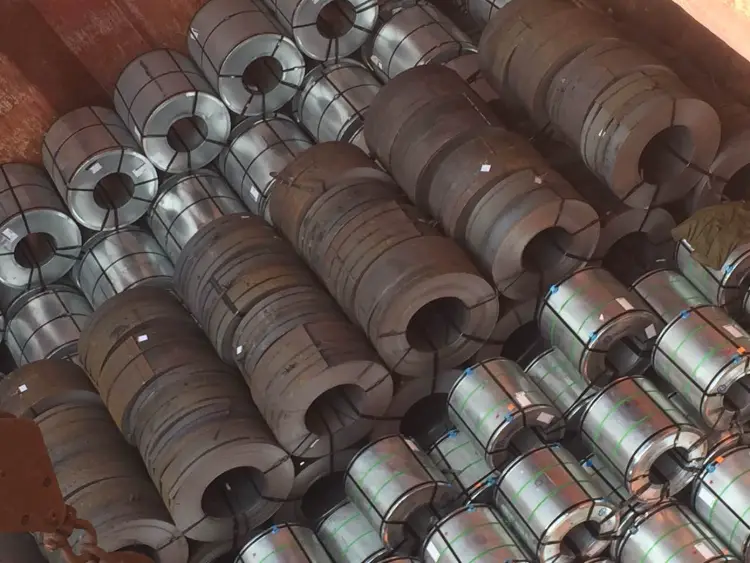
NK E51 Shipbuilding Steel Coil
NK E51 Shipbuilding Steel Coil - Low-Temperature High-Strength Grade for Ice-Class Vessels
Detailed material data for NK E51 shipbuilding steel coil: chemical composition, mechanical properties, thermal and electrical physical properties, international equivalents, and applications in marine construction.
Suitable for welding, cutting, bending, forming, and cold working; typical manufacturing processes include controlled rolling (TMCP) and normalising.
- Phone : +8618037372205
- Email : [email protected]
- WhatsApp: Contact via Whtsapp
- WeChat: +8618037372205
NK E51 Shipbuilding Steel Coil Introduction
NK E51 is a high-strength shipbuilding structural steel grade certified by Nippon Kaiji Kyokai (ClassNK). It is designed for critical hull components operating in low-temperature environments, offering a minimum yield strength of 355 MPa and a minimum tensile strength of 510 MPa. The steel exhibits excellent notch toughness at -40°C, ensuring reliable performance in ice-class ships and offshore structures. Key features include:
- Superior weldability and formability for complex ship geometries
- Consistent through-thickness properties achieved by controlled rolling or normalising
- Compliance with the NK Rules for the Survey and Construction of Steel Ships, guaranteeing stringent quality standards
NK E51 Shipbuilding Steel Coil Chemical Composition
The chemical composition of NK E51 is controlled to achieve high strength while maintaining excellent weldability and low-temperature toughness. The limits are in accordance with NK Rules for high‑strength shipbuilding steels, with additional microalloying elements (Nb, V, Ti) permitted to refine the grain structure. Key aspects:
- Low carbon content reduces susceptibility to cold cracking in welded joints
- Manganese is optimised to balance strength and ductility
- Strict control of phosphorus and sulphur ensures cleanliness and isotropic properties
| Element | Specification (wt%) | Remarks |
|---|---|---|
| Carbon (C) | ≤ 0.18 | Ladle analysis; typical aim 0.10–0.16 |
| Silicon (Si) | 0.10 – 0.50 | Deoxidation and strength refinement |
| Manganese (Mn) | 0.90 – 1.60 | Higher Mn for guaranteed tensile strength ≥ 510 MPa |
| Phosphorus (P) | ≤ 0.035 | For optimum toughness and resistance to embrittlement |
| Sulfur (S) | ≤ 0.035 | Low sulphur improves through‑thickness ductility |
| Chromium (Cr) | ≤ 0.20 | Residual element; not intentionally added |
| Nickel (Ni) | ≤ 0.80 | May be added to enhance low‑temperature toughness |
| Molybdenum (Mo) | ≤ 0.08 | Residual unless specified |
| Copper (Cu) | ≤ 0.35 | Residual from scrap |
| Niobium (Nb) | ≤ 0.05 | Grain refinement microalloy |
| Vanadium (V) | ≤ 0.10 | Optional precipitation hardening element |
| Titanium (Ti) | ≤ 0.02 | For nitrogen fixation and grain size control |
| Aluminium (Al) | ≥ 0.015 (acid soluble) | Guarantees fine grain practice |
NK E51 Shipbuilding Steel Coil Thermal and Electrical Physical Properties
The following physical properties are provided for design and processing calculations. They are typical for low‑alloy fine‑grain shipbuilding steels of this strength class and are not part of the mandatory NK specification. Important notes:
- Density is a key input for weight estimation
- Thermal conductivity and expansion influence welding residual stresses
- Electrical resistivity is relevant for corrosion protection systems
| Property | Approximate Value | Unit | Condition / Reference |
|---|---|---|---|
| Density (ρ) | 7.85 | g/cm³ | 20 °C |
| Modulus of elasticity (E) | 205 | GPa | 20 °C |
| Shear modulus (G) | 80 | GPa | 20 °C |
| Poisson's ratio (ν) | 0.3 | – | 20 °C |
| Thermal expansion coeff. (α) | 12.0 | ×10⁻⁶ /K | 20–100 °C |
| Thermal conductivity (λ) | 43 | W/(m·K) | 100 °C |
| Specific heat capacity | 0.46 | J/(g·K) | 20 °C |
| Electrical resistivity (ρ_e) | 0.18 – 0.22 | μΩ·m | 20 °C |
NK E51 Shipbuilding Steel Coil Mechanical Properties
Mechanical properties are determined on transverse test pieces taken from the delivery condition (normalised or TMCP). The guarantees comply with NK Rules and ensure structural integrity under static and dynamic loads. Notable characteristics:
- Yield strength is guaranteed for thicknesses up to 50 mm; for heavier sections a slight reduction applies
- High impact energy at -40°C confirms suitability for ice‑class notation
- Excellent bendability for forming operations
| Property | Specified Value | Unit | Test Condition |
|---|---|---|---|
| Yield strength (ReH) | ≥ 355 | MPa | Transverse, thickness ≤ 50 mm |
| Tensile strength (Rm) | 510 – 650 | MPa | Room temperature, transverse |
| Elongation (A5) | ≥ 21 | % | Gauge length 5.65√So, thickness ≤ 50 mm |
| Bend test (diameter) | d = 3a (180°) | – | No cracks; a = specimen thickness |
| Impact energy (KV₂) | ≥ 34 (individual) | J | Longitudinal, -40 °C |
| Impact energy (KV₂) | ≥ 27 (average) | J | Longitudinal, -40 °C |
NK E51 Shipbuilding Steel Coil Completely Equivalent Material Standards / Substitutable Grades
| Country/Region | Standard / Class | Grade | Remarks |
|---|---|---|---|
| International (ClassNK) | NK Rules | KE36 (enhanced) | Identical NKK E51 when tensile strength is specified as 510–650 MPa |
| International (Lloyd's Register) | LR Rules | EH36Mod | Grade specially approved for minimum UTS 510 MPa at -40°C |
| International (DNV) | DNV Rules | NVE36 (modified) | Modification required in material certificate for 510 MPa min. tensile |
NK E51 Shipbuilding Steel Coil Application Introduction
NK E51 steel is engineered for structural applications where high yield strength, reliable sub‑zero toughness, and excellent weldability are simultaneously required. Typical application areas include:
- Shell plating and longitudinal stiffeners of ice‑going vessels
- Decks and bottom structures exposed to low air and water temperatures
- Heavy‑duty ship cranes and hatch coamings
Product Applications: Ice‑class tankers and bulk carriers, Polar research vessels and icebreakers, Offshore platform deck structures and pontoon components, Large‑diameter welded pipe for subsea applications
Processed into products: Main deck plating and longitudinal girders, Bottom and side shell plating (above and below ice belt), Transverse bulkheads and web frames, Rudder horns, stern frames, and sea chest inserts, Towing brackets and bollard foundations
Application industries: Shipbuilding (merchant, naval, and special‑purpose vessels), Offshore oil & gas (FPSOs, semi‑submersibles, ice‑resistant platforms), Marine infrastructure (ice breakers, Arctic supply ships), Heavy engineering (welded structures in cold climates)
NK E51 Shipbuilding Steel Coil Similar / Near-Equivalent Materials for Reference
| Country/Region | Standard / Class | Grade | Remarks |
|---|---|---|---|
| Multi-class | NK/CCS/ABS/DNV/LR/BV | EH36 | Yield 355 MPa, tensile 490–620 MPa; slightly lower min. UTS; -40°C impact |
| Japan | JIS G 3106 | SM490YB | Tensile 490–610 MPa, available with low‑C; need to specify low‑temperature toughness separately |
| Multi-class | NK/CCS/ABS/DNV/LR/BV | EH40 | Yield 390 MPa, tensile 510–660 MPa; higher strength alternative for weight reduction |
| Europe | EN 10025‑4 | S460M/ML | Higher strength, requires additional toughness agreement at -40°C for ship use |
Notes:
The NK E51 designation may appear in older project specifications or shipyard material codes. It essentially represents an EH36‑grade steel with a guaranteed minimum tensile strength of 510 MPa. Users are advised to confirm the specific impact test temperature and minimum absorbed energy with the class surveyor, as additional requirements may apply for polar class notations (e.g., -60°C impact testing). All welding procedures should be qualified following NK guidelines using low‑hydrogen consumables and appropriate preheat/interpass temperatures.
- Share



