
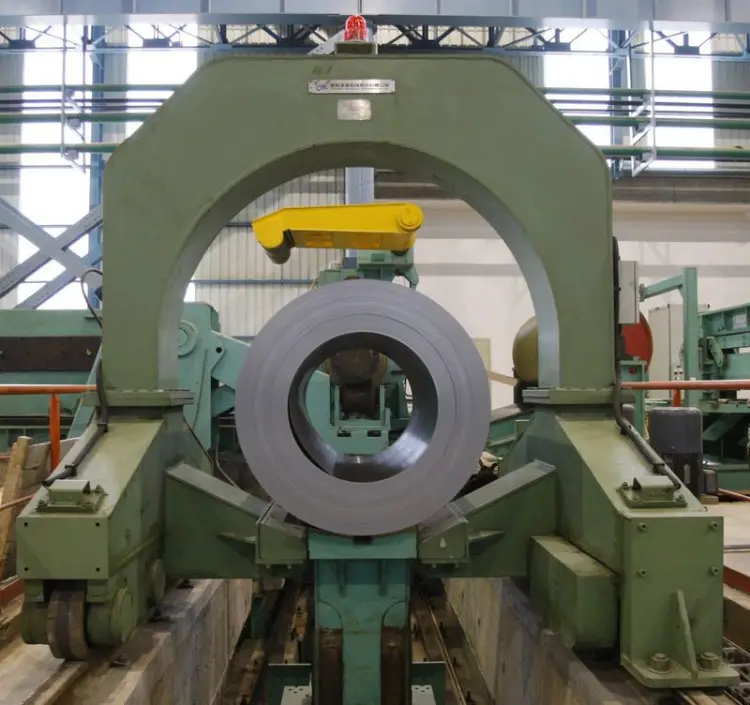
NK A63 Shipbuilding Steel Coil
NK A63 Shipbuilding Steel Coil – High-Strength Hull Structural Steel with Min 63 ksi Yield
NK A63 is a high-strength shipbuilding steel coil certified by ClassNK, offering minimum yield strength of 63 ksi (435 MPa) for hull and offshore structures.
Hot rolling, TMCP, normalizing, cutting, welding, forming
- Phone : +8618037372205
- Email : [email protected]
- WhatsApp: Contact via Whtsapp
- WeChat: +8618037372205
NK A63 Shipbuilding Steel Coil Introduction
NK A63 shipbuilding steel coil is a high-strength hull structural steel grade approved by Nippon Kaiji Kyokai (ClassNK) under Part K of its Rules for the Survey and Construction of Steel Ships. The designation A63 denotes an impact test temperature of 0°C (A-class toughness) and a minimum yield strength of 63 ksi (approximately 435 MPa). It is designed for primary structural members in ships and offshore units where high strength and good weldability are essential.
- Key features: Excellent combination of strength and ductility, reliable low-temperature toughness, controlled carbon equivalent for superior weldability, and consistent mechanical properties across a wide thickness range (up to 100 mm).
- Typical delivery condition: Hot-rolled, normalized, or thermo-mechanical controlled processed (TMCP), ensuring fine grain structure and homogeneity.
- Certification: Each coil is supplied with ClassNK inspection certificates, making it suitable for newbuilding and repair projects worldwide.
NK A63 Shipbuilding Steel Coil Chemical Composition
Chemical composition conforms to NK Rules Part K for high-strength steel. The steel is typically grain-refined with microalloying elements such as Nb, V, Ti, and Al. Carbon equivalent (Ceq) is controlled to ≤0.38% (for thickness ≤50 mm) to ensure good weldability.
| Element | Content (wt%) | Remarks |
|---|---|---|
| Carbon (C) | ≤ 0.20 | max |
| Silicon (Si) | 0.10 – 0.50 | range |
| Manganese (Mn) | 0.90 – 1.60 | range |
| Phosphorus (P) | ≤ 0.025 | max |
| Sulfur (S) | ≤ 0.025 | max |
| Chromium (Cr) | ≤ 0.20 | max |
| Nickel (Ni) | ≤ 0.40 | max |
| Copper (Cu) | ≤ 0.35 | max |
| Molybdenum (Mo) | ≤ 0.08 | max |
| Vanadium (V) | ≤ 0.10 | max |
| Niobium (Nb) | ≤ 0.05 | max |
| Titanium (Ti) | ≤ 0.05 | max |
| Aluminium (Als) | ≥ 0.015 (total Al) | min grain refining |
| Nitrogen (N) | ≤ 0.012 | max |
NK A63 Shipbuilding Steel Coil Thermal and Electrical Physical Properties
Physical properties listed below are typical for carbon‑manganese structural steel and are not specified in NK Rules. They serve as engineering reference for design and processing.
| Property | Typical Value | Unit | Condition |
|---|---|---|---|
| Density (ρ) | 7.85 | g/cm³ | 20 °C |
| Elastic modulus (E) | 205 | GPa | 20 °C |
| Shear modulus (G) | 80 | GPa | 20 °C |
| Poisson's ratio (ν) | 0.3 | – | 20 °C |
| Thermal expansion coefficient (α) | 12.0 × 10⁻⁶ | /K | 20–100 °C |
| Thermal conductivity (λ) | 50 | W/(m·K) | 20 °C |
| Specific heat capacity | 460 | J/(kg·K) | 20 °C |
| Electrical resistivity (ρₑ) | 0.22 × 10⁻⁶ | Ω·m | 20 °C |
NK A63 Shipbuilding Steel Coil Mechanical Properties
Mechanical testing is performed according to NK Rules. Tensile specimens are taken in the longitudinal direction. Bend test requirements depend on plate thickness; the bend angle is 180° and no cracks are allowed. Impact test temperature is 0 °C for A-grade.
| Property | Standard Requirement | Unit | Test Condition |
|---|---|---|---|
| Yield strength (ReH) | ≥ 435 | MPa | t ≤ 100 mm |
| Tensile strength (Rm) | 540 – 655 | MPa | t ≤ 100 mm |
| Elongation (A) | ≥ 18 | % | t ≤ 50 mm, gauge 5.65√So |
| Elongation (A) | ≥ 17 | % | 50 < t ≤ 70 mm |
| Elongation (A) | ≥ 16 | % | 70 < t ≤ 100 mm |
| Charpy impact (KV, long.) | ≥ 34 | J | 0 °C |
| Bend test (180°) d=3t | No cracks | – | t ≤ 25 mm |
| Bend test (180°) d=4t | No cracks | – | 25 < t ≤ 35 mm |
| Bend test (180°) d=5t | No cracks | – | 35 < t ≤ 50 mm |
| Bend test (180°) d=6t | No cracks | – | 50 < t ≤ 70 mm |
| Bend test (180°) d=7t | No cracks | – | 70 < t ≤ 100 mm |
NK A63 Shipbuilding Steel Coil Equivalent Material Standards and Substitute Grades
| Country / Region | Standard | Grade | Remarks |
|---|---|---|---|
| Japan | NK Rules Part K | AH63 (NK A63) | Original designation |
| USA | ABS Rules | AH63 | Same strength and toughness class |
| France | BV Rules | AH63 | Bureau Veritas equivalent |
| UK | LR Rules | AH63 | Lloyd's Register equivalent |
| China | CCS Rules | AH63 | China Classification Society |
| Italy | RINA Rules | AH63 | Registro Italiano Navale |
| South Korea | KR Rules | AH63 | Korean Register |
| Germany / Norway | DNV Rules | VL A63 (NV A63) | DNV A-grade, check latest issue (may be designated VL A63) |
NK A63 Shipbuilding Steel Coil Application Introduction
NK A63 steel coil is extensively applied in the shipbuilding and offshore industries. Its high strength allows weight reduction while maintaining structural integrity. The steel can be cold formed and welded using approved procedures, facilitating efficient fabrication of large and complex structures.
Product Applications: Bulk carriers and tankers, Container ships and Ro‑Ro vessels, Offshore accommodation modules, Semi‑submersible rigs and jack‑up legs, Hull and deck panels for large yachts
Processed into products: Hull plates (keel, side shell, bottom), Strength decks and weather decks, Longitudinal and transverse bulkheads, Web frames and stiffeners, Bottom girders and floors, Hatch coamings and crane pedestals, Rudder horns and stern frames
Application industries: Shipbuilding (merchant ships, naval vessels), Offshore engineering (platforms, FPSOs, jackets), Marine renewable energy (wind turbine foundations), Heavy structural engineering (bridges, pressure vessels where marine approval is accepted)
NK A63 Shipbuilding Steel Coil Similar / Alternative Material Recommendations
| Country / Region | Standard | Grade | Remarks |
|---|---|---|---|
| Japan | NK Rules Part K | AH56 | Slightly lower minimum YS (≥ 550 MPa); good weldability; suitable for less critical structural parts |
| Japan | NK Rules Part K | DH63 | Same strength, impact test at −20 °C, improved toughness for colder environments |
| Japan | NK Rules Part K | EH63 | Same strength, impact test at −40 °C, for severe low‑temperature applications |
| Europe | EN 10025‑6 | S690QL | Quenched and tempered steel with YS ≥ 690 MPa; not ship‑class certified unless specially approved |
| USA | ASTM A514/A514M | Grade B, H, etc. | High‑strength Q&T alloy steel (YS ≥ 690 MPa); requires supplementary approval for marine use |
Notes:
Welding: Preheat and interpass temperature must be controlled according to approved welding procedure specifications. Low‑hydrogen processes are recommended. Formability: The steel exhibits good cold formability; however, for severe deformation, intermediate stress relief may be considered. Corrosion protection: Standard marine coating systems should be applied; the steel is not inherently corrosion resistant. Certification: All coils are supplied with ClassNK 3.2 or 3.1 certificates as required. Carbon equivalent: Typically ≤ 0.38% for thicknesses up to 50 mm, supporting good weldability without excessive preheat.
- Share



