
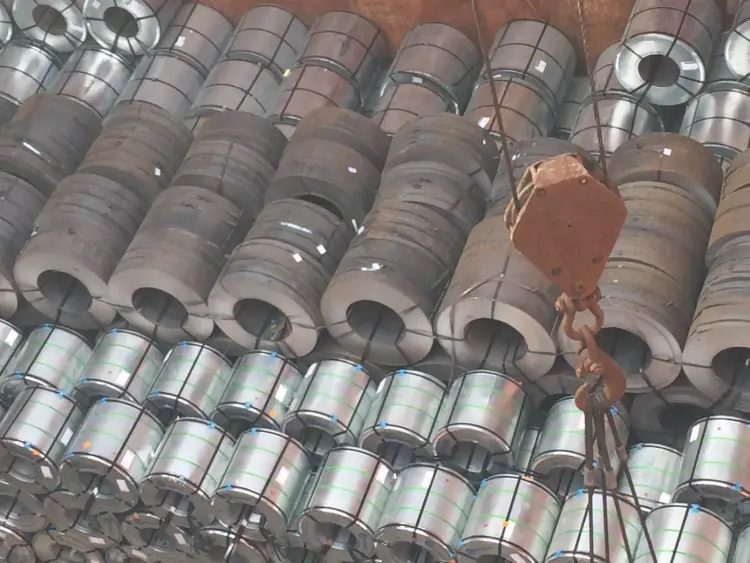
NK F47 Shipbuilding Steel Coil
NK F47 Shipbuilding Steel Coil: High-Strength Marine Structural Steel with -60°C Toughness
Comprehensive data for NK F47 shipbuilding steel coil certified by Nippon Kaiji Kyokai (ClassNK), featuring minimum yield strength 460 MPa and low-temperature F-class toughness. Includes chemical, mechanical, thermal, equivalences and application guidance.
Hot rolling, Thermo-mechanical controlled processing (TMCP), Normalizing rolling, Quenching and tempering (Q&T)
- Phone : +8618037372205
- Email : [email protected]
- WhatsApp: Contact via Whtsapp
- WeChat: +8618037372205
NK F47 Shipbuilding Steel Coil Introduction
NK F47 is a high-strength shipbuilding steel coil grade certified by Nippon Kaiji Kyokai (ClassNK). It possesses a minimum yield strength of 460 MPa (approximately 47 kgf/mm²) and is designated with the 'F' toughness class, ensuring reliable performance down to -60°C. Manufactured via advanced thermo-mechanical controlled processing (TMCP) or quenching and tempering (Q&T), this steel combines excellent weldability with good corrosion resistance. It is a preferred material for critical hull and offshore structural components subject to high stress and low-temperature service conditions.
NK F47 Shipbuilding Steel Coil Chemical Composition
The following maximum (or minimum, where indicated) values are specified by ClassNK for F47 grade high-strength steel. Microalloying elements such as Nb, V, Ti, and Al are used to achieve fine grain size and excellent toughness. Note: Product analysis may show slight variations within permitted tolerances.
| Element | Standard Value | Remarks |
|---|---|---|
| Carbon (C) | ≤0.18 | max |
| Silicon (Si) | ≤0.55 | max |
| Manganese (Mn) | ≤1.60 | max |
| Phosphorus (P) | ≤0.025 | max |
| Sulfur (S) | ≤0.025 | max |
| Aluminium (Al, total) | ≥0.020 | min, for fine grain treatment |
| Niobium (Nb) | ≤0.05 | max |
| Vanadium (V) | ≤0.10 | max |
| Titanium (Ti) | ≤0.02 | max |
| Chromium (Cr) | ≤0.25 | max |
| Nickel (Ni) | ≤0.40 | max |
| Molybdenum (Mo) | ≤0.10 | max |
| Copper (Cu) | ≤0.30 | max |
| Nitrogen (N) | ≤0.012 | max (if no N-binding elements present) |
| Boron (B) | ≤0.0005 | max, optional hardening element |
NK F47 Shipbuilding Steel Coil Physical Properties
These physical properties are typical for low-alloy quenched and tempered steels of this strength class and are not part of the ClassNK mandatory specification. They serve as engineering reference data.
| Property | Value | Unit | Condition / Temperature |
|---|---|---|---|
| Density (ρ) | 7850 | kg/m³ | 20°C |
| Modulus of elasticity (E) | 200 – 210 | GPa | 20°C |
| Shear modulus (G) | 80 | GPa | Estimated |
| Poisson's ratio (ν) | 0.3 | — | Elastic range |
| Thermal expansion coefficient (α) | 11.7 × 10⁻⁶ | /K | 20 – 100°C |
| Thermal conductivity (λ) | 42 | W/(m·K) | 20°C |
| Specific heat capacity (c) | 460 | J/(kg·K) | 20°C |
| Electrical resistivity (ρₑ) | 0.15 – 0.25 | µΩ·m | 20°C |
NK F47 Shipbuilding Steel Coil Mechanical Properties
The mechanical characteristics reflect the minimum requirements for quenched and tempered (Q&T) or TMCP NK F47 steel coils and plates. Testing is performed on transverse specimens. Impact test energy is measured at -60°C on V-notch Charpy samples. The bending test is carried out on a mandrel diameter of 3t (t = thickness) for material ≤12 mm.
| Property | Standard Requirement | Unit | Condition / Comments |
|---|---|---|---|
| Yield strength (ReH) | ≥ 460 | MPa | Thickness ≤ 50 mm |
| Yield strength (ReH) | ≥ 440 | MPa | Thickness > 50 mm and ≤ 100 mm |
| Yield strength (ReH) | ≥ 420 | MPa | Thickness > 100 mm and ≤ 200 mm |
| Tensile strength (Rm) | 570 – 720 | MPa | All thicknesses |
| Elongation (A5) | ≥ 17 | % | Transverse, gauge length 5.65√S0, thickness ≤ 50 mm |
| Elongation (A5) | ≥ 14 | % | Transverse, thickness > 50 mm |
| Charpy impact energy (KV) | ≥ 46 | J | at -60°C, transverse specimen, thickness ≤ 50 mm |
| Charpy impact energy (KV) | ≥ 34 | J | at -60°C, transverse specimen, thickness > 50 mm |
| Bending (180°) | d = 3t | — | Mandrel diameter 3 times plate thickness (t ≤ 12 mm) |
NK F47 Shipbuilding Steel Coil Exact Material Equivalents: Same Grade under Different Classification Societies
| Country / Region | Standard / Classification Society | Grade | Remarks |
|---|---|---|---|
| Japan | NK (Nippon Kaiji Kyokai) | NK F47 | Original designation |
| Multi-national | DNV GL (now DNV) | FH460 | Equivalent to NV F460 / VL F460 |
| USA | ABS (American Bureau of Shipping) | FH460 | Extra-high strength hull steel |
| UK | LR (Lloyd's Register) | FH460 | Identical mechanical and chemical requirements |
| France | BV (Bureau Veritas) | FH460 | Grade FH460 steel plates/coils |
| Korea | KR (Korean Register) | FH460 | Equivalent to KR FH460 |
| China | CCS (China Classification Society) | FH460 | Grade FH460 as per CCS Rules |
| Russia | RS (Russian Maritime Register) | FH460 | Approved material for ship structures |
NK F47 Shipbuilding Steel Coil Application Introduction
NK F47 steel coils are designed for demanding marine and offshore environments where high strength and resistance to brittle fracture at sub-zero temperatures are paramount. The material delivers an optimal combination of weldability, toughness, and strength, enabling reliable fabrication of large critical structures.
Product Applications: Hull shell plating and bottom structures of large vessel, Main deck and stringer plates, Web frames and transverse bulkheads, Hatch coaming girders, Longitudinal stiffeners and girders, Helideck support structures, Jack-up leg components (chord and bracing members)
Processed into products: Cut-to-length plates for shipyards (hull blocks), Welded built-up sections (T-beams, I-girders), Rolled and welded pipe for offshore legs, Brackets and reinforcements for high-stress zones, Transverse rings and floors in double-bottom structures
Application industries: Commercial shipbuilding (container ships, bulk carriers, oil and chemical tankers), Naval vessel construction, Offshore oil and gas (jack-up rigs, semi-submersibles, FPSO hulls), Arctic marine engineering, Renewable offshore energy (wind turbine foundation structures)
NK F47 Shipbuilding Steel Coil Similar / Nearly Equivalent Material Grades
| Country / Region | Standard | Grade | Remarks / Differences |
|---|---|---|---|
| EU | EN 10025-6 | S460Q / S460QL | Weldable fine grain structural steel; quenched and tempered; not specifically marine certified, but similar strength; toughness down to -40°C (QL). |
| USA | ASTM A572 / A572M | Grade 70 | High-strength low-alloy structural steel; min YS 485 MPa; does not guarantee low-temperature toughness below -30°C; not for shipbuilding without supplementary requirements. |
| EU | EN 10225 | S460G2+M | Weldable structural steel for offshore structures; normalized or TMCP; YS 460 MPa; weldable; some offshore certifications require impact at -40°C. |
| International | IACS (multiple class) | FH420 | Lowest strength in the extra-high strength series; YS 420 MPa; may be used when design allows lower strength; same F-class toughness. |
| USA / International | ABS / DNV / LR etc. | EH460 | Identical strength, but impact test temperature of -40°C (E-class) instead of -60°C. |
Notes:
Welding of NK F47 demands low-hydrogen processes (SMAW, SAW, FCAW, GMAW) and appropriate preheat/interpass temperatures to avoid cold cracking, especially for thicker sections ( >40 mm). Post-weld heat treatment is generally not required for thickness below 50 mm. For details on Charpy impact test acceptance criteria and sulphur/silicon fine print, the latest ClassNK Rules Part K should be consulted. Surfacing by thermal spray or protective coatings is recommended for prolonged exposure to aggressive marine environments.
- Share



