
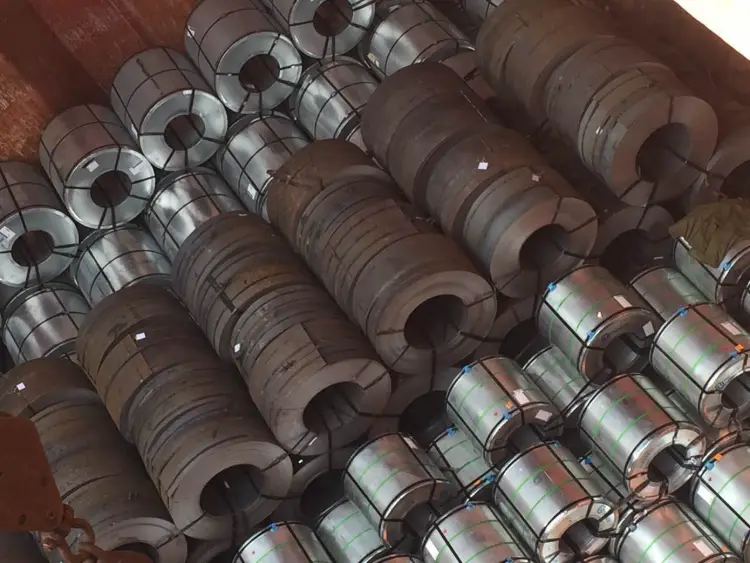
NK E47 Shipbuilding Steel Coil
NK E47 Shipbuilding Steel Coil: High-Strength Marine Structural Steel (ClassNK)
Comprehensive material data for NK E47 shipbuilding steel coil: chemical composition, mechanical properties, thermal and electrical properties, international equivalents, and application guidance.
Welding, cutting, forming, bending, machining, shot blasting
- Phone : +8618037372205
- Email : [email protected]
- WhatsApp: Contact via Whtsapp
- WeChat: +8618037372205
NK E47 Shipbuilding Steel Coil Introduction
NK E47 is a high-strength hull structural steel grade recognized by ClassNK (Nippon Kaiji Kyokai) under its Rules for the Survey and Construction of Steel Ships. It is a killed, fine-grain steel with a minimum yield strength of 460 MPa, designed for critical ship and offshore structures that require excellent weldability, high load-bearing capacity, and reliable toughness at low temperatures down to -40 °C. The steel is typically supplied in thermomechanically rolled (TMCP) or normalized condition, and it is widely used in the construction of container ships, bulk carriers, tankers, and offshore platforms.
NK E47 Shipbuilding Steel Coil Chemical Composition
The chemical composition of NK E47 steel is controlled to ensure high strength, good weldability, and low‑temperature toughness. Carbon equivalent (Ceq) is restricted to avoid cold cracking. Microalloying elements such as niobium, vanadium, and titanium are added for grain refinement and precipitation strengthening.
| Element | Specified Value (wt%) | Remarks |
|---|---|---|
| C | ≤0.18 | |
| Mn | 0.90–1.60 | |
| Si | ≤0.50 | |
| P | ≤0.035 | |
| S | ≤0.035 | |
| Al (acid soluble) | ≥0.015 | Minimum for fine‑grain practice |
| Nb | 0.02–0.05 | |
| V | 0.05–0.10 | |
| Ti | ≤0.02 | |
| Cu | ≤0.35 | Residual |
| Cr | ≤0.20 | Residual |
| Ni | ≤0.40 | Residual |
| Mo | ≤0.08 | Residual |
| Ceq | ≤0.43 | C + Mn/6 + (Cr+Mo+V)/5 + (Ni+Cu)/15 |
NK E47 Shipbuilding Steel Coil Thermal and Electrical Physical Properties
The physical constants listed below are representative for low‑alloy structural steels of similar composition and are not specified by ClassNK rules. They serve as engineering reference for design and process simulation.
| Property | Typical Value | Unit | Test Condition |
|---|---|---|---|
| Density (ρ) | 7.85 | g/cm³ | Room temperature |
| Modulus of Elasticity (E) | 205 | GPa | Room temperature |
| Shear Modulus (G) | 79 | GPa | Room temperature |
| Poisson's Ratio (ν) | 0.3 | — | Room temperature |
| Thermal Expansion Coefficient (α) | 12.0 | 10⁻⁶/K | 20–100 °C |
| Thermal Conductivity (λ) | 50 | W/(m·K) | Room temperature |
| Specific Heat Capacity (c) | 460 | J/(kg·K) | Room temperature |
| Electrical Resistivity (ρ_e) | 0.25 | μΩ·m | Room temperature |
NK E47 Shipbuilding Steel Coil Mechanical Properties
The following mechanical properties apply to NK E47 steel coil/plate in the delivery condition. Values are for transverse test specimens unless otherwise noted. Impact toughness is verified at -40 °C to ensure resistance to brittle fracture in cold marine environments.
| Property | Required Value | Unit | Test Condition |
|---|---|---|---|
| Yield Strength (ReH, min) | 460 | MPa | t ≤ 50 mm, transverse |
| Tensile Strength (Rm) | 570–720 | MPa | t ≤ 50 mm |
| Elongation (A, min) | 17 | % | t ≤ 50 mm, gauge length 5.65√So |
| Impact Energy (KV, min, longitudinal) | 50 | J | -40 °C, t ≤ 50 mm |
| Impact Energy (KV, min, transverse) | 34 | J | -40 °C, t ≤ 50 mm |
| Bend Test | d=3a, 180° no cracks | — | t ≤ 50 mm |
NK E47 Shipbuilding Steel Coil Fully Equivalent Material Standards and Substitute Grades
| Country / Region | Standard | Grade | Remarks |
|---|---|---|---|
| International (IACS) | UR W11 | E47 | Common base for classification society rules |
| United Kingdom | Lloyd's Register Rules | LR EH47 | Identical toughness and strength requirements |
| USA | ABS Rules | ABS EH47 | |
| Norway / Germany | DNV Rules (DNVGL) | DNV E47 | Formerly NV E47 |
| France | Bureau Veritas Rules | BV EH47 | |
| Italy | RINA Rules | RINA E47 | |
| China | CCS Rules | CCS EH47 | |
| South Korea | KR Rules | KR EH47 | |
| Russia | RMRS Rules | RS E47 | Equivalent strength class, -40 °C toughness |
NK E47 Shipbuilding Steel Coil Application Introduction
NK E47 is primarily used in welded ship and offshore structures where high strength, excellent weldability, and reliable low‑temperature toughness are essential. It is suitable for cold forming and welding with standard shipyard procedures, including submerged‑arc, flux‑cored, and manual metal‑arc welding with low‑hydrogen consumables. Preheating may be required for thick sections or high restraint conditions.
Product Applications: Container ships, Bulk carriers, Oil/chemical tankers, LNG/LPG carriers, Offshore platforms (jack‑ups, semi‑submersibles), FPSO hulls, Marine cranes and lifting equipment
Processed into products: Strength deck plates, Bottom and side shell plates, Bilge strakes and sheer strakes, Longitudinal and transverse frames, Web frames and bulkhead stiffeners, Hatch coamings and corners, Rudder horns and stern frames, Foundation plates for main engines and thrusters
Application industries: Shipbuilding, Offshore Engineering, Marine and Harbor Construction, Heavy Structural Fabrication
NK E47 Shipbuilding Steel Coil Similar / Alternative Materials for Reference
| Country / Region | Standard | Grade | Remarks |
|---|---|---|---|
| International | IACS UR W11 | EH36 | Lower yield strength (355 MPa), same -40 °C toughness, may be used if strength requirements permit |
| International | IACS UR W11 | DH47 | Same yield strength (460 MPa), higher test temperature (-20 °C), suitable where cold toughness is less critical |
| International | IACS UR W11 | FH47 | Same yield strength, superior toughness at -60 °C, for extreme cold service |
| Europe | EN 10025-4 | S460MLO | TMCP fine‑grain steel for offshore structures, similar strength, Charpy at -40 °C per option |
| International | API 2W / 2Y | API 2Y-50 | Offshore structural steel, min yield 345–414 MPa (50 ksi class), comparable toughness but lower strength |
Notes:
Through‑thickness properties (Z25, Z35) can be specified for structural elements subjected to high lamellar tearing risk. Approval by ClassNK surveyor is required for material certification. All welding procedures must be qualified according to ClassNK rules. For thicknesses above 50 mm, slightly reduced strength requirements and higher impact energy values may apply; refer to the latest ClassNK Part K tables.
- Share



