
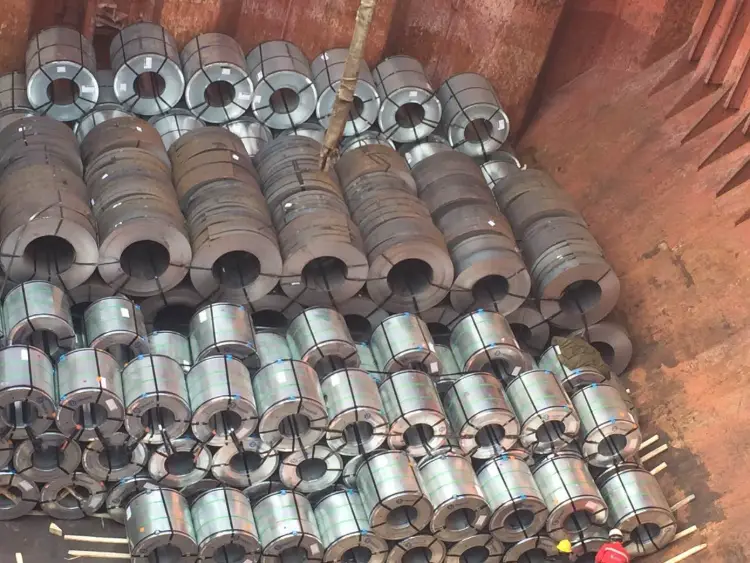
NK D47 Shipbuilding Steel Coil
NK D47 Shipbuilding Steel Coil - High Strength Hull Structural Steel per ClassNK Rules
NK D47 is a high strength shipbuilding steel grade certified by Nippon Kaiji Kyokai (ClassNK) with a minimum yield strength of 460 MPa, excellent low‑temperature toughness, and good weldability for critical hull structures.
Hot rolling, Normalizing, Thermo‑Mechanical Control Process (TMCP), Quenching & Tempering (optionally)
- Phone : +8618037372205
- Email : [email protected]
- WhatsApp: Contact via Whtsapp
- WeChat: +8618037372205
NK D47 Shipbuilding Steel Coil Introduction
NK D47 is a normalized or thermo‑mechanically controlled processed (TMCP) structural steel coil specifically developed for shipbuilding and offshore applications under the rules of ClassNK (Nippon Kaiji Kyokai). The designation 'D' indicates that the steel guarantees impact toughness at a test temperature of -20 °C, while '47' corresponds to a minimum yield strength of 47 kgf/mm² (approx. 460 MPa). This grade offers an excellent combination of high strength, superior weldability, and reliable low‑temperature performance, making it ideal for highly stressed hull members, deck plates, and bottom shells in large container ships, bulk carriers, and offshore structures. Typical delivery conditions include normalizing, TMCP, or controlled rolling, ensuring homogeneous mechanical properties across the coil thickness.
- Yield strength ≥ 460 MPa, tensile strength typically 570 – 720 MPa
- Charpy V‑notch impact energy ≥ 31 J at -20 °C (longitudinal)
- Excellent weldability with preheating recommendations well established
- Available in hot‑rolled coils for further cutting and forming
NK D47 Shipbuilding Steel Coil Chemical Composition
The chemical composition of NK D47 is balanced to achieve high strength while maintaining good weldability and low‑temperature toughness. Micro‑alloying elements such as niobium, vanadium, and titanium are used for grain refinement and precipitation strengthening. The values listed below are typical ranges derived from ClassNK Rules Part K and common steelmaking practices for this grade.
| Element | Standard Value (wt%) | Remarks |
|---|---|---|
| Carbon (C) | ≤ 0.18 | Max. to ensure weldability |
| Silicon (Si) | ≤ 0.55 | Deoxidation and strength |
| Manganese (Mn) | 1.00 – 1.60 | Main strengthening element |
| Phosphorus (P) | ≤ 0.030 | Strict control for toughness |
| Sulfur (S) | ≤ 0.030 | Low for reduced hot cracking |
| Copper (Cu) | ≤ 0.35 | Optional; improves corrosion resistance |
| Chromium (Cr) | ≤ 0.20 | Residual or intentionally added |
| Nickel (Ni) | ≤ 0.40 | Improves low‑temperature toughness |
| Molybdenum (Mo) | ≤ 0.08 | Contributes to hardenability |
| Niobium (Nb) | 0.02 – 0.05 | Grain refiner and precipitate strengthener |
| Vanadium (V) | 0.05 – 0.10 | Precipitation strengthening |
| Titanium (Ti) | ≤ 0.02 | Grain refinement, also fixes nitrogen |
| Aluminium (Al, total) | ≥ 0.020 | Minimum for fine‑grain practice |
| Nitrogen (N) | ≤ 0.012 | Controlled to avoid strain ageing |
NK D47 Shipbuilding Steel Coil Physical Properties
The following thermal and electrical properties are typical for a low‑alloy structural steel like NK D47. Slight variations may occur depending on exact composition and heat treatment condition. These values are suitable for design calculations and finite element simulations.
| Property | Typical Value | Unit | Test Condition / Remarks |
|---|---|---|---|
| Density (ρ) | 7.85 | g/cm³ | At 20 °C |
| Elastic modulus (E) | 210 | GPa | At 20 °C, static tensile test |
| Shear modulus (G) | ≈ 81 | GPa | Calculated from E and ν |
| Poisson's ratio (ν) | 0.30 | — | Within elastic range |
| Thermal expansion coefficient (α) | 11.1 × 10⁻⁶ | 1/K | 20 – 100 °C; average linear expansion |
| Thermal conductivity (λ) | 50 – 53 | W/(m·K) | At 20 °C, typical for low‑alloy steel |
| Specific heat capacity (c) | 461 | J/(kg·K) | At 20 °C, approximate |
| Electrical resistivity (ρ_e) | 0.15 – 0.20 × 10⁻⁶ | Ω·m | At 20 °C, typical for structural steel |
NK D47 Shipbuilding Steel Coil Mechanical Properties
The mechanical properties of NK D47 steel are verified by tensile and impact testing on specimens taken transversely or longitudinally, depending on product thickness and agreement. Values below are based on typical ClassNK rules for thicknesses up to 50 mm. Yield strength and tensile strength may vary slightly for thicker products.
| Property | Specification Value | Unit | Test Condition |
|---|---|---|---|
| Yield strength (ReH) | ≥ 460 | MPa | Room temperature, transverse, t ≤ 50 mm |
| Tensile strength (Rm) | 570 – 720 | MPa | Room temperature, transverse, t ≤ 50 mm |
| Elongation (A) | ≥ 17 | % | Gauge length 5.65√S₀, transverse specimen |
| Bend test (bend angle 180°) | d = 3a | — | Mandrel diameter d, specimen thickness a, t ≤ 50 mm |
| Charpy impact energy (KV2) | ≥ 31 (longitudinal) | J | ‑20 °C, V‑notch, longitudinal specimen |
| Charpy impact energy (KV2) | ≥ 24 (transverse) | J | ‑20 °C, V‑notch, transverse specimen |
NK D47 Shipbuilding Steel Coil Fully Equivalent Grades According to Major Classification Societies
| Country / Region | Standard (Rules) | Grade | Remarks |
|---|---|---|---|
| International | ABS (American Bureau of Shipping) | DH47 | Same nominal yield strength, -20 °C impact test |
| Norway/Germany | DNV (Det Norske Veritas) | D47 (NV D47) | Part 3, Ch. 1; identical technical delivery conditions |
| United Kingdom | LR (Lloyd's Register) | DH47 | Rules for the Manufacture, Testing and Certification of Materials |
| France | BV (Bureau Veritas) | DH47 | NR 216 Materials & Welding Rules |
| China | CCS (China Classification Society) | DH47 | Equivalent to NK D47, recognized for worldwide shipbuilding |
| South Korea | KR (Korean Register) | DH47 | KR Rules Part 2, Ch. 1 – identical properties |
| Italy | RINA (Registro Italiano Navale) | DH47 | RINA Rules Pt. C, Ch. 1 – Equivalent classification |
NK D47 Shipbuilding Steel Coil Application Introduction
NK D47 steel coil is designed for critical welded structures in the marine sector where high strength, dependable toughness, and good formability are required. The balanced chemistry enables efficient fabrication using standard shipyard processes: cutting, cold forming, and multi‑pass welding. Post‑weld heat treatment is normally not required if proper preheating and interpass temperature controls are followed.
Product Applications: Hull plates and coils, Deck plating and bottom shell panels, Longitudinal and transverse stiffeners, Bulkhead plates, Storage tank shells for FPSO and LNG vessels
Processed into products: Main deck plates, Side shell plates, Bottom shell plates (keel plates), Web frames and stringers, Hatch coaming plates, Offshore module structural beams
Application industries: Commercial shipbuilding (container ships, bulk carriers, tankers), Naval shipbuilding (hull and deck components), Offshore oil & gas (jack‑up legs, topside modules, flare booms), Marine renewable energy (offshore wind turbine foundations, floating structures), Port & harbour engineering (sheet piles, quay walls)
NK D47 Shipbuilding Steel Coil Similar or Nearly Equivalent High Strength Shipbuilding Steels
| Country / Region | Standard / Grade | Description | Remarks / Differences |
|---|---|---|---|
| International | ABS EH47 | Same yield strength, lower impact temperature -40 °C | Better low‑temperature toughness; more stringent for Arctic applications |
| International | ABS/DNV/LR DH40 | One strength class lower (min. YS 390 MPa) | Economical substitute if full 460 MPa is not required; widely available |
| Europe | EN 10225 S460G2+M | Offshore structural steel, yield 460 MPa, -20 °C toughness | Similar strength and toughness; not class‑certified for shipbuilding but used in offshore platforms |
| Japan | JIS G 3106 SM490B | Welded structural steel with min. YS 325–355 MPa | Lower strength; not an equivalent but sometimes used in less critical ship areas |
Notes:
NK D47 complies with the latest environmental and safety requirements of the International Maritime Organization (IMO) regarding steel quality. Mill test certificates (MTC) confirming chemical composition, mechanical properties, and impact testing are mandatory and issued per ClassNK guidelines. For thicknesses above 50 mm, the mechanical property requirements and chemical composition may be adjusted; consult the relevant edition of the NK Rules. This steel can be welded with standard consumables (AWS E7018, E71T‑1, or equivalent) provided suitable heat input and preheat conditions are observed.
- Share



