
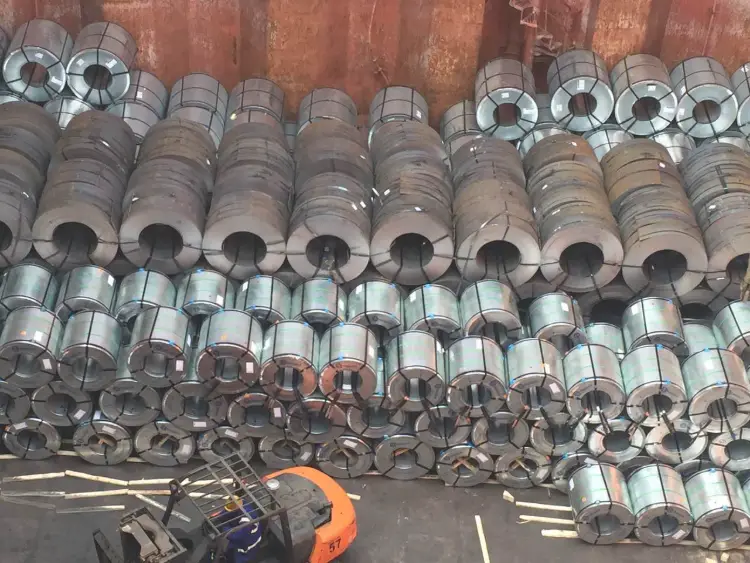
NK A51 Shipbuilding Steel Coil
NK A51 Shipbuilding Steel Coil - High Strength YS500 Grade for Marine and Offshore Structures
Comprehensive material data for NK A51 shipbuilding steel coil: chemical composition, mechanical properties, thermal and electrical physical properties, full international equivalents, and application guidance.
Cutting, cold forming, hot forming, welding (SAW, SMAW, GMAW), straightening, shot blasting
- Phone : +8618037372205
- Email : [email protected]
- WhatsApp: Contact via Whtsapp
- WeChat: +8618037372205
NK A51 Shipbuilding Steel Coil Introduction
NK A51 is a high-strength shipbuilding steel grade regulated by Nippon Kaiji Kyokai (ClassNK). It is designed for critical structural applications in ship hulls and offshore platforms, offering a minimum yield strength of 500 MPa and excellent weldability. This grade provides reliable toughness at low temperatures (0°C impact test) and can be delivered as plates, coils, and strips in normalized, thermo-mechanically controlled rolled (TMCP), or as-rolled condition.
- High yield and tensile strength for weight reduction
- Good low-temperature impact toughness
- Suitable for heavy plate forming and welding
NK A51 Shipbuilding Steel Coil Chemical Composition
Composition limits according to ClassNK Rules for higher-strength hull structural steel grade A51. Carbon equivalent (CEV) is controlled to ensure weldability. Fine grain practice elements (Nb, V, Ti) may be added singly or in combination.
| Element | Standard Value (%) | Remarks |
|---|---|---|
| Carbon (C) | ≤ 0.18 | CEV = C + Mn/6 + (Cr+Mo+V)/5 + (Ni+Cu)/15 ≤ 0.43 |
| Silicon (Si) | ≤ 0.55 | Killed fine grain practice |
| Manganese (Mn) | ≤ 1.70 | Higher Mn permitted if CEV and mechanical properties are met |
| Phosphorus (P) | ≤ 0.025 | Max. 0.030 for product analysis |
| Sulfur (S) | ≤ 0.025 | Max. 0.030 for product analysis |
| Aluminium (Al, total) | ≥ 0.015 | Usually soluble Al ≥ 0.015 |
| Niobium (Nb) | ≤ 0.06 | Optional microalloying element |
| Vanadium (V) | ≤ 0.10 | Optional microalloying element |
| Titanium (Ti) | ≤ 0.06 | Optional microalloying element |
| Nitrogen (N) | ≤ 0.012 | If combined with V/Nb/Ti |
| Copper (Cu) | ≤ 0.55 | May be present from scrap |
| Chromium (Cr) | ≤ 0.25 | Residual |
| Nickel (Ni) | ≤ 0.30 | Residual |
| Molybdenum (Mo) | ≤ 0.08 | Residual |
NK A51 Shipbuilding Steel Coil Thermal and Electrical Physical Properties
Physical properties are typical for low-alloy high-strength shipbuilding steel and may vary slightly with actual chemical composition and heat treatment condition. Density is for carbon-manganese steel.
| Property | Typical Value | Unit | Remarks |
|---|---|---|---|
| Density (ρ) | 7.85 | kg/dm³ (g/cm³) | At 20 °C |
| Elastic modulus (E) | 205 | GPa | At 20 °C, dynamic method |
| Shear modulus (G) | 80 | GPa | Calculated from E and Poisson ratio |
| Poisson's ratio (ν) | 0.30 | – | At 20 °C |
| Thermal expansion coefficient (α) | 11.5 × 10⁻⁶ | K⁻¹ | Between 20 °C and 100 °C |
| Thermal conductivity (λ) | 52 | W/(m·K) | At 20 °C |
| Specific heat capacity (cp) | 460 | J/(kg·K) | At 20 °C |
| Electrical resistivity (ρe) | 0.15 | Ω·mm²/m | At 20 °C |
NK A51 Shipbuilding Steel Coil Mechanical Properties
Tensile and impact properties according to ClassNK Rules for Grade A51 (impact test temperature 0°C). Values apply to thicknesses up to 100 mm. Bend test: 180° over mandrel diameter d = 3a (a = specimen thickness) without cracking.
| Property | Required Value | Unit | Test Condition / Thickness |
|---|---|---|---|
| Yield strength (ReH) | ≥ 500 | MPa | t ≤ 100 mm |
| Tensile strength (Rm) | 610 – 770 | MPa | t ≤ 100 mm |
| Elongation (A5) | ≥ 16 | % | t ≤ 50 mm |
| Elongation (A5) | ≥ 15 | % | 50 < t ≤ 70 mm |
| Elongation (A5) | ≥ 14 | % | 70 < t ≤ 100 mm |
| Impact energy (KV2, longitudinal) | ≥ 27 | J | at 0 °C (average of 3 tests) |
| Impact energy (KV2, transverse) | ≥ 20 | J | at 0 °C (if required by purchaser) |
| Bend test (diameter ratio) | d = 3a | – | 180° bend, no cracking |
NK A51 Shipbuilding Steel Coil Full Equivalent Material Standards and Substitutable Grades
| Country / Region | Standard / Class Society | Grade | Remarks |
|---|---|---|---|
| International | IACS (Class Rules) | A51 (high strength) | Refer to individual class society |
| USA | ABS (American Bureau of Shipping) | AH51 | Same yield and toughness requirements |
| France | BV (Bureau Veritas) | AH51 | Identical mechanical properties |
| Norway / Germany | DNV (Det Norske Veritas) / DNV GL | VL A51 | Equivalent grade; now DNV VL A51 |
| UK | LR (Lloyd's Register) | AH51 | Directly comparable |
| Italy | RINA (Registro Italiano Navale) | AH51 | Directly comparable |
| Russia | RS (Russian Maritime Register of Shipping) | A51 | Equivalent |
| China | CCS (China Classification Society) | AH51 | Equivalent |
| South Korea | KR (Korean Register) | AH51 | Equivalent |
NK A51 Shipbuilding Steel Coil Application Introduction
NK A51 steel is primarily used in the shipbuilding and offshore industry where high strength and excellent weldability are essential. Its 500 MPa minimum yield strength allows weight reduction in large structures without compromising safety. Typical applications include:
Product Applications: Ship hull plates and stiffeners, Deck and bottom longitudinals, Transverse bulkheads and web frames, Offshore platform nodes and braces, Wind turbine tower sections (transition rings), High-head penstock pipes
Processed into products: Keel plates and bilge strakes (hull primary members), Hatch coamings and corner pieces, Heavy-lift crane pedestals, Jack-up leg racks (if quench & tempered variant used), Fatigue-critical welded joints in offshore structures, Reinforcement pads and doubler plates
Application industries: Shipbuilding – container ships, bulk carriers, tankers, naval vessels, Offshore engineering – jacket platforms, semi-submersibles, FPSO hulls, Wind energy – monopile foundations, transition pieces for offshore wind turbines, Heavy civil engineering – bridges, lock gates, flood barriers, Mining & heavy machinery – dump truck bodies, crane booms, structural frames
NK A51 Shipbuilding Steel Coil Similar / Comparable Material Recommendations
| Country / Region | Standard | Grade | Remarks |
|---|---|---|---|
| Europe | EN 10225 | S500G2+M | Weldable structural steel for offshore structures; YS 500 MPa, similar toughness, TMCP delivery |
| Norway | NORSOK M-120 | YS500 | Norwegian standard for structural steel; YS 500 MPa, Charpy at -20°C (can be tailored to 0°C) |
| International | API RP 2A / API 2W | Grade 50 (517 MPa YS) | Offshore platform steel; yield strength 345-517 MPa, close but lower minimum; check toughness class |
| Japan | JIS G 3106 | SM570 | Rolled steel for welded structure; YS ≥ 430 MPa, TS 570-720 MPa, lower strength but higher ductility; suitable for less demanding ship parts |
| Europe | EN 10025-6 | S500Q / S500QL | Quenched and tempered structural steel; YS 500 MPa, good impact toughness; requires controlled fabrication due to tempering |
| USA | ASTM A514 / A514M | Grade Q (or B) | High yield quenched & tempered alloy steel plate; YS ≥ 690 MPa, much higher strength, use with design review |
Notes:
- For thicknesses above 100 mm, the mechanical properties must be agreed upon between the purchaser and the manufacturer; ClassNK may require additional tests such as through-thickness tensile or CTOD.
- All welding shall be performed with low-hydrogen consumables and preheat/interpass temperatures controlled according to the carbon equivalent and joint thickness. Post-weld heat treatment (PWHT) is generally not required for thicknesses up to 50 mm, but may be applied for stress relief in heavily restrained joints.
- Ultrasonic testing (UT) per ClassNK guidelines is often specified for plates used in critical areas.
- The steel is typically supplied in the TMCP condition, which provides fine grain size and optimum balance of strength and toughness; normalized delivery may be required for hot forming applications.
- When ordering, the required impact test temperature (0°C for A51) must be clearly stated.
- Share



