
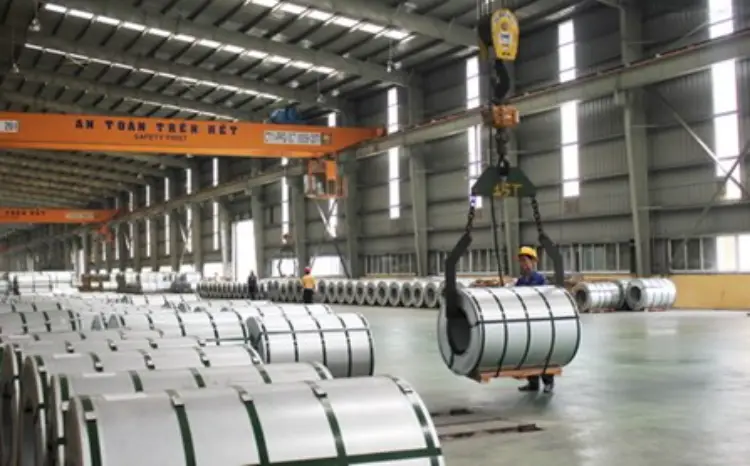
NK F40 Shipbuilding Steel Coil
NK F40 Shipbuilding Steel Coil: High-Strength Hull Structural Steel with Excellent Low-Temperature Toughness
NK F40 is a high-strength shipbuilding steel coil classified by Nippon Kaiji Kyokai (ClassNK) under its rules for hull structural steel. It offers minimum yield strength of 390 MPa, excellent weldability, and guaranteed impact toughness down to -60°C, making it suitable for critical offshore and marine structures operating in cold environments.
Cutting, cold forming, hot forming, welding, machining, bending, flanging
- Phone : +8618037372205
- Email : [email protected]
- WhatsApp: Contact via Whtsapp
- WeChat: +8618037372205
NK F40 Shipbuilding Steel Coil Introduction
NK F40 is a high-strength hull structural steel grade certified by Nippon Kaiji Kyokai (ClassNK) under its Rules for the Survey and Construction of Steel Ships. With a minimum specified yield strength of 390 MPa (40 kgf/mm²), it belongs to the high-strength steel series for shipbuilding and offshore engineering.
- Excellent low-temperature toughness: guaranteed Charpy V-notch impact energy ≥41 J at -60°C, suitable for ice-class vessels and Arctic service.
- Controlled chemical composition with microalloying elements (Nb, V, Ti) to ensure fine grain structure and good weldability.
- Supplied in normalized, thermo-mechanical controlled process (TMCP), or quenched and tempered condition as per thickness requirements.
- Widely used for critical hull components such as main deck, bottom shell, side shell, and structural members that require high strength and toughness.
NK F40 Shipbuilding Steel Coil Chemical Composition
Chemical composition according to Nippon Kaiji Kyokai (ClassNK) rules for Grade F40 hull structural steel. Values are maximum unless a range is shown.
- The sum of niobium, vanadium, and titanium shall not exceed 0.12%.
- If aluminum is used for grain refinement, total aluminum content is typically 0.015–0.060%.
- Carbon equivalent (CEV) may be restricted based on thickness and toughness requirements to ensure weldability.
| Chemical Element | Standard Value | Remarks |
|---|---|---|
| Carbon (C) | ≤ 0.16% | Ladle analysis; product analysis ±0.02% |
| Silicon (Si) | ≤ 0.50% | May be specified lower for improved weldability |
| Manganese (Mn) | 0.90 – 1.60% | Higher Mn allowable for thicker plates |
| Phosphorus (P) | ≤ 0.025% | Low P essential for toughness |
| Sulfur (S) | ≤ 0.025% | Low S for reduced inclusion content |
| Aluminum (Al, acid-soluble) | ≥ 0.015% | Only when Al is used as grain refiner |
| Niobium (Nb) | 0.02 – 0.05% | Typical range; combined Nb+V+Ti ≤ 0.12% |
| Vanadium (V) | 0.05 – 0.10% | Typical; combined Nb+V+Ti ≤ 0.12% |
| Titanium (Ti) | ≤ 0.02% | May be used for grain refinement; combined ≤ 0.12% |
| Nitrogen (N) | ≤ 0.009% | For fine grain practice when applicable |
| Copper (Cu) | ≤ 0.35% | If specified |
| Chromium (Cr) | ≤ 0.20% | Residual element |
| Nickel (Ni) | ≤ 0.40% | Residual |
| Molybdenum (Mo) | ≤ 0.08% | Residual |
NK F40 Shipbuilding Steel Coil Thermal and Electrical Physical Properties
Typical physical properties for high-strength low-alloy structural steel, representative of NK F40 at room temperature unless otherwise stated. Actual values may vary slightly with exact composition and heat treatment.
- Density: 7.85 g/cm³ typical for carbon-manganese steels.
- Thermal expansion coefficient is average over the indicated temperature range.
- Thermal conductivity decreases with increasing temperature.
| Property | Typical Value | Unit | Test Condition |
|---|---|---|---|
| Density (ρ) | 7.85 | g/cm³ | 20°C |
| Modulus of Elasticity (E) | 205 – 210 | GPa | 20°C |
| Shear Modulus (G) | 80 | GPa | 20°C |
| Poisson's Ratio (ν) | 0.3 | — | 20°C |
| Thermal Expansion Coefficient (α) | 12.0 | 10⁻⁶/K | 0 – 100°C |
| Thermal Expansion Coefficient (α) | 12.5 | 10⁻⁶/K | 0 – 200°C |
| Thermal Expansion Coefficient (α) | 13.0 | 10⁻⁶/K | 0 – 300°C |
| Thermal Conductivity (λ) | 42 | W/(m·K) | 20°C |
| Thermal Conductivity (λ) | 40 | W/(m·K) | 100°C |
| Thermal Conductivity (λ) | 38 | W/(m·K) | 200°C |
| Specific Heat Capacity (Cp) | 460 | J/(kg·K) | 20°C |
| Electrical Resistivity (ρ_e) | 0.20 – 0.25 | µΩ·m | 20°C |
NK F40 Shipbuilding Steel Coil Mechanical Properties
Mechanical properties per ClassNK rules for F40 shipbuilding steel. Tensile testing shall be performed on transverse specimens; minimum elongation based on gauge length 5.65√So. Impact energy verified by Charpy V-notch tests at -60°C for longitudinal specimens. Values apply to plate/coil in delivery condition.
- Thicker sections may have slightly lower yield strength; approved higher strength from TMCP/QT may be accepted.
- Cold bending test (180°) usually required with no cracks.
| Property | Standard Requirement | Unit | Test Condition |
|---|---|---|---|
| Yield Strength (ReH) | ≥ 390 | MPa | Thickness ≤ 100 mm; transverse specimen |
| Tensile Strength (Rm) | 510 – 650 | MPa | Transverse specimen |
| Elongation (A) | ≥ 20 | % | Gauge length 5.65√So; transverse |
| Charpy Impact Energy (KV) | ≥ 41 (mean) / ≥ 28 (single) | J | Longitudinal, -60°C, 10x10 mm specimen |
| Charpy Impact Energy (KV) | ≥ 27 (transverse, when specified) | J | Transverse, -60°C |
| Bend Test (Diameter) | 3 x thickness (t ≤ 35 mm); 4 x thickness (t >35 mm) | — | 180° bending, no cracks; mandrel diameter as given |
NK F40 Shipbuilding Steel Coil Identical Equivalent Material Standards and Substitutable Grades
The following classification society grades are considered fully equivalent to NK F40, based on common IACS Unified Requirement W11. They share identical yield strength level, impact test temperature (-60°C), and similar chemistry restrictions.
| Country/Region | Standard | Grade | Remarks |
|---|---|---|---|
| USA | ABS Rules | FH40 | American Bureau of Shipping; identical requirement |
| UK | LR Rules | FH40 | Lloyd's Register; equivalent to FH40 |
| Norway/Germany | DNV Rules | FH40 | DNV (now DNV GL) class; identical impact test at -60°C |
| France | BV Rules | FH40 | Bureau Veritas; fully equivalent |
| China | CCS Rules | FH40 | China Classification Society; identical properties |
| Italy | RINA Rules | FH40 | Registro Italiano Navale |
| South Korea | KR Rules | FH40 | Korean Register; equivalent |
| Russia | RS Rules | FH40 | Russian Maritime Register of Shipping |
| India | IRS Rules | FH40 | Indian Register of Shipping |
| International | IACS UR W11 | FH40 | Common base specification for all IACS members |
NK F40 Shipbuilding Steel Coil Application Introduction
NK F40 steel coils and plates are extensively used in marine and offshore construction where high strength, low weight, and excellent low-temperature toughness are essential. The grade is particularly suitable for structures operating in cold waters or Arctic conditions.
- Typical processing includes plasma cutting, high-power laser cutting, cold forming, and multi-pass welding with low-hydrogen processes.
- Preheating and interpass temperature control are recommended based on plate thickness to avoid hydrogen cracking.
- Post-weld heat treatment is generally not required for thicknesses below 50 mm when using TMCP condition.
Product Applications: Container ships, bulk carriers, tankers, LNG carriers, Ice-breakers and ice-strengthened vessels, Floating production storage and offloading (FPSO) units, Jack-up rigs and semi-submersible platforms, Offshore wind turbine monopiles and transition pieces, Heavy crane booms and lifting structures for marine use
Processed into products: Main deck and side shell plates, Bottom shell plating and bilge strakes, Transverse and longitudinal bulkheads, Strength deck longitudinals and frames, Hatch coaming and corner structures, Foundation plates for heavy equipment on deck, Ice belt plating for ice-class vessels, Structural stiffeners and brackets
Application industries: Shipbuilding (commercial and naval vessels), Offshore oil & gas exploration and production, Renewable offshore energy (wind turbine foundations), Arctic engineering and ice-class structures, Heavy civil engineering and bridge construction (when marine certification accepted)
NK F40 Shipbuilding Steel Coil Similar / Alternative Materials with Close Properties
Grades that can be considered as alternatives, either due to similar strength but different toughness level, or slightly different compositional approach. They may require additional approvals for ClassNK regulated projects.
| Country/Region | Standard | Grade | Remarks |
|---|---|---|---|
| Japan/International | ClassNK | AH40/DH40/EH40 | Same strength (390 MPa min), but lower impact test temperature (0°C, -20°C, -40°C respectively); suitable when -60°C toughness is not required. |
| Europe | EN 10025-4 | S420ML/S420MLO | Thermo-mechanical rolled structural steel with 420 MPa yield; good impact toughness down to -50°C; may be accepted with special consideration. |
| USA | ASTM A131 / ABS | AH40/DH40/EH40 | Equivalent strength but different toughness designations; can substitute if lower temperature toughness is not critical. |
| China | GB/T 712 | FH420 | Higher yield strength (≥420 MPa) and same -60°C impact test; can be used as a higher-strength alternative. |
| Various | IACS UR W11 | FH420 | Next higher strength grade (420 MPa) with -60°C; suitable when weight reduction is needed; weldability considerations apply. |
Notes:
- Delivery condition: The steel is usually supplied in coil form, hot-rolled, and then processed into flat plates. Coils may be provided as-rolled and subsequently cut to length. Normalizing or TMCP is specified depending on the target thickness and toughness class.
- Certification: Products must be marked with the NK stamp and inspection certificate (3.2 certificate per EN 10204 or equivalent).
- Welding consumables: Matching welding electrodes (e.g., E55xx type low-hydrogen) should be used to achieve equivalent strength and toughness in the weld metal. Consumables should be qualified for -60°C service.
- Surface condition: As per standard shipbuilding steel practice; usually pickled and oiled or shot-blasted and primed for thin-gauge coils.
- Actual chemical composition and mechanical test results are subject to the specific mill's delivery program and agreement between purchaser and manufacturer, but must fully comply with ClassNK minimum requirements.
- Share



