
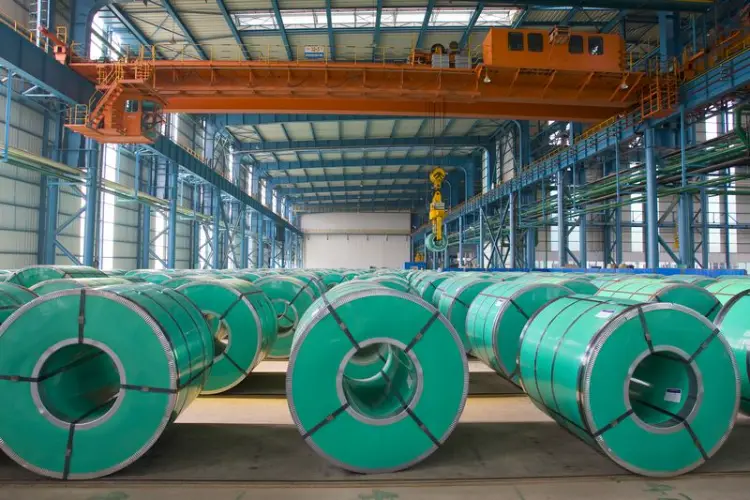
NK E40 Shipbuilding Steel Coil
NK E40 Shipbuilding Steel Coil: High-Strength Structural Material for Ship Construction
Detailed material data sheet for NK E40 shipbuilding steel coil, including chemical composition, mechanical properties, and international equivalents per ClassNK standards.
Normalizing (N), Thermo-Mechanically Controlled Rolling (TMCP), Cold Forming after normalizing, Hot Rolling, Cutting, Bending, Welding
- Phone : +8618037372205
- Email : [email protected]
- WhatsApp: Contact via Whtsapp
- WeChat: +8618037372205
NK E40 Shipbuilding Steel Coil Introduction
NK E40 is a high-strength structural shipbuilding steel grade certified by ClassNK (Nippon Kaiji Kyokai), meeting the requirements of the NK Rules for the Survey and Construction of Ships. Designed for critical marine structures, it offers enhanced toughness and weldability for demanding shipbuilding applications. Typical supply condition is normalized or thermo-mechanically controlled rolled (TMCP). Key characteristics include a minimum yield strength of 390 MPa, excellent low-temperature impact toughness at -40°C, and strict controls on carbon equivalent (Ceq) to ensure good weldability. This grade is essential for primary hull structures, such as decks, bottom shell plates, and longitudinal bulkheads of large vessels operating in harsh environments.
NK E40 Shipbuilding Steel Coil Chemical Composition
The chemical composition of NK E40 steel is precisely controlled during steelmaking to balance high strength and excellent weldability. Key elements like Carbon (C) and Manganese (Mn) are specified with maximum limits to ensure a fine-grained ferritic-pearlitic microstructure after controlled rolling. Micro-alloying elements such as Niobium (Nb) and Vanadium (V) are typically added per manufacturer's practice for grain refinement and precipitation strengthening. The Carbon Equivalent (Ceq) is strictly limited, typically not exceeding 0.40% for thicknesses ≤50mm, governed by the formula: Ceq = C + Mn/6 + (Cr+Mo+V)/5 + (Ni+Cu)/15.
| Element | Standard Value (max, %) | Remarks |
|---|---|---|
| Carbon (C) | ≤0.18 | Deoxidized steel. For TMCP condition, the carbon equivalent (Ceq) limit is applied. |
| Manganese (Mn) | 0.90 - 1.60 | For thicknesses ≤12.5mm, Mn may be reduced to 0.70% minimum. |
| Silicon (Si) | ≤0.50 | Fully killed steel is required. |
| Phosphorus (P) | ≤0.025 | Maximum residual content to ensure toughness. |
| Sulfur (S) | ≤0.025 | Maximum residual content to ensure formability and weld quality. |
| Aluminum (Al) | ≥0.015 | Acid-soluble aluminum. Required for fine grain practice. |
| Niobium (Nb) | 0.02 - 0.05 | Micro-alloying element for grain refinement. |
| Vanadium (V) | 0.05 - 0.10 | Micro-alloying element for precipitation strengthening. |
| Titanium (Ti) | ≤0.02 | Optional micro-alloying element for grain control. |
| Copper (Cu) | ≤0.35 | Residual element limit. |
| Chromium (Cr) | ≤0.20 | Residual element limit. |
| Nickel (Ni) | ≤0.40 | Residual element limit. |
| Molybdenum (Mo) | ≤0.08 | Residual element limit. |
| Nitrogen (N) | ≤0.009 | Typically bound by Al, Nb, or Ti. |
NK E40 Shipbuilding Steel Coil Thermal and Electrical Physical Properties
Physical properties are standardized for high-strength C-Mn steel grades and are essential for design calculations involving heat treatment, thermal expansion, and welding pre-heating. Values are typical at room temperature unless otherwise specified. These parameters are considered nominal for NK E40 grade steel within the density range of ~7850 kg/m³.
| Property | Standard Requirement Value | Unit | Test Condition |
|---|---|---|---|
| Density (ρ) | 7.85 | kg/dm³ (or g/cm³) | At 20°C. |
| Elastic Modulus (E) | 205 | GPa | At 20°C, longitudinal. |
| Shear Modulus (G) | 80 | GPa | At 20°C. |
| Poisson Ratio (ν) | 0.30 | - | At 20°C. |
| Thermal Expansion Coefficient (α) | 12.5 (avg.) | 10^-6/°C | For a temperature range of 20°C to 100°C. |
| Thermal Expansion Coefficient (α) | 13.2 (avg.) | 10^-6/°C | For a temperature range of 20°C to 200°C. |
| Thermal Expansion Coefficient (α) | 13.9 (avg.) | 10^-6/°C | For a temperature range of 20°C to 300°C. |
| Thermal Conductivity (λ) | 42 | W/(m·°C) | At 20°C. |
| Thermal Conductivity (λ) | 39 | W/(m·°C) | At 300°C. |
| Specific Heat Capacity (cp) | 460 | J/(kg·°C) | At 20°C to 100°C. |
| Electrical Resistivity (ρ_e) | 0.22 | (Ω·mm²)/m | At 20°C. |
NK E40 Shipbuilding Steel Coil Mechanical Properties
The mechanical properties are verified through tensile and impact testing according to NK Rules. NK E40 is designated for low-temperature applications, requiring specific minimum Charpy V-notch impact absorbed energy at -40°C. The following values are for specimens taken transversely for plate products and longitudinally for coil products. Elongation is proportional to the original gauge length, following the principle A5 = 5.65√So for tensile testing.
| Property | Standard Requirement Value | Unit | Test Condition |
|---|---|---|---|
| Yield Strength (ReH) | ≥390 | MPa | Transverse specimen, room temperature. For thickness ≤50mm. |
| Tensile Strength (Rm) | 510 - 650 | MPa | Transverse specimen, room temperature. For thickness ≤50mm. |
| Elongation (A5) | ≥20 | % | Tensile test on a gauge length L₀ = 5.65√So (approx. 50mm). |
| Charpy Impact Energy (KV2) | ≥31 | J | Average of 3 tests, transverse specimens, at -40°C. Individual min. value allowed is 22 J. |
| Charpy Impact Energy (KV) | ≥31 | J | Average of 3 tests, longitudinal specimens, at -40°C. For coil products. Individual min. value allowed is 22 J. |
| Bend Test (180°) | d=3a, no cracks | - | Bend angle: 180°; d: bending center diameter; a: specimen thickness. For thicknesses ≤25mm. |
| Bend Test (180°) | d=4a, no cracks | - | Bend angle: 180°; d: bending center diameter; a: specimen thickness. For thicknesses >25mm up to 50mm. |
NK E40 Shipbuilding Steel Coil Fully Equivalent Material Standards & Replaceable Grade Recommendations
| Country/Region | Standard | Grade | Remarks |
|---|---|---|---|
| International | IACS (UR W11) | 40E | International Association of Classification Societies unified requirement for ordinary and high-strength hull structural steels. |
| USA | ABS (American Bureau of Shipping) | ABS EH40 | 100% equivalent for deck, shell, and structural applications in shipbuilding, certified for low-temperature service at -40°C. |
| Norway/Germany | DNV (Det Norske Veritas) | DNV E40 | Equivalent steel per DNV rules for ships, requiring impact test at -40°C. Identical chemical and mechanical limits. |
| France | BV (Bureau Veritas) | BV EH40 | Mirror specification for hull structural steel under BV rules, fully interchangeable with NK E40. |
| UK | LR (Lloyd's Register) | LR EH40 | Compliant with LR Rules and Regulations, this grade provides identical strength and toughness properties. |
| China | CCS (China Classification Society) | CCS EH40 | Matched grade within the CCS Material and Welding specification for high-strength ship steel. |
| Italy | RINA (Registro Italiano Navale) | RINA E40 | Similar rules apply, making this grade fully equivalent in application for marine structures. |
NK E40 Shipbuilding Steel Coil Application Introduction
NK E40 steel coil is a fundamental material in the maritime industry, designed for heavy-lift and high-stress components of vessels. Uncoiled and flattened into plates, it is cut, formed, and welded to create the structural skeleton of a ship. Its high strength-to-weight ratio allows for reduced scantlings in design, thereby decreasing the ship's structural weight and increasing cargo capacity. The -40°C impact toughness designation specifically qualifies this steel for ships operating in cold waters and ambient temperatures as low as -15°C for special structural details.
Product Applications: Transverse and longitudinal frames/beams, Hull envelope plating (Deck, bottom shell, bilge strake, sheer strake), Flanges and webs of built-up girders, Corrugated bulkheads in watertight compartments, Structural stiffeners for hatch coamings
Processed into products: Watertight and oiltight floors in double bottoms, Rudder horn castings and rudder stock plates (welded fabrication), Bracket plates for main engine seatings, Deckhouse structural pillars, Hawse pipe foundations and chain locker plates
Application industries: Commercial Shipbuilding (Bulk carriers, container ships, tankers), Naval Shipbuilding (Auxiliary vessels, naval support ships), Offshore Oil & Gas (Topsides, jacket structures, FPSO hulls), Marine Engineering (Lock gates, dry dock caissons, sea water intake structures), Port & Harbor Infrastructure (Quayside walls, piling, mooring dolphins)
NK E40 Shipbuilding Steel Coil Similar/Alternative Material Recommendations
| Country/Region | Standard | Grade | Remarks |
|---|---|---|---|
| Japan | NK Rules | NK E36 | NK E36 has a lower yield strength (≥355 MPa) and tensile strength range (490-630 MPa). It is a direct 'step-down' alternative where thickness is increased. |
| International | IACS | EH40 (WT) | Specification for EH40 with enhanced through-thickness properties (Z-test) for joints susceptible to lamellar tearing. A superior material quality option. |
| Europe | EN 10025-4 | S420ML/ML1 | Thermomechanically rolled weldable fine grain structural steel with a min. yield strength of 420 MPa. A close structural steel alternative for non-marine classified applications, requiring impact test at -50°C for nominal equivalence. |
| Russia (CIS) | GOST R 52927 | PC E40 | Russian Maritime Register of Shipping equivalent grade for shipbuilding steel. Similar composition and mechanical properties with guaranteed toughness at -40°C. |
Notes:
When ordering NK E40 steel coil, it is mandatory to specify the delivery condition (Normalizing or TMCP), desired edge condition (mill edge or trimmed edge), and coil weight/size limits. For critical applications, supplementary testing such as through-thickness tensile testing (Z-direction properties) may be invoked per NK Rules Chapter 3 for materials suitable for high fatigue or restrained joint configurations. Proper storage and pre-heating prior to welding (typically 50-100°C) is essential to prevent hydrogen-induced cold cracking in thick sections.
- Share



