
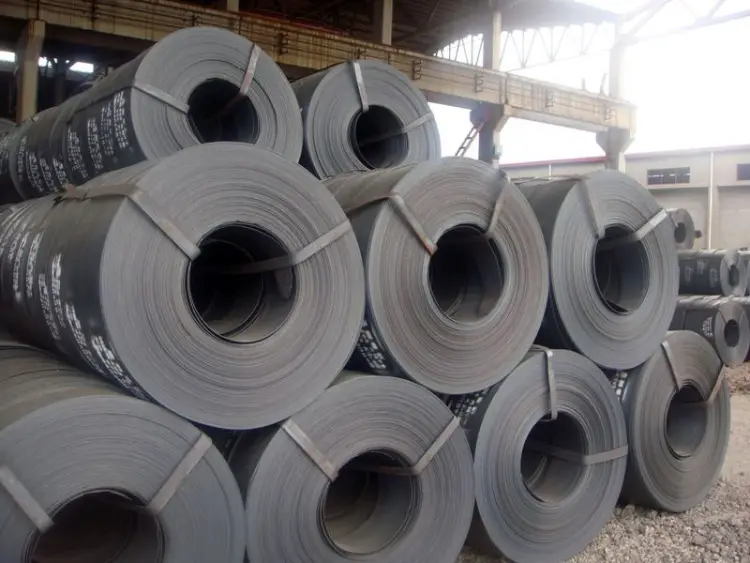
NK D40 Shipbuilding Steel Coil
NK D40 Shipbuilding Steel Coil - High Strength Marine Plate for Superior Hull Integrity
NK D40 is a high-strength shipbuilding steel certified by Nippon Kaiji Kyokai, offering a minimum yield strength of 390 MPa and excellent notch toughness at -20°C. Ideal for critical hull structures, it ensures reliable performance in harsh marine environments.
Suitable for cold forming, hot forming, welding (all common processes, e.g., SAW, SMAW, GMAW), and thermal cutting. The TMCP condition permits moderate heat straightening.
- Phone : +8618037372205
- Email : [email protected]
- WhatsApp: Contact via Whtsapp
- WeChat: +8618037372205
NK D40 Shipbuilding Steel Coil Introduction
NK D40 is a normalized or thermo-mechanically controlled processed (TMCP) high-strength structural steel plate and coil for shipbuilding applications, certified under the rules of Nippon Kaiji Kyokai (ClassNK). As a Grade D40 steel, it delivers a guaranteed minimum yield strength of 390 MPa and tensile strength between 510 and 660 MPa, with enhanced low-temperature toughness down to -20°C. It is designed for critical load-bearing sections of ships such as hull envelopes, strength decks, and bottom structures, where weight reduction and high strength are essential. The steel is weldable and formable, meeting stringent marine classification society requirements for safety and longevity in seawater and low-temperature service conditions.
NK D40 Shipbuilding Steel Coil Chemical Composition as per ClassNK Rules
The chemical composition of NK D40 is strictly controlled to ensure high strength and weldability while maintaining excellent notch toughness at -20°C. Maximum limits for phosphorus and sulfur are low to improve cleanliness and impact properties. Niobium, vanadium, and titanium may be added individually or in combination to refine the grain structure and increase strength without impairing toughness. The carbon equivalent (CEV) is typically specified for weldability assurance.
| Element | Standard Value (max unless range given) | Remarks |
|---|---|---|
| Carbon (C) | ≤0.18 | As per ladle analysis |
| Silicon (Si) | ≤0.50 | |
| Manganese (Mn) | 0.90 – 1.60 | For higher thickness, upper limit may be raised by agreement |
| Phosphorus (P) | ≤0.035 | |
| Sulfur (S) | ≤0.035 | |
| Aluminum (acid soluble) | ≥0.015 | Minimum for grain refinement; total Al may be specified |
| Niobium (Nb) | ≤0.05 | |
| Vanadium (V) | ≤0.10 | |
| Titanium (Ti) | ≤0.02 | |
| Nitrogen (N) | ≤0.012 | Unless sufficient Al present to fix N |
| Copper (Cu) | ≤0.35 | May be present from scrap |
| Chromium (Cr) | ≤0.20 | Residual element |
| Nickel (Ni) | ≤0.40 | Residual element |
| Molybdenum (Mo) | ≤0.08 | Residual element |
| Carbon Equivalent (CEV) | Typically ≤0.38 – 0.43 | Depending on thickness, for good weldability |
NK D40 Shipbuilding Steel Coil Thermal and Electrical Physical Properties
Typical thermophysical properties for structural steel of this composition class are given below. Slight variations may occur depending on exact composition and manufacturing condition. These values are useful for thermal analysis and welding simulations.
| Property | Typical Value | Unit | Test Condition / Temperature |
|---|---|---|---|
| Density (ρ) | 7850 | kg/m³ | At 20°C |
| Elastic Modulus (E) | 205 – 210 | GPa | At 20°C |
| Shear Modulus (G) | 79 – 81 | GPa | At 20°C |
| Poisson's Ratio (ν) | 0.30 | — | At 20°C |
| Thermal Expansion Coefficient (α) | 11.5 – 12.5 | 10⁻⁶/K | Range 20°C – 100°C |
| Thermal Conductivity (λ) | 48 – 52 | W/(m·K) | At 20°C |
| Specific Heat Capacity (c) | 450 – 470 | J/(kg·K) | At 20°C |
| Electrical Resistivity (ρ_e) | 0.14 – 0.18 | Ω·mm²/m (µΩ·m) | At 20°C |
NK D40 Shipbuilding Steel Coil Mechanical Properties – Tensile and Impact Tests
Tensile tests are performed in transverse direction for plates ≥3 mm thickness. Impact test specimens are taken in longitudinal direction unless transverse is agreed. The minimum average absorbed energy is verified at -20°C, ensuring suitability for low-temperature marine service. Bending test requires 180° bend over a specified former diameter without cracking.
| Property | Standard Requirement | Unit | Test Condition |
|---|---|---|---|
| Yield Strength (ReH) | ≥390 | MPa | Transverse, min. 0.2% proof stress for TMCP |
| Tensile Strength (Rm) | 510 – 660 | MPa | Transverse, gauge length 5.65√S0 |
| Elongation (A) | ≥20 | % | Gauge length 5.65√S0; for thickness ≤40 mm |
| Thickness >40 mm | ≥19 | % | Gauge length 5.65√S0 |
| Impact Energy (KV) -20°C, longitudinal | ≥42 (average of 3) | J | Minimum single value 28 J |
| Impact Energy (KV) -20°C, transverse | ≥27 (average of 3) | J | Minimum single value 19 J (if transverse specified) |
| Bend Test (180°) | d=3a | — | For thickness ≤20 mm; larger former for >20 mm |
NK D40 Shipbuilding Steel Coil Completely Equivalent Standards and Substitutable Grades
| Country / Region | Standard | Grade | Remarks |
|---|---|---|---|
| International | IACS UR W32 | D40 | Basis for most classification societies |
| USA | ABS Rules | D40 | American Bureau of Shipping |
| UK | LR Rules | D40 | Lloyd's Register |
| France | BV Rules | D40 | Bureau Veritas |
| Norway | DNV Rules | VL D40 | DNV GL (now DNV) |
| Germany | GL Rules | D40 | Germanischer Lloyd (merged with DNV) |
| China | CCS Rules | D40 | China Classification Society |
| Italy | RINA Rules | D40 | Registro Italiano Navale |
| Russia | RS Rules | D40 | Russian Maritime Register of Shipping |
| Korea | KR Rules | D40 | Korean Register |
| India | IRS Rules | D40 | Indian Register of Shipping |
NK D40 Shipbuilding Steel Coil Application Introduction
NK D40 steel is primarily used in the construction of sea-going vessels and offshore structures where high strength-to-weight ratio and excellent low-temperature toughness are required. It can be fabricated into a variety of products and components through cutting, forming, and welding operations common in shipyards.
Product Applications: Steel coils and cut-to-length plates for ship hulls, Pre-fabricated ship blocks and modules, Pre-painted or primed plates for corrosion protection, Bent and profiled sections (frames, stiffeners)
Processed into products: Hull shell plates (bottom, side, strength deck), Transverse bulkheads and longitudinal bulkheads, Deck girders and bottom girders, Floor plates and keel plates, Bilge strakes and sheer strakes, Web frames and stiffeners, Hatch coamings and corner castings, Superstructure main support elements
Application industries: Commercial shipbuilding (tankers, bulk carriers, container ships), Naval and coast guard vessels, Offshore oil and gas platforms (topsides, jackets), Floating production storage and offloading (FPSO) units, Marine and port infrastructure (barges, pontoons, locks), Renewable energy (offshore wind turbine foundations)
NK D40 Shipbuilding Steel Coil Similar or Analogous Substitute Material Recommendations
| Country / Region | Standard | Grade | Remarks |
|---|---|---|---|
| International | IACS UR W29 | D36 | Lower strength (≥355 MPa yield), may be used where strength demand is lower; similar low-temp toughness at -20°C |
| International | IACS UR W36 | E40 | Same strength level with stricter toughness requirement at -40°C; suitable for thicker sections or colder environments |
| International | IACS UR W31 | A40 | Same strength but with lower notch toughness test temperature (0°C); not recommended for cold-water service |
| ISO | ISO 4950-2 | S355ML | Structural steel with similar strength and low-temperature toughness; may be considered for non-marine applications |
| USA (ASTM) | ASTM A131 | DH40 | Identical strength and toughness, but different certification; can be substituted in shipbuilding with approval |
Notes:
Ultrasonic testing according to ClassNK requirements may be specified for critical applications. Surface condition and tolerances should conform to ClassNK standards. For heavy thicknesses (>40 mm), through-thickness properties (Z-quality) may be required for lamellar tearing resistance and should be subject to separate agreement. Weldability should be verified with appropriate carbon equivalent (CEV) and crack-sensitive index (Pcm) values.
- Share



