
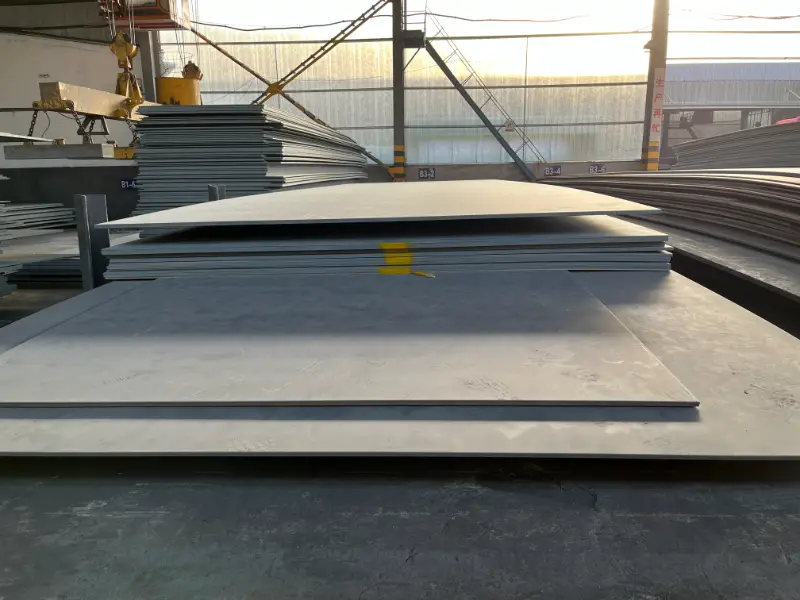
NK E63 Shipbuilding Steel
NK E63 Shipbuilding Steel Coil: High Strength Marine Grade for Heavy Structures
NK E63 is a high tensile shipbuilding steel governed by ClassNK rules, offering minimum 620 MPa yield strength and superior low-temperature toughness for critical marine structures.
Thermo-mechanical controlled rolling (TMCP), normalizing, or normalizing rolling; suitable for cold forming, cutting, welding
- Phone : +8618037372205
- Email : [email protected]
- WhatsApp: Contact via Whtsapp
- WeChat: +8618037372205
NK E63 Shipbuilding Steel Introduction
NK E63 steel coil is a high-strength structural shipbuilding plate/coil grade certified by Nippon Kaiji Kyokai (ClassNK) under Part K of its Rules for the Survey and Construction of Steel Ships. It belongs to the E63 category, where 'E' denotes guaranteed impact toughness down to -40°C, and '63' indicates a minimum yield strength of 620 MPa (63 kgf/mm²). This fine-grained, fully killed steel is designed for heavy-load hull members, offshore platforms and other marine structures where excellent weldability, notch toughness and strength-to-weight ratio are essential. The material is typically supplied in normalized or thermo-mechanically controlled rolled (TMCP) condition, ensuring consistent mechanical properties across large sections. Its balanced chemistry with microalloying elements (Nb, V, Ti) allows good formability and crack arrest capability. NK E63 is widely adopted in shipyards worldwide for building ultra-large container vessels, bulk carriers and LNG tanks, significantly reducing weight while maintaining structural integrity under severe sea conditions.
NK E63 Shipbuilding Steel Chemical Composition according to ClassNK Rules
The following ladle analysis limits apply to NK E63 as per ClassNK Part K, Chapter 3, Table K5.6. Fine grain practice with sufficient aluminum is mandatory. Microlloying additions (Nb, V, Ti) may be used singly or in combination. Carbon equivalent (CEV, IIW) usually ≤ 0.44% (depends on thickness and shipyard agreement) to ensure weldability without preheat.
- CEV = C + Mn/6 + (Cr + Mo + V)/5 + (Ni + Cu)/15
- If Nb and Ti are used, the CEV formula is adapted accordingly.
| Element | Specification (max, unless range given) | Remarks |
|---|---|---|
| C | ≤ 0.20 % | Depending on plate thickness, lower for thicker plates |
| Si | 0.10 – 0.55 % | Killed steel requires min Si or Al |
| Mn | 0.90 – 1.65 % | Higher Mn improves strength and toughness |
| P | ≤ 0.025 % | Lower P for better toughness |
| S | ≤ 0.025 % | Ensures soundness and improves through-thickness properties |
| Al (total) | ≥ 0.020 % | Grain refinement; soluble Al often 0.015-0.040% |
| Nb | 0.02 – 0.05 % | Grain refiner and precipitation hardener |
| V | 0.05 – 0.10 % | Optional microalloying for strength |
| Ti | 0.007 – 0.05 % | Optional; Ti promotes grain refinement and improves HAZ toughness |
| Cu | ≤ 0.35 % | Residual or added for atmospheric corrosion resistance |
| Cr | ≤ 0.20 % | Residual or tramp element |
| Ni | ≤ 0.40 % | Residual from scrap; may be added for low-temperature toughness |
| Mo | ≤ 0.08 % | Typically residual, not intentionally added |
| N | ≤ 0.012 % | Nitrogen combined via Al/Ti to avoid strain aging |
NK E63 Shipbuilding Steel Thermal and Electrical Physical Properties
Physical properties for NK E63 are typical of low-alloy high-strength steel grades with a density around 7850 kg/m³. These values are not specification requirements but serve for design calculations. Data apply in the temperature range 20-100°C unless otherwise noted. Thermal conductivity decreases with temperature; expansion coefficient increases. All data are representative for carbon-manganese structural steels.
- Young's modulus slightly decreases at elevated temperatures (~185 GPa at 300°C).
- Electrical resistivity increases with temperature; for precise values consult supplier data.
| Property | Typical Value | Unit | Test Conditions / Reference |
|---|---|---|---|
| Density (ρ) | 7850 | kg/m³ | At 20°C |
| Young's modulus (E) | 205 | GPa | At room temperature, tensile modulus |
| Shear modulus (G) | ~80 | GPa | Calculated, G = E / [2(1+ν)] |
| Poisson's ratio (ν) | 0.30 | – | Within elastic range |
| Mean coefficient of thermal expansion (α) – 20 to 100°C | 11.8 | ×10⁻⁶ / K | Linear expansion |
| α – 20 to 300°C | 12.8 | ×10⁻⁶ / K | |
| α – 20 to 500°C | 13.7 | ×10⁻⁶ / K | |
| Thermal conductivity (λ) at 20°C | ~45 | W/(m·K) | Typical for Mn-Si steel |
| λ at 100°C | ~43 | W/(m·K) | Decreases slightly with temperature |
| Specific heat capacity (Cp) at 20°C | ~460 | J/(kg·K) | Room temperature |
| Cp at 100°C | ~480 | J/(kg·K) | Increases with temperature |
| Electrical resistivity (ρₑ) at 20°C | 0.22 – 0.30 | μΩ·m | Depends on exact composition and microstructure; ~0.25 typical |
NK E63 Shipbuilding Steel Mechanical Properties at Ambient Temperature
Tensile and impact test requirements for NK E63 are based on ClassNK Rules Part K. Values vary with product thickness: plate yields tend to decrease slightly for thickness >100 mm. Impact tests are mandatory at -40°C for longitudinal specimens; transverse values are typically 70% of longitudinal. Bending test with 180° bend and mandrel diameter = 3 × thickness (a) for plates up to 25 mm; for thicker plates the ratio may increase.
- Yield strength reduction for thickness > 50 mm may apply (e.g., >50 mm ReH min. 620 → 600).
- Elongation measured on gauge length 5.65√So (L0 = 5.65√S0).
| Property | Specified Value | Unit | Test Conditions / Remarks |
|---|---|---|---|
| Yield strength (ReH) – plate t ≤ 50 mm | ≥ 620 | MPa | Minimum, transverse or longitudinal; for coil, longitudinal values often reported |
| Yield strength (ReH) – plate 50 < t ≤ 100 mm | ≥ 600 | MPa | Reduction for thickness; verify with mill certificate |
| Tensile strength (Rm) | 720 – 890 | MPa | Across whole thickness range |
| Elongation (A5) – t ≤ 25 mm | ≥ 15 (long.) / ≥ 14 (trans.) | % | Gauge length L0 = 5.65√S0; t=plate thickness |
| Elongation (A5) – 25 < t ≤ 50 mm | ≥ 14 (long.) / ≥ 13 (trans.) | % | |
| Elongation (A5) – t > 50 mm | ≥ 13 (long.) / ≥ 12 (trans.) | % | Extended gauge or specific clause may apply |
| Charpy V-notch impact (KV2) at -40°C – longitudinal | ≥ 31 (average), ≥ 22 (single) | J | Test temperature -40°C for E grade; specimen 10×10 mm |
| Charpy V-notch impact (KV2) at -40°C – transverse | ≥ 21 (average), ≥ 15 (single) | J | Transverse values are minimum 70% of longitudinal |
| Bending test (180°) – plate t ≤ 25 mm | d = 3a | – | Mandrel diameter d, specimen thickness a; no cracks permitted |
NK E63 Shipbuilding Steel Fully Equivalent Material Standards & Substitutable Grades
| Country / Region | Standard | Grade | Remarks |
|---|---|---|---|
| International / USA | ABS Rules | E620 (EH620) | ABS equivalent of E63; E620 denotes 620 MPa yield, H for high strength; toughness identical at -40°C |
| UK / International | Lloyd's Register (LR) | EH63 | LR high strength grade; directly matches NK E63 for all thicknesses |
| Norway / Germany | DNV Rules | E620 (VL E620) | Det Norske Veritas equivalent, now DNV GL, E620 specification |
| France | Bureau Veritas (BV) | E620 | BV EH620 or E620; same mechanical and chemical requirements |
| China | CCS Rules | E620 | China Classification Society E620; widely used in Asian shipbuilding |
| Italy | RINA Rules | E620 | Registro Italiano Navale EH620 |
| South Korea | KR Rules | RE63 | Korean Register of Shipping RE63, identical performance (some minor chemistry adjust) |
| Russia | RMRS | E620 | Russian Maritime Register of Shipping high-strength 620 MPa grade (Category E) |
| Japan | NK Rules | NK E63 | Original ClassNK specification |
NK E63 Shipbuilding Steel Application Introduction
NK E63 shipbuilding steel coil is engineered for weight-critical, heavy-duty marine constructions. Its excellent combination of strength, weldability and low-temperature toughness makes it the material of choice for the most aggressively loaded hull members. The steel is suitable for fabrication processes that require cold bending, high heat input welding (with appropriate consumables), and precise dimensional control. It finds application across various vessel types and offshore structures where durability and safety are paramount.
- Used in both longitudinal and transverse frames, enabling thinner sections and increased payload.
- Compatible with all common welding techniques (SAW, FCAW, SMAW) using low-hydrogen practices.
- Coil form enables efficient nesting and automated panel lines.
Product Applications: Hull plates and stiffener coils for ultra-large container ships (above 20,000 TEU), Deck girders and stress concentration zones of VLCC and LNG carriers, Sheer strake, bilge strake, and longitudinal bulkhead sections of naval auxiliary vessels, Legs and racks of self-elevating jack-up drilling rigs, Chords and nodes in tubular jacket structures for platforms, Inner bottom and hopper plates in bulk carriers for heavy ballast/holds
Processed into products: Main deck stringer plates, Bilge strake plates, Longitudinal bulkhead lower strake, Hatch coaming and flangings (thick plates), Transverse web frames in wing tanks, Foundation plates for heavy machinery (main engine, crane pedestals), Shock/strengthened panels for ice-class vessels (if toughness at -40°C suffices), Built-up stiffeners and T-bars from cut coil
Application industries: Shipbuilding (commercial and naval) – mega container ships, VLCCs, bulk carriers, Offshore oil & gas – FPSO, fixed platforms, jack-up rigs, subsea templates, Maritime equipment – heavy-lift crane booms, winch foundations, mooring equipment, Bridge and civil engineering – for river/lake mobile bridges or marine terminals, Wind energy – offshore wind turbine transition pieces and heavy monopiles (with marine approval)
NK E63 Shipbuilding Steel Similar / Proximate Alternative High-Strength Shipbuilding Grades
| Country / Region | Standard | Grade | Comparative Analysis |
|---|---|---|---|
| International | NK / ABS / LR etc. | E56 (EH56) | Lower yield strength (≥ 560 MPa), similar toughness at -40°C; lower tensile range; suitable when weight saving is less critical but still high strength needed |
| International | NK / ABS / LR etc. | EH40 (E40) | Commonly used high-strength grade (≥ 390 MPa yield); much lower strength than E63 but easier forming and welding, used where very high strength not required |
| International | NK / ABS / LR etc. | F63 | Grade F63 offers even better low-temperature toughness (down to -60°C) for cryogenic or Arctic applications, but with same strength; premium alternative to E63 |
| Europe | EN 10025-6 | S620QL / S690QL | Quenched and tempered structural steels with 620 MPa yield and good toughness; not direct ship class steel but may be accepted with additional certification for marine structures |
| USA | ASTM A710 / A514 | A514 Gr. H / A710 Gr. A | High-strength low-alloy plate steels with similar strength levels; require special approval for marine use; A514 is less weldable |
Notes:
Key manufacturing considerations:
- ClassNK approval requires each batch to be tested in the presence of a surveyor; mill test certificates (MTC) according to EN 10204 3.1 or 3.2 are standard.
- Preheating before welding is usually not necessary for thicknesses up to 50 mm with TMCP delivery, but for plate >50 mm a minimum preheat of 75-100°C may be recommended to avoid hydrogen cracking.
- Post-weld heat treatment (PWHT) is permissible but stress relief at 580-620°C can be applied without significant strength loss thanks to microalloy stability; hold time per 25 mm thickness.
- The steel exhibits good through-thickness properties; for Z-quality requirements (e.g., Z25, Z35), special ladle refining and inclusion shape control (Ca treatment) must be specified.
- The coil product may show some coil set; leveling before cutting is advised for flatness-critical parts.
- Share



