
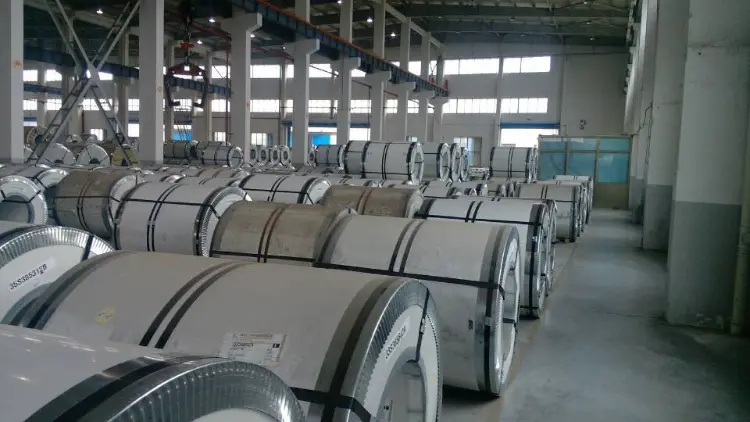
NK F63 Shipbuilding Steel Coil
NK F63 Ultra-High Strength Shipbuilding Steel Coil for Cryogenic Applications
NK F63 is a Nippon Kaiji Kyokai certified, 620 MPa yield strength shipbuilding steel coil designed for extreme low-temperature service. It meets IACS UR W11 requirements for Arctic-class vessels and large container ships. Excellent toughness at -60°C, high strength-to-weight ratio, and good weldability.
Suitable for cold forming, thermal cutting, and welding (with preheat and post-weld heat treatment as needed)
- Phone : +8618037372205
- Email : [email protected]
- WhatsApp: Contact via Whtsapp
- WeChat: +8618037372205
NK F63 Shipbuilding Steel Coil Introduction
NK F63 is an ultra-high strength hull structural steel coil certified by ClassNK (Nippon Kaiji Kyokai). It is produced in accordance with the IACS Unified Requirement W11 for steel grades FH 620, exhibiting a minimum yield strength of 620 MPa. This grade is specifically developed for critical structural components in large container ships, icebreakers, and offshore platforms operating in Arctic or cryogenic environments. The steel combines high strength with excellent low-temperature notch toughness (impact test at -60°C) and good weldability using low-hydrogen processes. Typical supply condition is thermomechanical controlled rolled (TMCP) or quenched and tempered (Q&T). The microstructure is predominantly fine-grained bainite and martensite, providing an optimal balance of strength and ductility. Key advantages:
- Superior tensile and yield strength, reducing hull weight and increasing payload
- Excellent brittle fracture resistance at temperatures down to -60°C
- Good formability and weldability with approved consumables and heat inputs
- Available in coil form for efficient automated cutting and welding
NK F63 Shipbuilding Steel Coil Chemical Composition
The chemical composition conforms to IACS UR W11 for FH620. Fine microalloy additions of Nb, V, Ti, and controlled nitrogen ensure grain refinement and precipitation strengthening. Strict limits on sulfur, phosphorus, and residual elements secure excellent low-temperature impact toughness. Carbon equivalent (CEV) is controlled for weldability.
| Element | Standard Requirement | Remarks |
|---|---|---|
| C (Carbon) | ≤ 0.18 | Max. |
| Si (Silicon) | ≤ 0.55 | Max. |
| Mn (Manganese) | ≤ 1.60 | Max. |
| P (Phosphorus) | ≤ 0.025 | Max. |
| S (Sulfur) | ≤ 0.025 | Max. |
| Al (Aluminium, total) | ≥ 0.020 | Min. acid-soluble Al |
| Nb (Niobium) | ≤ 0.06 | Max. |
| V (Vanadium) | ≤ 0.10 | Max. |
| Ti (Titanium) | ≤ 0.02 | Max. |
| Cu (Copper) | ≤ 0.35 | Max. |
| Cr (Chromium) | ≤ 0.25 | Max. |
| Ni (Nickel) | ≤ 0.80 | Max. |
| Mo (Molybdenum) | ≤ 0.30 | Max. |
| N (Nitrogen) | ≤ 0.012 | Max. |
| B (Boron) | ≤ 0.0005 | Max., if intentionally added |
| CEV (Carbon Equivalent) | ≤ 0.57 (t ≤ 50 mm) | CEV = C + Mn/6 + (Cr+Mo+V)/5 + (Ni+Cu)/15 |
NK F63 Shipbuilding Steel Coil Thermal and Electrical Physical Properties
These physical property values are representative for a quenched and tempered or TMCP ultra-high strength steel of the 620 MPa class. Actual values may vary slightly depending on the heat treatment condition and section thickness. Data are provided for engineering calculations.
| Property | Typical Value | Unit | Test Condition / Remarks |
|---|---|---|---|
| Density (ρ) | 7850 | kg/m³ | Ambient temperature |
| Modulus of elasticity (E) | 205 | GPa | At 20°C |
| Shear modulus (G) | 80 | GPa | At 20°C |
| Poisson's ratio (ν) | 0.3 | – | Elastic range |
| Thermal expansion coefficient (α) | 11.5 | 10⁻⁶/K | 20 – 100°C |
| Thermal expansion coefficient (α) | 12.2 | 10⁻⁶/K | 20 – 200°C |
| Thermal conductivity (λ) | 38 | W/(m·K) | At 20°C |
| Specific heat capacity (c) | 460 | J/(kg·K) | At 20°C |
| Electrical resistivity (ρ_e) | 0.25 | µΩ·m | At 20°C |
NK F63 Shipbuilding Steel Coil Mechanical Properties
Mechanical properties are in accordance with IACS UR W11 for FH620, measured on transverse test pieces from coil after flattening. All values are minimum unless specified as a range. Impact tests are carried out at -60°C on V-notch Charpy specimens to guarantee brittle fracture safety.
| Property | Standard Requirement | Unit | Test Condition |
|---|---|---|---|
| Yield strength (ReH) | ≥ 620 | MPa | t ≤ 50 mm, transverse specimen |
| Yield strength (ReH) | ≥ 580 | MPa | 50 < t ≤ 100 mm, transverse |
| Tensile strength (Rm) | 720 – 890 | MPa | t ≤ 100 mm, transverse |
| Elongation (A) | ≥ 14 | % | t ≤ 50 mm, gauge length 5.65√So |
| Elongation (A) | ≥ 13 | % | 50 < t ≤ 100 mm |
| Charpy V-notch impact energy (KV) | ≥ 41 | J | -60°C, longitudinal specimen |
| Charpy V-notch impact energy (KV) | ≥ 27 | J | -60°C, transverse specimen |
| Bend test (diameter a) | No cracks | - | 180° bend, d = 3a, t ≤ 50 mm |
NK F63 Shipbuilding Steel Coil Fully Equivalent Material Standards and Replaceable Grade Recommendations
| Country/Region | Standard | Grade | Remarks |
|---|---|---|---|
| International (IACS) | IACS UR W11 (2020) | FH 620 | Direct equivalent; same chemistry and mechanics for F-grade |
| Norway/Germany | DNV Rules | F620 | DNV-certified shipbuilding steel, fully interchangeable |
| USA | ABS Rules | FH620 | ABS certification for FH620 grade |
| United Kingdom | Lloyd's Register Rules | FH620 | LR grade FH620 |
| France | Bureau Veritas Rules | FH620 | BV grade FH620 |
| Japan | JIS / ClassNK | NK F63 (FH620) | Original designation; material identical to IACS FH620 |
NK F63 Shipbuilding Steel Coil Application Introduction
NK F63 steel coil is engineered for the most demanding structural applications in shipbuilding and offshore engineering where reduced weight and high payload capacity are essential. It is typically used in areas with high stress and low-temperature exposure, delivering long fatigue life and resistance to brittle fracture. The coil form enables efficient automated nesting, cutting, and robotic welding. Typical industries:
Product Applications: Hull structural plates and stiffeners for mega-boxships, Ice belt and collision bulkhead plates for polar vessels, Upper deck and hatch coaming structures for container ships, Legs and chords of jack-up drilling platforms, Heavy-lift crane booms and lattice structures, High-pressure pipeline and manifolds for subsea applications (after additional qualification)
Processed into products: Shell plates of ship hulls and ice-strengthened bow sections, Longitudinal and transverse bulkheads, Web frames and stiffeners, Truss nodes and tubular joints in offshore structures, Pedestal cranes and lifting devices, Cut-to-shape blanks for mobile crane telescopic parts
Application industries: Shipbuilding (ultra-large container ships, LNG carriers, Arctic tankers, icebreakers), Offshore and marine engineering (jack-up rig legs, semi-submersible platforms, FPSO modules), Heavy lifting and transport equipment (crane booms, forklift masts, heavy-duty trailers), Pressure vessel and storage tank manufacturing (low-temperature service)
NK F63 Shipbuilding Steel Coil Similar/Approximate Substitute Material Recommendations
| Country/Region | Standard | Grade | Remarks |
|---|---|---|---|
| Europe | EN 10025-6 | S690Q | 690 MPa yield class; similar strength & low-temp toughness; not ship-specific, requires additional certification for marine use |
| USA | ASTM A514/A517 | Grade S | 690 MPa quenched & tempered steel; good strength match, but specified impact test temperature is higher (-40°C typical); need supplementary -60°C qualification |
| China | GB/T 712 | FH620 | Chinese standard for hull structural steel FH620; fully align with IACS, can be substituted after verification |
| Russia | GOST R 52927 | F620W | Arctic shipbuilding steel; yield 620 MPa, low-temperature design; requires equivalence assessment with ClassNK |
Notes:
- Welding must be performed with strictly controlled heat input (typically 15–25 kJ/cm) using low-hydrogen consumables. Preheating to 100–150°C is recommended for thicker sections to avoid hydrogen cracking.
- The steel is delivered with ClassNK inspection and certification; survey includes chemical analysis, mechanical testing, non-destructive examination by ultrasonic testing, and surface inspection.
- For thicknesses over 100 mm, mechanical property values and welding procedures require separate approval by the classification society.
- Storage and handling of coils should follow standard practices to avoid mechanical damage and preserve surface condition. De-scaling or blasting before shop primer is recommended.
- Share



