
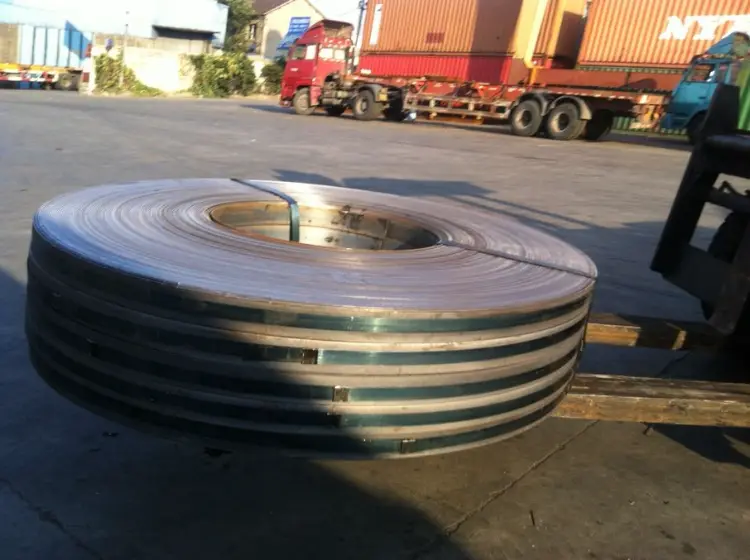
NK A32 Shipbuilding Steel Coil
NK A32 Shipbuilding Steel Coil - IACS Normalized High-Strength Hull Structural Steel
Detailed material properties and equivalents of ClassNK Grade A32 shipbuilding steel coil, including chemical composition, mechanical and thermo-physical performance.
Thermo-mechanical controlled processing (TMCP), normalizing, hot rolling, welding, cutting, forming
- Phone : +8618037372205
- Email : [email protected]
- WhatsApp: Contact via Whtsapp
- WeChat: +8618037372205
NK A32 Shipbuilding Steel Coil Introduction
NK A32 is a high-strength shipbuilding structural steel grade certified by ClassNK (Nippon Kaiji Kyokai) in compliance with the IACS UR W11 unified requirements. Designed for critical hull and offshore structures, it offers a minimum yield strength of 315 MPa and excellent weldability with controlled carbon equivalent (≤0.38%). Typically supplied in normalized or thermo-mechanically controlled processed (TMCP) condition, NK A32 provides reliable toughness at 0°C, making it suitable for primary structural members in shipbuilding and marine engineering. The steel is also widely recognized under equivalent grade designations by major classification societies worldwide.
NK A32 Shipbuilding Steel Coil Chemical Composition
Chemical composition limits for NK A32 as per ClassNK Rules and IACS UR W11. Fine grain practice is usually applied; total aluminium content is specified for grain refinement. Microalloying elements like Nb, V, and Ti may be added singly or in combination to achieve required strength and toughness. Carbon Equivalent (CE) is strictly controlled to ensure weldability: CE = C + Mn/6 ≤ 0.38%.
| Element | Standard Value | Remarks |
|---|---|---|
| Carbon (C) | ≤ 0.18 | Ladle analysis; controls strength and weldability |
| Silicon (Si) | ≤ 0.50 | Deoxidizer; higher values may be allowed if approved |
| Manganese (Mn) | 0.90 – 1.60 | Essential for strength and toughness; upper limit may be extended if CE requirement met |
| Phosphorus (P) | ≤ 0.035 | Maximum to ensure ductility and welding quality |
| Sulfur (S) | ≤ 0.035 | Maximum to avoid hot shortness and improve toughness |
| Aluminium (total Al) | ≥ 0.015 | Required for fine grain practice; acid soluble Als may be specified |
| Niobium (Nb) | 0.02 – 0.05 | Optional microalloy; for grain refinement and strength |
| Vanadium (V) | 0.05 – 0.10 | Optional microalloy; precipitation strengthening |
| Titanium (Ti) | ≤ 0.02 | Optional; for grain refinement or inclusion shape control |
| Carbon Equivalent (CE) | ≤ 0.38 | C + Mn/6 (ladle analysis). CEV = C + Mn/6 + (Cr+Mo+V)/5 + (Ni+Cu)/15 may be specified |
NK A32 Shipbuilding Steel Coil Thermal and Electrical Physical Properties
Typical physical properties at room temperature for NK A32 steel (low-carbon Mn steel). Values can vary slightly with exact composition and heat treatment. Density is used for weight calculations; thermal expansion and thermal conductivity are relevant for welding and fire engineering. These are derived from standard structural steel data and are consistent with similar shipbuilding grades.
| Property | Typical Value | Unit | Test Condition / Remarks |
|---|---|---|---|
| Density (ρ) | 7850 | kg/m³ | At 20°C |
| Modulus of Elasticity (E) | 205 – 210 | GPa | At room temperature, tension |
| Shear Modulus (G) | ~80 | GPa | Calculated from E and ν |
| Poisson's Ratio (ν) | 0.30 | — | At room temperature, within elastic range |
| Thermal Expansion Coefficient (α) | 12.0 × 10⁻⁶ | K⁻¹ | In the range 20–100°C |
| Thermal Expansion Coefficient (α) | 12.5 × 10⁻⁶ | K⁻¹ | In the range 20–200°C |
| Thermal Expansion Coefficient (α) | 13.2 × 10⁻⁶ | K⁻¹ | In the range 20–300°C |
| Thermal Conductivity (λ) | ~50 | W/(m·K) | At 20°C |
| Thermal Conductivity (λ) | ~45 | W/(m·K) | At 200°C |
| Thermal Conductivity (λ) | ~38 | W/(m·K) | At 400°C |
| Specific Heat Capacity (cp) | ~460 | J/(kg·K) | At 20°C |
| Electrical Resistivity (ρe) | ~0.22 × 10⁻⁶ | Ω·m | At 20°C |
NK A32 Shipbuilding Steel Coil Mechanical Properties
Minimum requirements for NK A32 steel plates, coils and sections according to ClassNK rules based on IACS UR W11. Specimens are taken in transverse direction. Impact test temperature is 0°C for A32. Yield strength and tensile strength depend on thickness. Bend test mandrel diameter depends on specimen thickness. Impact energy minimum average is 31 J for standard Charpy V-notch specimens (10×10 mm).
| Property | Required Value | Unit | Test Conditions |
|---|---|---|---|
| Yield Strength (ReH) | ≥ 315 | MPa | For thickness t ≤ 100 mm |
| Yield Strength (ReH) | ≥ 295 | MPa | For thickness 100 mm < t ≤ 150 mm (tentative; verify with current ClassNK rules) |
| Tensile Strength (Rm) | 440 – 570 | MPa | For all thicknesses |
| Elongation (A) | ≥ 22 | % | On gauge length 5.65√So; for t ≤ 50 mm |
| Elongation (A) | ≥ 22 | % | For 50 < t ≤ 70 mm (transverse specimens); minimum 22% for longitudinal specimens |
| Charpy Impact Energy (KV) | ≥ 31 (average), ≥ 22 (individual) | J | At 0°C, V-notch, transverse specimens, 10×10 mm |
| Bend Test (Mandrel Diameter) | 3t | — | For t ≤ 25 mm, 180° bend, no cracks |
| Bend Test (Mandrel Diameter) | 4t | — | For 25 < t ≤ 50 mm |
| Bend Test (Mandrel Diameter) | 5t | — | For 50 < t ≤ 100 mm |
NK A32 Shipbuilding Steel Coil Fully Equivalent Standards and Substitutable Grades
| Country / Region | Standard / Authority | Grade Designation | Remarks |
|---|---|---|---|
| International | IACS UR W11 | A32 | Unified requirement; directly equivalent |
| Japan | NK (ClassNK) | KA32 / NK A32 | Original grade |
| USA | ABS | A32 | Identical chemical and mechanical requirements |
| France | BV | A32 | Identical to IACS A32 |
| Norway / Germany | DNV | A32 | Formerly NV A32; now DNV A32 |
| UK | LR | A32 | Lloyd's Register grade A32 |
| South Korea | KR | A32 | Korean Register; fully equivalent |
| China | CCS | A32 | China Classification Society; same requirements |
| Italy | RINA | A32 | Registro Italiano Navale |
| Russia | RS | A32 | Russian Maritime Register of Shipping |
NK A32 Shipbuilding Steel Coil Application Introduction
NK A32 steel coil and plate are primarily used in the construction of sea‑going vessels and offshore structures where high strength, good weldability, and adequate toughness are essential. Typical applications include primary hull members, deck plating, side shells, bulkheads, and stiffeners. The steel can be formed, welded, and machined using standard shipyard practices. It is also employed in the fabrication of structural components for offshore oil and gas platforms, floating production units, and polar‑class vessels when impact requirements are met. The material is available as hot‑rolled coil, heavy plate, and sections, facilitating efficient design and fabrication.
Product Applications: Ship hulls (tankers, bulk carriers, container vessels), Deck plates and bottom plates, Bulkheads and transverse frames, Stiffeners (angles, bulb flats, T‑bars), Offshore platform decks and legs, Pressure hulls for submersibles (when toughness requirements are met)
Processed into products: Shell plates (side, bottom, deck) up to 100 mm thickness, Longitudinal girders and transverse web frames, Stringers and stiffeners, Hatch coamings and crane pedestals, Foundation plates for engines and deck equipment, Bracing members and tubular nodes (if bent and welded)
Application industries: Shipbuilding, Offshore oil & gas structures, Marine engineering, Heavy fabrication, Port equipment
NK A32 Shipbuilding Steel Coil Similar / Closely Related Substitute Materials
| Country / Region | Standard / Authority | Grade Designation | Remarks |
|---|---|---|---|
| International | IACS | A36 | Higher yield strength (≥355 MPa); similar chemistry but higher strength class |
| International | IACS | D32 / E32 | Same strength, lower impact test temperature (-20°C / -40°C); used where better low‑temperature toughness is required |
| International | IACS | AH32 | Same strength, impact tested at 0°C (same as A32), but may have minor chemistry differences in normalized products |
| International | IACS | DH32 / EH32 | Higher toughness variants of A32 (impact at -20°C / -40°C) |
| EN 10025 | S355J2+N / S355K2+N | S355J2 (0°C impact) structural steel; usable for less demanding shipbuilding parts if agreed | |
| EN 10225 | S355G2+N | Fixed offshore structures; similar strength and toughness |
Notes:
Certification: All NK A32 steel must be surveyed by ClassNK and stamped with the grade and heat number. Mill test certificates (EN 10204 3.1 or 3.2) are mandatory. Welding: Low‑hydrogen welding processes are recommended; preheating may be required for thicker sections. Corrosion protection: The steel does not have inherent corrosion resistance; coatings or cathodic protection are required for seawater exposure. Dimensional tolerances: According to ClassNK or the relevant delivery standard (e.g., ASTM A6).
- Share



