
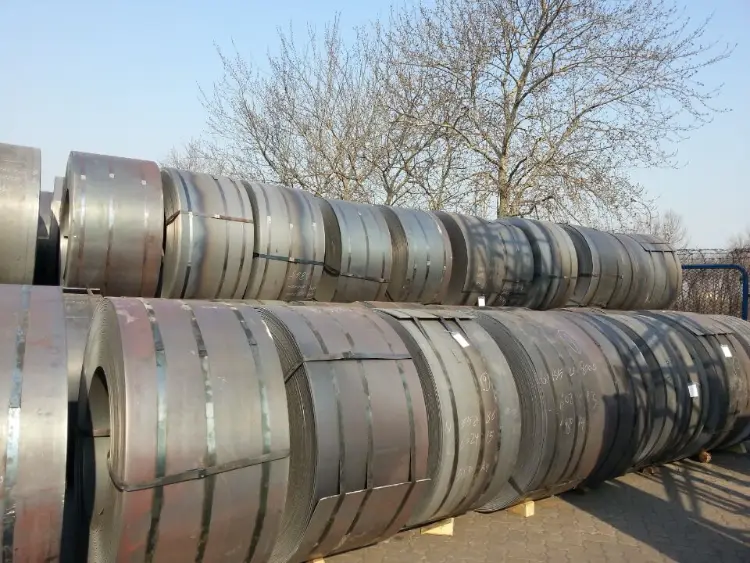
NK D32 Shipbuilding Steel Coil
NK D32 Shipbuilding Steel Coil - High-Strength Marine Grade for Hull & Offshore Structures
Explore the full material data, chemical composition, mechanical and physical properties of NK D32 shipbuilding steel coil per Nippon Kaiji Kyokai (ClassNK) rules. Equivalent grades and application guide included.
Hot rolling, normalized rolling, thermo-mechanical controlled processing (TMCP), bending, welding, cutting, machining
- Phone : +8618037372205
- Email : [email protected]
- WhatsApp: Contact via Whtsapp
- WeChat: +8618037372205
NK D32 Shipbuilding Steel Coil Introduction
NK D32 is a high-strength hull structural steel certified by Nippon Kaiji Kyokai (ClassNK), one of the world's leading classification societies. It belongs to the 32‑kgf/mm² yield strength class (minimum 315 MPa) and is designated with a 'D' toughness grade, indicating guaranteed impact properties at -20 °C. As a normalized or thermo-mechanically controlled rolled (TMCP) product, NK D32 offers excellent weldability, good formability, and reliable low‑temperature toughness, making it ideal for critical applications in ship hulls, offshore platforms, and marine equipment. The steel is typically supplied in coils and subsequently cut into plates or profiles.
The material fully complies with the IACS UR W11 unified requirements, ensuring worldwide recognition. Its balanced chemistry with fine‑grain practice and low carbon equivalent ensures robust performance in harsh marine environments.
NK D32 Shipbuilding Steel Coil Chemical Composition
The chemical composition complies with NK Rules / IACS UR W11 for D32 grade. All values are maximum limits unless a range is indicated. Grain refining elements such as Al, Nb, V, and Ti are added singly or in combination to achieve the required fine‑grained structure and mechanical properties. The carbon equivalent (CEV) is controlled to guarantee weldability.
| Element | Standard Value | Remarks |
|---|---|---|
| Carbon (C) | ≤ 0.18 | Crucial for strength and weldability; lower is better for toughness |
| Manganese (Mn) | 0.90 – 1.60 | Provides solid‑solution strengthening and enhances hardenability |
| Silicon (Si) | ≤ 0.50 | Deoxidiser; contributes to strength |
| Phosphorus (P) | ≤ 0.035 | Maximum limit to avoid embrittlement |
| Sulfur (S) | ≤ 0.035 | Maximum limit to ensure internal soundness and toughness |
| Aluminium (Al) (acid soluble) | ≥ 0.015 | Mandatory for fine‑grain practice |
| Niobium (Nb) | ≤ 0.05 | Optional microalloy; refines grain and increases strength |
| Vanadium (V) | ≤ 0.10 | Optional microalloy; used for precipitation strengthening |
| Titanium (Ti) | ≤ 0.02 | Optional; often used for nitrogen fixation |
| Copper (Cu) | ≤ 0.35 | Residual element; beneficial for corrosion resistance |
| Chromium (Cr) | ≤ 0.20 | Residual element |
| Nickel (Ni) | ≤ 0.40 | Residual element; improves toughness |
| Molybdenum (Mo) | ≤ 0.08 | Residual element |
| Nitrogen (N) | ≤ 0.009 | If not fixed by Al and Ti, higher values may be permitted |
| Carbon Equivalent (CEV) | ≤ 0.38 (typically ≤ 0.36) | CEV = C + Mn/6 + (Cr+Mo+V)/5 + (Ni+Cu)/15, based on ladle analysis |
NK D32 Shipbuilding Steel Coil Thermal and Electrical Physical Properties
The following physical properties are typical values for carbon‑manganese structural steels of similar composition. They are not part of the mandatory NK classification survey but are essential for design calculations and finite element analysis. Actual values may vary slightly depending on the final microstructure (normalized or TMCP).
| Property | Typical Value | Unit | Test Condition / Remarks |
|---|---|---|---|
| Density (ρ) | 7850 | kg/m³ | At 20 °C |
| Modulus of elasticity (E) | 205 – 210 | GPa | At 20 °C, longitudinal |
| Shear modulus (G) | ≈ 80 | GPa | Calculated from E and Poisson's ratio |
| Poisson's ratio (ν) | 0.29 – 0.30 | – | In the elastic range |
| Thermal expansion coefficient (α) | 12.0 – 12.5 | 10⁻⁶/K | Mean coefficient from 20 °C to 100 °C |
| Thermal expansion coefficient (α) | 13.0 – 13.5 | 10⁻⁶/K | Mean coefficient from 20 °C to 200 °C |
| Thermal conductivity (λ) | 50 – 52 | W/(m·K) | At 100 °C |
| Thermal conductivity (λ) | 45 | W/(m·K) | At 300 °C |
| Specific heat capacity (cₚ) | 460 – 480 | J/(kg·K) | At 20 °C – 100 °C |
| Electrical resistivity (ρₑ) | 0.20 – 0.25 | µΩ·m | At 20 °C |
NK D32 Shipbuilding Steel Coil Mechanical Properties
Mechanical properties are determined on test pieces taken transverse to the rolling direction (for plates) or longitudinal (for sections) and conform to NK Rules / IACS UR W11. Values are valid for thicknesses ≤ 50 mm unless otherwise noted. Impact tests are performed on Charpy V‑notch specimens at -20 °C.
| Property | Standard Requirement | Unit | Test Condition / Remarks |
|---|---|---|---|
| Yield Strength (ReH) | ≥ 315 | MPa | For thickness ≤ 50 mm; may be slightly reduced for thicker products |
| Tensile Strength (Rm) | 440 – 590 | MPa | Minimum and maximum range |
| Elongation after fracture (A) | ≥ 22 | % | Gauge length L₀ = 5.65√S₀, transverse test piece |
| Impact energy (KV₂) | ≥ 31 (longitudinal) | J | Charpy V‑notch, -20 °C, average of three tests; individual minimum 22 J |
| Impact energy (KV₂) | ≥ 24 (transverse) | J | Charpy V‑notch, -20 °C, average of three tests; individual minimum 17 J |
| Bend test (bending angle 180°) | d = 3t | – | Bend over a former of diameter three times the specimen thickness t; no cracks or ruptures |
NK D32 Shipbuilding Steel Coil Completely Equivalent Material Standards / Replaceable Grades
| Country / Region | Standard / Classification Society | Grade / Designation | Remarks |
|---|---|---|---|
| Global (IACS members) | ABS Rules | ABS D32 | Identical mechanical and toughness specifications |
| Global (IACS members) | BV Rules | BV D32 | Same requirements as NK D32 |
| Global (IACS members) | CCS Rules | CCS D32 | China Classification Society equivalent |
| Global (IACS members) | DNV Rules | DNV D32 | Det Norske Veritas equivalent |
| Global (IACS members) | KR Rules | KR D32 | Korean Register equivalent |
| Global (IACS members) | LR Rules | LR D32 | Lloyd's Register equivalent |
| Global (IACS members) | RINA Rules | RINA D32 | Italian classification society equivalent |
| Global (IACS members) | RS Rules | RS D32 | Russian Maritime Register equivalent |
| Europe / International | EN 10025‑4 | S355ML (to be verified) | Thermo‑mechanically rolled structural steel with comparable yield strength; may need supplementary impact test at -20 °C and special approval for marine use |
| International | ISO 4995 | HR355‑D (draft) | Hot‑rolled structural sheet; similar strength and ductility, not certified for shipbuilding without approval |
NK D32 Shipbuilding Steel Coil Application Introduction
NK D32 steel, with its balanced strength, toughness and weldability, is widely used in ship and offshore engineering. It can be processed into a variety of products through cutting, bending, welding, and machining. Below are typical application sectors, end‑products, and specific components:
Product Applications: Steel coils and cut‑to‑length plates, Welded H‑beams and I‑beams, Cellular beams, Ship sections (profile structures), Spiral or longitudinally welded pipes (for piling), Fabricated nodes for jacket structures
Processed into products: Hull shell plates (bottom, side, bilge keel), Deck stringers and sheer strakes, Transverse web frames, Longitudinal stiffeners, Bulkhead panels, Hatch coamings and corner castings, Crane pedestals and A‑frames, Jacket braces and leg chords, Pile sleeves and cone connections, Transition pieces for offshore wind turbines
Application industries: Shipbuilding (hull structures, decks, bulkheads, stiffeners), Offshore engineering (jack‑up legs, topside modules, jacket primary members), Bridge and infrastructure (large welded girders, piers), Heavy machinery (crane booms, excavator arms), Pressure vessels and storage tanks (for low‑temperature LPG/ammonia service when impact tested accordingly), Port and harbour construction (sheet pile walls, combi‑wall systems)
NK D32 Shipbuilding Steel Coil Similar / Alternative Materials with Comparable Performance
| Country / Region | Standard | Grade / Designation | Remarks |
|---|---|---|---|
| IACS Members | Classification Society Rules | AH32 | Same strength level but with impact requirement at 0 °C instead of -20 °C; suitable for less severe service conditions |
| IACS Members | Classification Society Rules | EH32 | Same strength level but with impact requirement at -40 °C; superior low‑temperature toughness for arctic‑class vessels |
| Europe | EN 10025‑2 | S355J2+N | Structural steel with 355 MPa min. yield and guaranteed impact at -20 °C. Not approved for ship hulls without additional certification but often used in offshore and bridge construction |
| Japan | JIS G 3106 | SM490A/B/C | Welded structural steel with 325‑365 MPa yield (thickness dependent). SM490B offers impact test at 0 °C; SM490C at 0 °C or -20 °C according to specification. Not certified for marine classification without supplementary testing |
| USA | ASTM A131 / A131M | Grade EH32 (or DH32) | Identical in concept; DH32 matches -20 °C, EH32 provides -40 °C. Recognized by many shipyards globally |
Notes:
- When ordering NK D32 steel, the certificate must be issued by Nippon Kaiji Kyokai or a surveyor acting on its behalf. All marking and documentation must comply with the NK Rules.
- For thicknesses above 50 mm, the mechanical properties may be subject to special agreement; the minimum yield strength may be reduced stepwise as per the rules.
- The steel is normally supplied with shop primer (e.g. inorganic zinc silicate) for temporary corrosion protection unless otherwise agreed.
- Welding consumables must be approved for the grade and the required heat input range, and preheat may be applied depending on the combined thickness and carbon equivalent.
- If the material is to be used in critical structural applications exposed to seawater or low temperatures, supplementary through‑thickness properties (Z‑direction) according to class rules should be specified in the order.
- All data provided herein reflect typical values based on the current edition of NK Rules and IACS UR W11; for the latest requirements always refer to the official rule documents.
- Share



