
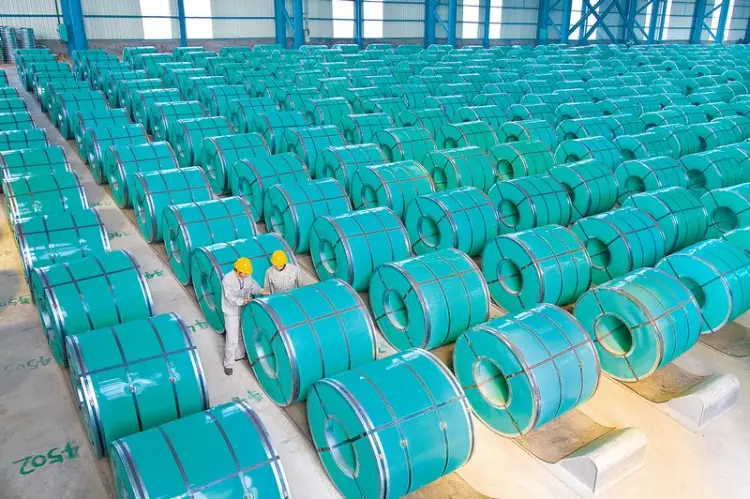
LR Grade E Shipbuilding Steel Coil
LR Grade E Shipbuilding Steel Coil: Low-Temp Marine Hull Steel
Complete data on LR Grade E shipbuilding steel coil: chemical composition, mechanical and thermal properties, international equivalents, and application guidance as per Lloyd's Register rules.
Hot Rolling, Controlled Rolling, Normalising, Welding, Cutting, Forming
- Phone : +8618037372205
- Email : [email protected]
- WhatsApp: Contact via Whtsapp
- WeChat: +8618037372205
LR Grade E Shipbuilding Steel Coil Introduction
LR Grade E is a normal-strength hull structural steel certified by Lloyd's Register (LR) for shipbuilding and marine construction. It delivers a minimum yield strength of 235 MPa and a tensile strength between 400 and 520 MPa. The "E" grade indicates superior low-temperature toughness: it guarantees a Charpy V‑notch impact energy of at least 27 J at -40°C (longitudinal).
Key features:
- Fine‑grained microstructure achieved through normalising or controlled rolling.
- Excellent weldability and resistance to brittle fracture in cold seawater environments.
- Supplied as hot‑rolled coils, plates, or sheets in normalised, normalised rolled, or thermomechanically rolled condition.
- Widely adopted for ship hulls, decks, superstructures, and offshore components where notch toughness at low temperature is mandatory.
LR Grade E Shipbuilding Steel Coil Chemical Composition
The following limits apply to ladle analysis in accordance with Lloyd's Register Rules for normal strength Grade E. Aluminium is typically used as a grain‑refining element; the total aluminium content and Al:N ratio are controlled to ensure fine austenitic grain size. Residual elements such as chromium, nickel, copper, and molybdenum are generally limited to 0.25 % each.
| Element | Standard Requirement | Remarks |
|---|---|---|
| Carbon, C | ≤0.18 | max |
| Silicon, Si | ≤0.50 | max |
| Manganese, Mn | 0.70 – 1.40 | range |
| Phosphorus, P | ≤0.035 | max |
| Sulfur, S | ≤0.035 | max |
| Aluminium, Al (total) | ≥0.015 | min, if used for grain refinement |
| Nitrogen, N | ≤0.009 | max (when Al is used) |
| Cr + Ni + Cu + Mo (residuals) | ≤0.25 each | max per element |
LR Grade E Shipbuilding Steel Coil Thermal and Electrical Physical Properties
The following physical properties are typical for carbon‑manganese structural steels at room temperature unless otherwise noted. They are not part of LR mandatory requirements but are widely used in engineering calculations.
| Property | Typical Value | Unit | Test Condition / Remarks |
|---|---|---|---|
| Density (ρ) | 7.85 | g/cm³ | at 20°C |
| Elastic Modulus (E) | 200 – 210 | GPa | at 20°C; typically 205 GPa |
| Shear Modulus (G) | ≈80 | GPa | calculated from E and ν |
| Poisson's Ratio (ν) | 0.30 | – | elastic region |
| Thermal Expansion Coefficient (α) | 11.7 × 10⁻⁶ | K⁻¹ | 20–100°C |
| Thermal Conductivity (λ) | 50 | W/(m·K) | at 20°C |
| Specific Heat Capacity (cp) | 460 | J/(kg·K) | at 20°C |
| Electrical Resistivity (ρe) | 0.15 – 0.20 | μΩ·m | at 20°C; typical 0.16 μΩ·m |
LR Grade E Shipbuilding Steel Coil Mechanical Properties
Mechanical properties are determined on test specimens taken from the finished product in the delivery condition. The values below are the minimum or range requirements specified in LR Rules for Grade E plates and coils. For thicknesses above 100 mm, separate certification agreements apply.
| Property | Standard Requirement | Unit | Test Condition |
|---|---|---|---|
| Yield Strength (ReH) | ≥235 | MPa | t ≤ 100 mm, transverse |
| Tensile Strength (Rm) | 400 – 520 | MPa | t ≤ 100 mm, transverse |
| Elongation (A5) | ≥22 | % | t ≤ 50 mm, longitudinal, gauge L=5.65√So |
| Elongation (A5) | ≥19 | % | 50 < t ≤ 70 mm, longitudinal |
| Elongation (A5) | ≥17 | % | 70 < t ≤ 100 mm, longitudinal |
| Impact Energy (KV) at -40°C | ≥27 | J | Longitudinal, min average of 3 specimens |
| Impact Energy (KV) at -40°C | ≥20 | J | Transverse (if specified), min average |
| Bend Test (180°) | No cracks | – | D=2t (t≤20mm); D=3t (t>20mm) |
LR Grade E Shipbuilding Steel Coil Full Equivalent Material Standards and Replaceable Grades
| Country / Region | Standard | Grade | Remarks |
|---|---|---|---|
| International (IACS) | UR W11 | Grade E | Normal strength, -40°C impact |
| United States | ABS Rules | Grade E | American Bureau of Shipping |
| Norway/Germany | DNV Rules | NV E | Det Norske Veritas |
| France | BV Rules | Grade E | Bureau Veritas |
| China | CCS Rules | Grade E | China Classification Society |
| Korea | KR Rules | Grade E | Korean Register |
| Japan | NK Rules | Grade E | Nippon Kaiji Kyokai |
| Italy | RINA Rules | Grade E | Registro Italiano Navale |
| Russia | RS Rules | Grade E | Russian Maritime Register |
LR Grade E Shipbuilding Steel Coil Application Introduction
LR Grade E is primarily used in marine environments where reliable low‑temperature toughness is essential. It forms the backbone of ship hulls and offshore structures, and can be processed into various shapes by welding, cutting, and forming without losing its certified properties.
Typical industries and products include:
Product Applications: Ship hull plates (side, bottom, weather decks), Superstructure framing and bulkheads, Cargo hold internals and hatch covers, Offshore platform decks, helidecks, and modules, Floating production storage and offloading (FPSO) units
Processed into products: Main deck and side shell plates, Longitudinal and transverse stiffeners, Web frames and stringers, Bulkhead panels and brackets, Rudders, stern frames, and skeg, Hatch coamings and container support structures
Application industries: Shipbuilding (cargo, passenger, naval vessels), Marine Engineering (docks, piers, floating structures), Offshore Oil & Gas (platforms, jackets), Barge and tug construction, Defence and Coast Guard vessels
LR Grade E Shipbuilding Steel Coil Similar / Alternative Materials with Close Performance
| Country / Region | Standard | Grade | Remarks |
|---|---|---|---|
| United States | ASTM A131/A131M | Grade E | Marine steel, identical strength and -40°C impact; intended for shipbuilding |
| China | GB 712 | E | Mirrors LR Grade E; yield 235 MPa, -40°C Charpy |
| European Union | EN 10025-2 | S235J2 | Structural steel, 235 MPa yield, -20°C impact (not marine‑specific; lower toughness temperature) |
| International | ISO 630-2 | S235G2 | Structural steel, comparable strength, not shipbuilding‑qualified |
Notes:
For thicknesses greater than 100 mm, additional through‑thickness properties or special agreement with the classification society may be required. Preheating (typically 50–100°C) is recommended for welding sections thicker than 40 mm to prevent hydrogen cracking. Normalising or thermomechanical rolling is essential to achieve fine‑grain structure and satisfy impact requirements. This steel is not suitable for cryogenic liquid gas containment; for such applications, nickel steels or austenitic stainless steels are used.
- Share



