
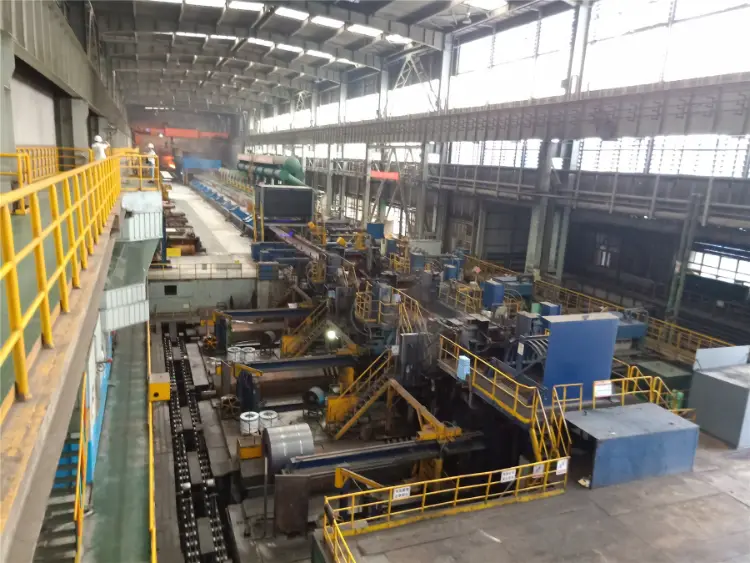
LR Grade D Shipbuilding Steel Coil
LR Grade D Shipbuilding Steel Coil - Properties, Equivalents & Applications
Comprehensive material data for LR Grade D shipbuilding steel coil: chemical composition, mechanical properties, thermal and electrical physical properties, international equivalents, and application guide.
Cutting, welding, bending, forming, machining
- Phone : +8618037372205
- Email : [email protected]
- WhatsApp: Contact via Whtsapp
- WeChat: +8618037372205
LR Grade D Shipbuilding Steel Coil Introduction
LR Grade D is a normal-strength hull structural steel grade certified by Lloyd's Register (LR). It is widely used in the construction of ships and offshore structures. This steel is typically supplied as hot-rolled coils or plates and offers good weldability, toughness, and formability.
- Minimum yield strength of 235 MPa at ambient temperature
- Impact tested at -20°C (KV 27 J longitudinal)
- Suitable for welded ship hulls, decks, and structural members
- Complies with IACS UR W11 and LR Rules for Materials
LR Grade D Shipbuilding Steel Coil Chemical Composition
The chemical composition of LR Grade D shall meet the limits specified by Lloyd's Register Rules. All values are maximum unless a range is indicated. The steel is typically fully killed and may contain grain refining elements.
- Carbon content is limited to ensure good weldability.
- Phosphorus and sulfur are tightly controlled for toughness and corrosion resistance.
| Element | Standard Value (max %) | Remarks |
|---|---|---|
| Carbon (C) | 0.21 | If thickness > 25 mm, max C may be reduced to 0.20% by agreement |
| Manganese (Mn) | ≥ 0.80 (for t ≤ 12.5 mm ≥ 0.60 is acceptable) | Minimum value; may be higher for thick products |
| Silicon (Si) | 0.50 | Maximum; lower limits may apply if deoxidised with Si |
| Phosphorus (P) | 0.035 | Max |
| Sulfur (S) | 0.035 | Max |
| Aluminum (Al, acid soluble) | ≥ 0.015 | Required for grain refinement; total Al may be agreed |
| Niobium (Nb) | 0.02 – 0.05 | Optional grain refiner; if used, typical range |
| Vanadium (V) | 0.05 – 0.10 | Optional; may be added singly or in combination |
| Titanium (Ti) | 0.02 | Optional; if used for grain refinement |
| Copper (Cu) | 0.35 | Max if specified; for improved corrosion resistance |
| Nickel (Ni) | 0.40 | Max if specified |
| Chromium (Cr) | 0.20 | Max if specified |
| Molybdenum (Mo) | 0.08 | Max if specified |
| Nitrogen (N) | 0.009 | Max, unless bound by grain refiners; if total Al ≥ 0.020 or sufficient Nb/V, higher N allowed |
LR Grade D Shipbuilding Steel Coil Thermal & Electrical Physical Properties
The following physical properties are approximate for low-carbon steel and are not part of the LR specification. They are provided for engineering calculations. Values may vary slightly with composition and temperature.
- Density is standard for construction steel.
- Modulus values are for ambient temperature.
| Property | Approximate Value | Unit | Test Condition |
|---|---|---|---|
| Density (ρ) | 7850 | kg/m³ | At 20°C |
| Modulus of Elasticity (E) | 200 – 210 | GPa | At 20°C |
| Shear Modulus (G) | 80 – 85 | GPa | At 20°C |
| Poisson Ratio (ν) | 0.30 | - | At 20°C |
| Thermal Expansion Coefficient (α) | 11.5 – 12.5 x 10⁻⁶ | 1/K | 20 – 100°C |
| Thermal Conductivity (λ) | 50 – 54 | W/(m·K) | At 20°C |
| Specific Heat Capacity | 460 – 480 | J/(kg·K) | At 20°C |
| Electrical Resistivity (ρ_e) | 0.14 – 0.20 | µΩ·m | At 20°C |
LR Grade D Shipbuilding Steel Coil Mechanical Properties
Mechanical properties are determined on test pieces taken in the transverse direction (unless longitudinal is specified for coil products). Values shown are minimum for yield and elongation, and range for tensile strength. Charpy impact test temperature is -20°C.
- For thicknesses ≤ 100 mm, properties are valid as per LR rules.
- Bend test may be specified; it should be free from cracks.
| Property | Requirement | Unit | Test Condition / Remarks |
|---|---|---|---|
| Yield Strength (ReH) | ≥ 235 | MPa | Upper yield, for thickness ≤ 100 mm; for t > 100 mm, min may be 215 MPa |
| Tensile Strength (Rm) | 400 – 520 | MPa | For all thicknesses up to 100 mm |
| Elongation (A5) | ≥ 22 (longitudinal), ≥ 20 (transverse) | % | Gauge length 5.65√S0; longitudinal test for coil; transverse for plates |
| Charpy Impact (KV) | ≥ 27 (longitudinal), ≥ 20 (transverse) | J | Test temperature -20°C; average of three specimens, individual min 70% of average |
LR Grade D Shipbuilding Steel Coil Fully Equivalent Grades
| Country/Region | Standard | Grade | Remarks |
|---|---|---|---|
| International | IACS UR W11 | D | Normal-strength hull structural steel, impact @ -20°C |
| Lloyd's Register | LR Rules | LR D | Original grade |
| American Bureau of Shipping | ABS Rules | ABS Grade D | Identical requirements |
| Bureau Veritas | BV Rules | BV D | Identical |
| DNV | DNV Rules | DNV D | Now part of DNV GL (Grade D) |
| China Classification Society | CCS Rules | CCS D | Identical |
| Korean Register | KR Rules | KR D | Identical |
| Nippon Kaiji Kyokai | NK Rules | NK D | Identical |
| Registro Italiano Navale | RINA Rules | RINA D | Identical |
LR Grade D Shipbuilding Steel Coil Application Introduction
LR Grade D steel coils and plates are primarily used in the construction of seagoing vessels and offshore platforms. The grade offers reliable toughness at low temperatures, making it suitable for hull structures that may be exposed to cold water.
- Welding consumables should be selected to match the base metal strength and toughness (e.g., low-hydrogen electrodes).
- Forming operations like bending and flanging can be performed at ambient temperature for thicknesses up to 25 mm; thicker material may require preheating.
- Surface preparation and coating should follow IMO PSPC standards if for water ballast tanks.
Product Applications: Ship hull plating (outer shell, bulkheads, decks), Stiffeners, frames, and girders, Bulk carriers, container ships, tankers, Barge and pontoon structures, Offshore wind turbine transition pieces (if accepted by class)
Processed into products: Main deck plates, Bottom shell plates, Side shell plates, Longitudinal and transverse frames, Bracket plates, Beams and vertical struts, Hatch coamings, Bollard and mooring fittings (hot-rolled base material)
Application industries: Shipbuilding (commercial vessels, naval ships, barges), Marine and offshore engineering (platforms, FPSO), Port and harbor construction (dock gates, caissons), Structural steel fabrication (bridges, industrial buildings near coastal environments)
LR Grade D Shipbuilding Steel Coil Similar Materials
| Country/Region | Standard | Grade | Remarks |
|---|---|---|---|
| Europe | EN 10025-2 | S235J2 (+N or +AR) | Yield 235 MPa, impact -20°C (27 J). Lacks specific shipbuilding certifications; stricter chemistry and deoxidation not guaranteed. |
| USA | ASTM A131 / A131M | Grade D | Equivalent strength, but exact LR acceptance may need separate certification. |
| China | GB/T 712 | D | China standard for shipbuilding steel. Usually accepted by class societies when certified to IACS. |
| Russia | GOST R 52927 | D | Strength and impact match, but full equivalence depends on mill certification. |
Notes:
LR Grade D steel is typically supplied with a class society certificate (3.2 certificate) confirming compliance with LR rules. The material is suitable for cold bending and welding under controlled conditions. For thicknesses above 50 mm, post-weld heat treatment may be recommended after major fabrications. The steel is not intended for elevated temperature service; for applications above 200°C, creep properties should be verified. Magnetic permeability is typical of carbon steel (~ferromagnetic).
- Share



