
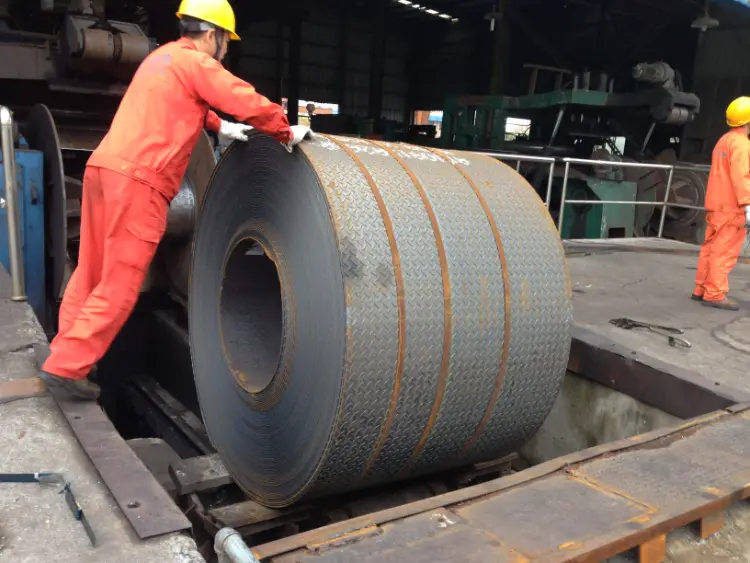
LR Grade B Shipbuilding Steel Coil
LR Grade B Shipbuilding Steel Coil – Lloyd's Register Certified Hull Structural Steel
Comprehensive data sheet for LR Grade B shipbuilding steel coil: chemical composition, mechanical properties, thermal and electrical physical properties, international equivalents, and applications in marine construction.
Hot rolling, cold bending, welding, cutting, forming
- Phone : +8618037372205
- Email : [email protected]
- WhatsApp: Contact via Whtsapp
- WeChat: +8618037372205
LR Grade B Shipbuilding Steel Coil Introduction
LR Grade B is a normal-strength hull structural steel certified by Lloyd's Register (LR), widely used in the construction of ships and offshore structures. It offers a minimum yield strength of 235 MPa, good weldability, and reliable low-temperature toughness at 0 °C. The steel is typically supplied as hot-rolled coils, plates, or sections, and is suitable for cold forming and welding. It complies with the rigorous requirements of the LR Rules for the Manufacture, Testing and Certification of Materials.
- Excellent balance of strength and ductility
- Good notch toughness at moderate temperatures
- Widely accepted by major classification societies
LR Grade B Shipbuilding Steel Coil Chemical Composition , Ladle Analysis
The chemical composition of LR Grade B is specified by Lloyd's Register to ensure weldability, toughness, and corrosion resistance. The steel is typically fully killed and fine-grain treated, with aluminium as a grain refiner. Elements not listed are controlled as residuals.
- Carbon equivalent (CEV) is usually limited for welding considerations.
- All values are maximum unless a range is given.
| Element | Standard Value (% by mass) | Remarks |
|---|---|---|
| Carbon (C) | ≤ 0.21 | Max 0.21% for all thicknesses |
| Manganese (Mn) | ≥ 2.5 × C, typically 0.60 – 1.40 | Minimum Mn based on carbon content; actual range depends on thickness |
| Silicon (Si) | 0.10 – 0.50 | Range for killed steel practice |
| Phosphorus (P) | ≤ 0.035 | Residual element |
| Sulfur (S) | ≤ 0.035 | Residual element |
| Aluminium (Al, acid soluble) | ≥ 0.015 | For fine-grain practice; total Al may also be specified |
| Chromium (Cr) | ≤ 0.20 | Residual |
| Nickel (Ni) | ≤ 0.40 | Residual |
| Copper (Cu) | ≤ 0.35 | Residual |
| Molybdenum (Mo) | ≤ 0.08 | Residual |
| Nitrogen (N) | ≤ 0.009 | Unless sufficient Al is present to fix nitrogen |
| Carbon equivalent (CEV) | Typically ≤ 0.38 | Calculated as C + Mn/6 + (Cr+Mo+V)/5 + (Cu+Ni)/15, value agreed with LR |
LR Grade B Shipbuilding Steel Coil Thermal and Electrical Physical Properties
The physical properties listed below are typical for carbon-manganese structural steel similar to LR Grade B. They are not mandatory requirements but are widely accepted for engineering calculations. Values apply at room temperature unless otherwise specified.
- Properties are essentially identical to those of common mild steel (e.g., S235JR).
- Thermal conductivity decreases with increasing temperature.
| Property | Typical Value | Unit | Test Condition / Temperature |
|---|---|---|---|
| Density (ρ) | 7.85 | g/cm³ | At 20 °C |
| Modulus of elasticity (E) | 210 | GPa | At 20 °C, tension |
| Shear modulus (G) | 81 | GPa | At 20 °C, calculated from E and ν |
| Poisson's ratio (ν) | 0.3 | Elastic range | |
| Thermal expansion coefficient (α) | 12.0 | ×10⁻⁶ /K | Average 20–100 °C |
| Thermal expansion coefficient (α) | 13.8 | ×10⁻⁶ /K | Average 20–300 °C |
| Thermal conductivity (λ) | 50 | W/(m·K) | At 100 °C |
| Thermal conductivity (λ) | 45 | W/(m·K) | At 200 °C |
| Specific heat capacity (cp) | 460 | J/(kg·K) | At 20–100 °C |
| Electrical resistivity (ρe) | 0.18 | 10⁻⁶ Ω·m | At 20 °C, typical for low-carbon steel |
LR Grade B Shipbuilding Steel Coil Mechanical Properties
The mechanical properties specified here are the minimum requirements according to LR Rules for Grade B hull steel. Testing is performed on transverse specimens (tensile) and longitudinal Charpy V-notch specimens in the as-rolled or normalized condition.
- Yield strength and tensile strength depend on product thickness; values shown are for material up to 50 mm thick.
- Impact test temperature is 0 °C.
| Property | Standard Requirement | Unit | Test Condition / Remarks |
|---|---|---|---|
| Yield strength (ReH) | ≥ 235 | MPa | Upper yield or 0.2% proof strength, thickness ≤ 50 mm |
| Tensile strength (Rm) | 400 – 520 | MPa | For all thicknesses |
| Elongation (A) | ≥ 22 | % | Gauge length 5.65√S₀ (L₀=50 mm for thickness ≤ 50 mm) |
| Bend test (d = bend diameter, a = thickness) | 180° bend, d = 3a | For thickness ≤ 25 mm; wider specimens may use d = 4a, no cracks accepted | |
| Charpy impact energy (KV) | ≥ 27 (longitudinal) | J | At 0 °C, specimen 10×10 mm; average of 3 tests, single min 20 J |
| Charpy impact energy (KV) | ≥ 27 (transverse) | J | At 0 °C, if specified by LR for certain applications |
| Hardness (HV10) | Not mandated | HV | Typical 130–170 HV; for information only |
LR Grade B Shipbuilding Steel Coil Fully Equivalent International Standards and Substitute Grades
| Country/Region | Standard | Grade | Remarks |
|---|---|---|---|
| International (IACS) | UR W11 | Grade B | Normal-strength hull steel, common to all IACS societies |
| United States | ABS Rules | ABS Grade B | Identical chemical and mechanical requirements |
| Norway/Germany | DNV Rules | DNV Grade B (NV B) | Widely used; identical acceptance criteria |
| France | BV Rules | BV Grade B | Equivalent in all respects |
| China | CCS Rules | CCS Grade B | Chemical composition and properties match LR Grade B |
| Japan | NK Rules | NK Grade B | Same toughness class (0 °C impact) |
| South Korea | KR Rules | KR Grade B | Fully interchangeable with LR B |
| Italy | RINA Rules | RINA Grade B | Equivalent strength and toughness level |
| Russia | RMRS Rules | RMRS Grade B | Adopted from IACS W11 requirements |
LR Grade B Shipbuilding Steel Coil Application Introduction
LR Grade B steel coil is extensively used in the marine and offshore industry where moderate toughness and good weldability are required. Typical applications demand reliable strength at ambient and low ambient temperatures, and the material is well suited for automated welding and forming.
- Frequently selected for hull plates, beams, and stiffeners
- Approved by all major classification societies for newbuilding and repair
Product Applications: Container vessels, bulk carriers, tankers, general cargo ships, Jack-up rig legs and spudcans, Offshore platform decks and modules, Floating docks and pontoons, Lock gates and shipyard infrastructure
Processed into products: Hull shell plates and bottom plates, Longitudinal and transversal stiffeners, Deck plating and hatch coamings, Bulkhead plates and web frames, Bracket plates, floors, and girders, Superstructure elements (non-exposed), Pipe supports and small fabrications
Application industries: Shipbuilding and ship repair, Offshore oil and gas platforms, Marine engineering, Port and harbor construction, Barge and dredger fabrication, Wind turbine jacket foundations (offshore)
LR Grade B Shipbuilding Steel Coil Similar or Alternative Materials
| Country/Region | Standard | Grade | Remarks |
|---|---|---|---|
| International | LR Rules | LR Grade A | Lower toughness requirement (20 °C impact); otherwise similar strength and chemistry; can substitute where 0 °C toughness is not needed. |
| International | LR Rules | LR Grade D | Higher toughness (-20 °C impact); slightly higher quality; suitable for lower service temperatures, often interchangeable with B but at additional cost. |
| European | EN 10025-2 | S235JR / S235J0 | Structural carbon steel with similar strength (yield 235 MPa); not certified for shipbuilding, but engineering equivalent for non-marine applications. J0 has 0 °C impact. |
| European | EN 10025-2 | S275JR | Higher strength alternative (275 MPa yield) with similar weldability and toughness; sometimes used in shipbuilding with LR approval for non-critical parts. |
| ASTM | A131 / A131M | Grade B | ASTM shipbuilding steel; fully equivalent to LR B and widely recognized in international shipbuilding. |
Notes:
- Thinner gauges (typically below 6 mm) may be supplied as hot-rolled coil and require slightly adjusted elongation values.
- All data are based on the current Lloyd's Register Rules for Materials (2022 edition). For exact project requirements, the latest version of the rules and specific approval documents should be consulted.
- Welding consumables must be matched to the base material and should be qualified in accordance with LR requirements.
- Surface condition: free from harmful scale, pitting, and laminations.
- Share



