
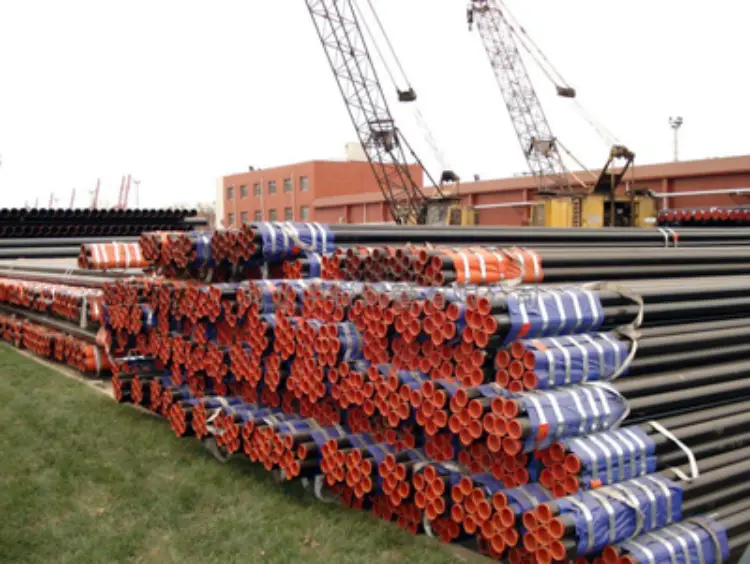
ASTM A312 TP304 Stainless Steel Pipe
ASTM A312 TP304 Stainless Steel Pipe: Comprehensive Guide to Properties, Equivalents & Applications
In-depth analysis of ASTM A312 TP304 austenitic stainless steel pipe, covering chemical composition, mechanical and physical properties, international equivalents, and application guide for industrial use.
Hot Working, Cold Working, Machining, Welding (all common processes), Cold Drawing
- Phone : +8618037372205
- Email : [email protected]
- WhatsApp: Contact via Whtsapp
- WeChat: +8618037372205
ASTM A312 TP304 Stainless Steel Pipe Introduction
ASTM A312 TP304 is an austenitic chromium-nickel stainless steel pipe widely utilized for high-temperature and general corrosive service. As the most common grade within the 300 series, TP304 offers an excellent combination of corrosion resistance, formability, and weldability. Key characteristics include:
- Excellent resistance to a wide range of atmospheric environments and many corrosive media.
- Superior toughness at cryogenic temperatures down to -196°C.
- Good oxidation resistance in intermittent service up to 870°C and continuous service up to 925°C.
- Non-hardenable by heat treatment, readily formed and fabricated.
The material is typically supplied in the solution-annealed condition to ensure optimal ductility and corrosion resistance.
ASTM A312 TP304 Stainless Steel Pipe Chemical Composition as per ASTM A312
The chemical composition of TP304 stainless steel is strictly controlled to ensure a stable austenitic structure and optimum corrosion resistance. The balance is primarily iron (Fe). The specified values represent the heat analysis limits mandated by the ASTM A312 standard. Crucial elements:
- Chromium (Cr) provides the fundamental corrosion resistance by forming a passive chromium oxide layer.
- Nickel (Ni) stabilizes the austenitic structure, enhancing ductility, toughness, and resistance to reducing acids.
- Carbon (C) is maintained at a low level (0.08% max) to inhibit sensitization during welding, which can lead to intergranular corrosion.
| Element | Standard Value (wt%) | Remarks |
|---|---|---|
| Carbon (C) | ≤ 0.08 | Low carbon content minimizes sensitization risk. |
| Manganese (Mn) | ≤ 2.00 | Improves hot working properties and acts as a deoxidizer. |
| Phosphorus (P) | ≤ 0.045 | Considered an impurity, kept low to maintain ductility. |
| Sulfur (S) | ≤ 0.030 | Controlled for improved weldability and surface quality. |
| Silicon (Si) | ≤ 1.00 | Used as a deoxidizer during steelmaking. |
| Chromium (Cr) | 18.0 - 20.0 | Primary element for corrosion and oxidation resistance. |
| Nickel (Ni) | 8.0 - 11.0 | Stabilizes the austenitic (non-magnetic) microstructure. |
| Iron (Fe) | Balance | The base element for the alloy. |
ASTM A312 TP304 Stainless Steel Pipe Physical Properties
These physical properties are typical for ASTM A312 TP304 in the annealed condition and are vital for design engineers calculating thermal stress, heat transfer, and electromagnetic interactions. Understanding these values is critical:
- Thermal Expansion: The expansion rate is relatively high. Design must accommodate dimensional changes during thermal cycling to prevent warping or stress on connected components.
- Thermal Conductivity: The low thermal conductivity, which is further reduced at cryogenic temperatures, makes it an excellent choice for insulation components under stress.
- Electrical Resistivity: The high resistivity, combined with a low temperature coefficient, provides stable electrical heating performance.
Values are for reference and may vary slightly with specific product form and processing.
| Property | Standard Reference Value | Unit | Test Condition |
|---|---|---|---|
| Density (ρ) | 8.0 | g/cm³ | At 20°C |
| Modulus of Elasticity (E) | 193 | GPa | In tension, at 20°C |
| Shear Modulus (G) | 77 | GPa | Calculated from E and ν, at 20°C |
| Poisson's Ratio (ν) | 0.25 | — | At 20°C |
| Coefficient of Thermal Expansion (α) | 17.2 | µm/m·°C | Between 0 and 100°C |
| Coefficient of Thermal Expansion (α) | 17.8 | µm/m·°C | Between 0 and 315°C |
| Coefficient of Thermal Expansion (α) | 18.4 | µm/m·°C | Between 0 and 538°C |
| Thermal Conductivity (λ) | 14.9 | W/m·K | At 20°C |
| Thermal Conductivity (λ) | 18.8 | W/m·K | At 500°C |
| Specific Heat Capacity | 500 | J/kg·K | At 0-100°C |
| Electrical Resistivity (ρe) | 0.72 | µΩ·m | At 20°C |
ASTM A312 TP304 Stainless Steel Pipe Mechanical Properties
The mechanical properties of ASTM A312 TP304 pipes are specified for material in the solution-annealed condition at room temperature. These properties ensure the material can withstand significant forming and service stresses. Key points:
- Yield and Tensile Strength: The specified minimums guarantee structural integrity under pressure. Actual values can be significantly higher.
- Elongation: High ductility, indicated by elongation, allows for bending, flaring, and moderate cold forming without cracking.
- Hardness: The maximum hardness values ensure the material is fully solution-annealed for optimum softness and machinability.
These values are mandatory as per the standard for tension test requirements.
| Property | Standard Required Value | Unit | Test Condition |
|---|---|---|---|
| Tensile Strength (Rm) | ≥ 515 (75) | MPa (ksi) | Room temperature, solution-annealed condition. |
| Yield Strength (ReH, 0.2% offset) | ≥ 205 (30) | MPa (ksi) | Room temperature, solution-annealed condition. |
| Elongation (A) in 2 in. or 50 mm | ≥ 35 | % | For standard longitudinal strip or round bar test specimen. |
| Hardness, Brinell (HBW) | ≤ 192 | HBW | As annealed tube or pipe, 3000kgf load, 10mm ball. |
| Hardness, Rockwell B (HRBW) | ≤ 90 | HRBW | As annealed tube or pipe, 100kgf load, 1/16 in. ball. |
ASTM A312 TP304 Stainless Steel Pipe Completely Equivalent Material Standards and Substitutable Grade Recommendations
| Country/Region | Standard | Designation/ Grade | Remarks |
|---|---|---|---|
| USA/International | ASTM A312 | TP304 (UNS S30400) | The base standard and grade. |
| European Union | EN 10216-5 | 1.4301 (X5CrNi18-10) | Chemically and mechanically equivalent for pressure tubes. |
| Japan | JIS G3459 | SUS304TP | Direct equivalent for corrosion resisting pipes. |
| China | GB/T 14976 | 06Cr19Ni10 (former 0Cr18Ni9) | Equivalent Chinese standard for stainless steel seamless pipes for fluid transport. |
| Russia/Ukraine | GOST 9941 | 08Х18Н10 (08Kh18N10) | Equivalent grade for cold-worked and hot-worked seamless tubes. |
ASTM A312 TP304 Stainless Steel Pipe Application Introduction
ASTM A312 TP304 is the workhorse of the stainless steel pipe industry, renowned for its versatility across a vast spectrum of applications. Its selection is typically based on a balance of corrosion resistance in moderately aggressive environments, excellent fabrication characteristics, and favorable economics compared to higher-alloyed grades. Key application logic:
- Corrosion Service: Ideal for organic chemicals, dyestuffs, and wide-ranging atmospheric exposures. Not suitable for strong reducing acids like hydrochloric acid or stagnant seawater.
- Hygiene: The smooth, non-porous surface resists bacterial growth and is easily cleaned, making it perfect for sanitary applications.
- Thermal Cycling: Its ductility and toughness accommodate thermal stresses between room and elevated temperatures without brittle fracture.
Product Applications: Process Piping Systems and Manifolds, Heat Exchanger Tubes and Shells, Boiler and Superheater Tubes, Sanitary Tubing for Food and Pharma, Distillation Columns and Reactor Vessels, Structural Pipe and Handrails, Instrumentation Tubing, Flexible Stainless Steel Hose
Processed into products: Flanges, Fittings (Elbows, Tees, Reducers), Valve Bodies and Components, Tube Sheets and Baffles for Heat Exchangers, Spiral Ducts and Exhaust Systems, Sprinkler System Piping, Dairy and Brewing Clamps, Ferrules, and Tubing Coils, Cryogenic Liquid Fuel Piping and Fittings
Application industries: Chemical and Petrochemical Processing, Food and Beverage Production (Dairy, Brewery, Winery), Oil and Gas (refineries, LNG plants, subsea flowlines), Pulp and Paper Industry, Power Generation (boiler tubes, feedwater heaters), Pharmaceutical and Biotechnology, Architecture and Construction (water supply, handrails), Cryogenics (storage and transfer of liquefied gases)
ASTM A312 TP304 Stainless Steel Pipe Recommendations for Similar/Proximate Substitute Materials
| Country/Region | Standard | Designation/ Grade | Remarks |
|---|---|---|---|
| USA | ASTM A312 | TP304L (UNS S30403) | Extra-low carbon (≤0.03%) version for enhanced as-welded corrosion resistance. Slightly lower strength. |
| USA | ASTM A312 | TP304H (UNS S30409) | Higher carbon version (0.04-0.10%) for better elevated temperature strength above 500°C. |
| Europe | EN 10216-5 | 1.4307 (X2CrNi18-9) | The low-carbon equivalent of 1.4301 for welded structures with improved intergranular corrosion resistance. |
| Europe | EN 10216-5 | 1.4401 (X5CrNiMo17-12-2) | A molybdenum-bearing austenitic grade with significantly higher pitting and crevice corrosion resistance. |
Notes:
Welding Considerations: TP304 is readily weldable by common fusion and resistance methods. Filler metal should be ER308L or E308L. Post-weld annealing is not typically required for thicknesses under 6 mm. For thicker sections or services involving intergranular corrosion risk, TP304L is preferred. Hardening: This material work-hardens rapidly during cold forming, which can be used to increase strength but may require intermediate annealing for severe deformation. It cannot be hardened by heat treatment. Magnetic Properties: The solution-annealed condition is essentially non-magnetic (<1.0 permeability), but cold working can induce a slight magnetic response in the deformed areas.
- Share



