
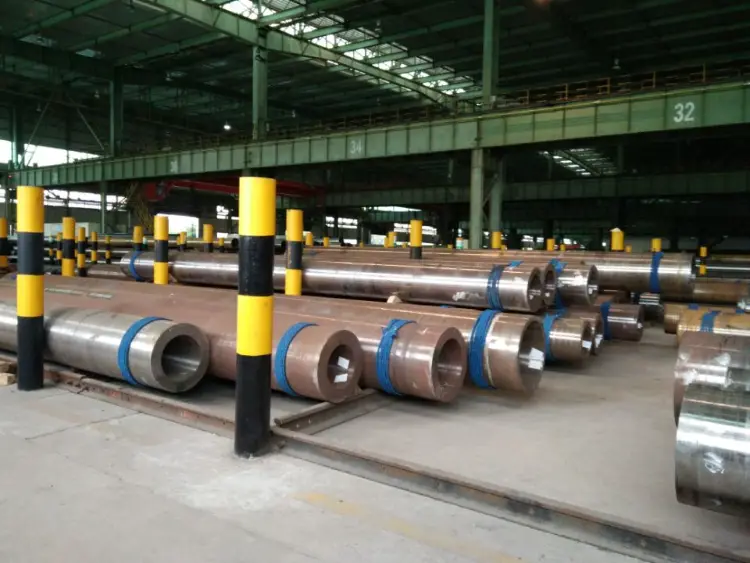
ASTM A312 TP304L Stainless Steel Pipe
ASTM A312 TP304L Stainless Steel Pipe: Composition, Properties, and Equivalents
Comprehensive material data for ASTM A312 TP304L stainless steel pipe, including chemical composition, mechanical and physical properties, international equivalents, and application guidance.
Cold forming, hot forming, welding (TIG, MIG, SAW), machining, pickling, passivation
- Phone : +8618037372205
- Email : [email protected]
- WhatsApp: Contact via Whtsapp
- WeChat: +8618037372205
ASTM A312 TP304L Stainless Steel Pipe Introduction
ASTM A312 TP304L is an austenitic chromium-nickel stainless steel pipe grade with ultra-low carbon content, providing enhanced resistance to intergranular corrosion after welding or stress relieving. It is the low-carbon variant of TP304, widely used for seamless and welded pipes in corrosive and high-temperature environments. Key characteristics include:
- Excellent corrosion resistance in a wide range of atmospheric environments and many corrosive media
- Good formability and weldability without post-weld annealing
- High toughness down to cryogenic temperatures
- Non-magnetic in the annealed condition
ASTM A312 TP304L Stainless Steel Pipe Chemical Composition
Chemical composition requirements for TP304L according to ASTM A312/A312M, UNS designation S30403. The low carbon content (max 0.030%) minimizes carbide precipitation during welding.
| Chemical Element | Standard Value | Remarks |
|---|---|---|
| Carbon (C) | ≤0.030 | Ultra-low carbon to prevent sensitization |
| Manganese (Mn) | ≤2.00 | General austenite stabilizer |
| Phosphorus (P) | ≤0.045 | Residual element |
| Sulfur (S) | ≤0.030 | Improved machinability grades may have higher controlled S |
| Silicon (Si) | ≤1.00 | Deoxidizer; higher Si may improve oxidation resistance |
| Chromium (Cr) | 18.0–20.0 | Primary element for corrosion resistance |
| Nickel (Ni) | 8.0–12.0 | Stabilizes austenitic structure |
| Nitrogen (N) | ≤0.10 | Residual; enhances strength but can promote sensitization if uncontrolled |
ASTM A312 TP304L Stainless Steel Pipe Thermal and Electrical Physical Properties
Typical physical properties for 304L stainless steel in the annealed condition. Data are representative for engineering calculations and are not specification requirements. Properties vary slightly with composition and temperature.
| Property | Typical Value | Unit | Test Condition / Temperature |
|---|---|---|---|
| Density (ρ) | 8.00 | g/cm³ | 20°C |
| Elastic Modulus (E) | 193 | GPa | 20°C |
| Shear Modulus (G) | 77 | GPa | 20°C |
| Poisson's Ratio (ν) | 0.29 | — | 20°C |
| Thermal Expansion Coeff. (α) | 16.0 | 10⁻⁶/°C | 20–100°C |
| Thermal Expansion Coeff. (α) | 17.3 | 10⁻⁶/°C | 20–200°C |
| Thermal Expansion Coeff. (α) | 18.0 | 10⁻⁶/°C | 20–500°C |
| Thermal Conductivity (λ) | 16.2 | W/m·K | 100°C |
| Thermal Conductivity (λ) | 18.4 | W/m·K | 300°C |
| Thermal Conductivity (λ) | 21.5 | W/m·K | 500°C |
| Specific Heat Capacity | 500 | J/kg·K | 0–100°C |
| Electrical Resistivity (ρ_e) | 720 | nΩ·m | 20°C |
ASTM A312 TP304L Stainless Steel Pipe Mechanical Properties
Minimum required tensile properties for TP304L pipe at room temperature in the solution-annealed condition per ASTM A312. Elongation requirements vary with wall thickness. The material is ductile and typically undergoes a flattening or guided-bend test instead of impact testing.
| Property | Standard Requirement | Unit | Test Condition |
|---|---|---|---|
| Tensile Strength (Rm) | ≥485 | MPa | Room temperature, longitudinal |
| Yield Strength (ReH, 0.2% offset) | ≥170 | MPa | Room temperature, longitudinal |
| Elongation (A) | ≥35 | % | 50 mm gauge, wall thickness ≤5/16 in. (7.94 mm) |
| Elongation (A) | ≥30 | % | 50 mm gauge, wall thickness >5/16 in. (7.94 mm) |
| Hardness | ≤90 HRB (or 200 HBW) | — | Typical annealed hardness; not required by ASTM A312 |
ASTM A312 TP304L Stainless Steel Pipe Exact Equivalent Material Standards and Substitutable Grades
| Country/Region | Standard | Grade | Remarks |
|---|---|---|---|
| USA | ASTM A312/A312M | TP304L (UNS S30403) | Original specification; also covers A358, A409 etc. for welded pipe |
| International | ISO 9329-4 | X2CrNiN18-10 (similar to 1.4307) | May have slight nitrogen control differences |
| Europe (EN) | EN 10216-5 / EN 10217-7 | 1.4307 (X2CrNi18-9) | Full equivalent; small variation in Ni range (8.0–10.5%) |
| Japan | JIS G3459 | SUS304LTP | Chemically equivalent, similar tensile requirements |
| China | GB/T 14976 | 022Cr19Ni10 (S30403) | Equivalent grade for seamless stainless steel pipes |
| Russia | GOST 9941-81 | 08Ch18N10 (08Х18Н10) approx. | Carbon may be slightly higher; 08X18H10 is a close match but check low-carbon variant |
ASTM A312 TP304L Stainless Steel Pipe Application Introduction
ASTM A312 TP304L pipes are used where corrosion resistance combined with good mechanical properties and fabricability is required. The low carbon content minimizes carbide precipitation, making it the material of choice for welded components that cannot be solution annealed after fabrication. Typical operating temperatures range from cryogenic (-196°C) up to 425°C continuously. It is not recommended for concentrated acids at high temperatures but performs well in food contact, architectural, and general industrial environments.
Product Applications: Process piping systems for corrosive fluids, Sanitary tubing for food and dairy industries, Heat exchanger tubes and shells, Cryogenic transfer lines and storage tanks, Structural hollow sections in corrosive atmospheres, Instrumentation and hydraulic tubing
Processed into products: Pipe spools, elbows, tees, reducers, flanges (welded from pipe), Pressure vessel shells and dished heads (when rolled from plate, but pipe may serve as shell), Tube bundles for shell-and-tube exchangers, Spargers, dip pipes, and injectors in reactors, Handrails and architectural fittings, Cleanroom panels and support frames
Application industries: Chemical and Petrochemical Processing, Food and Beverage Production, Pharmaceutical Equipment, Water Treatment and Desalination, Pulp and Paper Industry, Cryogenic Engineering (LNG, liquid oxygen), Architecture and Construction, Heat Exchanger and Boiler Manufacturing
ASTM A312 TP304L Stainless Steel Pipe Similar or Substitute Materials
| Country/Region | Standard | Grade | Remarks |
|---|---|---|---|
| USA | ASTM A312 | TP304 (UNS S30400) | Higher carbon (max 0.08%); susceptible to sensitization after welding; similar corrosion resistance but inferior weldability |
| USA | ASTM A312 | TP304H (UNS S30409) | Higher carbon (0.04–0.10) for improved high-temperature strength; not recommended for wet corrosion resistance after welding |
| USA | ASTM A312 | TP316L (UNS S31603) | Molybdenum-bearing austenitic steel; better pitting and crevice corrosion resistance; slightly higher cost |
| Europe | EN 10216-5 | 1.4306 (X2CrNi19-11) | Very low carbon (max 0.030); composition close to 304L; considered interchangeable in many applications |
| China | GB/T 14976 | 022Cr17Ni12Mo2 (S31603) | Equivalent to 316L; superior chloride resistance |
Notes:
- Welding: TP304L can be welded by all common processes without preheating. Filler metal should be ER308L or E308L. Post-weld heat treatment is not normally required for service in non-sensitizing environments.
- Corrosion: Resistant to atmospheric exposure, foodstuffs, organic chemicals, and many inorganic chemicals. Not recommended for chloride environments above 60°C due to risk of stress corrosion cracking unless design measures are taken.
- Product forms: ASTM A312 covers seamless, straight-seam welded, and heavily cold-worked welded pipes in schedules 5S through 160 (and beyond).
- Testing: Hydrostatic or nondestructive electric testing is mandatory. Flattening test, bend test, or guided-bend test required depending on pipe size and wall thickness.
- Share



