
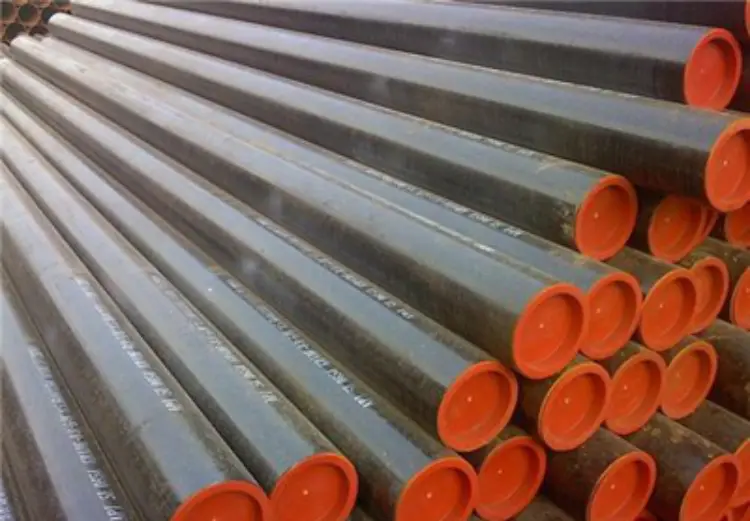
ASTM A312 TP309S Stainless Steel Pipe
ASTM A312 TP309S Stainless Steel Pipe | Austenitic High-Temperature Grade
Comprehensive technical data for ASTM A312 TP309S stainless steel pipe: chemical composition, mechanical properties, physical constants, equivalent grades and typical applications in high-temperature and corrosive environments.
Hot working, cold working, welding (TIG, MIG, SAW, resistance), machining, bending, flaring
- Phone : +8618037372205
- Email : [email protected]
- WhatsApp: Contact via Whtsapp
- WeChat: +8618037372205
ASTM A312 TP309S Stainless Steel Pipe Introduction
ASTM A312 TP309S is an austenitic chromium-nickel stainless steel pipe grade designed for elevated temperature service and moderate corrosion resistance. With a nominal composition of 23% chromium and 13.5% nickel, it offers excellent oxidation resistance up to approximately 1000°C (1830°F) in continuous service. The low carbon content (max 0.08%) minimizes carbide precipitation during welding, reducing susceptibility to intergranular corrosion. This grade combines good strength and ductility in the solution-annealed condition, making it suitable for fabricating components such as heat exchangers, furnace parts, and piping systems in chemical, petrochemical, and power generation industries.
- High chromium and nickel for superior high-temperature oxidation resistance
- Low carbon variant of 309 for improved as-welded corrosion resistance
- Excellent formability and weldability by common fusion and resistance methods
- Non-magnetic in the annealed condition, slightly magnetic after cold working
ASTM A312 TP309S Stainless Steel Pipe Chemical Composition
Chemical composition limits as specified in ASTM A312/A312M for TP309S (UNS S30908). Iron constitutes the balance. All values are maximum unless a range is indicated. The controlled low carbon content (< 0.08%) distinguishes TP309S from the standard TP309 grade to improve weldability and reduce sensitization.
| Element | Content (%) | Remarks |
|---|---|---|
| Carbon (C) | ≤ 0.08 | Max |
| Manganese (Mn) | ≤ 2.00 | Max |
| Silicon (Si) | ≤ 1.00 | Max |
| Phosphorus (P) | ≤ 0.045 | Max |
| Sulfur (S) | ≤ 0.030 | Max |
| Chromium (Cr) | 22.0 – 24.0 | Range |
| Nickel (Ni) | 12.0 – 15.0 | Range |
ASTM A312 TP309S Stainless Steel Pipe Physical and Thermal Properties
Typical physical data for fully austenitic 309S stainless steel in the annealed condition. These values are representative for grade and may vary slightly depending on exact composition and heat treatment condition. Useful for furnace design, thermal expansion calculations, and heat transfer analysis.
| Property | Typical Value | Unit | Test Condition / Temperature |
|---|---|---|---|
| Density (ρ) | 7.90 | g/cm³ | 20°C |
| Elastic Modulus (E) | 193 | GPa | 20°C |
| Shear Modulus (G) | 77 | GPa | 20°C |
| Poisson's Ratio (ν) | 0.29 | — | 20°C |
| Thermal Expansion Coefficient (α) | 16.5 | µm/m·°C | 20 – 100°C |
| Thermal Expansion Coefficient (α) | 17.5 | µm/m·°C | 20 – 500°C |
| Thermal Expansion Coefficient (α) | 18.0 | µm/m·°C | 20 – 800°C |
| Thermal Conductivity (λ) | 15.0 | W/m·K | 100°C |
| Thermal Conductivity (λ) | 21.5 | W/m·K | 500°C |
| Specific Heat Capacity (cp) | 500 | J/kg·K | 20°C |
| Electrical Resistivity (ρe) | 0.78 | µΩ·m | 20°C |
ASTM A312 TP309S Stainless Steel Pipe Mechanical Properties
Room temperature tensile requirements per ASTM A312 for TP309S in the solution-annealed condition. Properties apply to longitudinal strip or full-section specimens from pipe walls. Elongation is measured over a 2 in. (50 mm) gauge length. Bending test criteria are applicable only to welded pipe; the bend is performed with the weld at the point of maximum bending.
| Property | Minimum Value | Unit | Test Condition |
|---|---|---|---|
| Tensile Strength (Rm) | 515 | MPa | Room temperature (ASTM A312) |
| Yield Strength (ReH, 0.2% offset) | 205 | MPa | Room temperature (ASTM A312) |
| Elongation (A, longitudinal) | 35 | % | In 50 mm (2 in.) gauge length |
| Elongation (A, transverse) | 25 | % | In 50 mm (2 in.) gauge length (for welded pipe) |
| Bend test (180°) | No cracks | — | Mandrel diameter = 4 × wall thickness; room temperature |
ASTM A312 TP309S Stainless Steel Pipe Completely Equivalent Material Standards and Substitute Grades
The following grades are either direct equivalents or technically identical to ASTM A312 TP309S (UNS S30908) under their respective national or international standards. Slight differences in specified chemistry ranges may exist; users should verify per project specifications.
| Country / Region | Standard | Grade | Remarks |
|---|---|---|---|
| USA | ASTM A312/A312M | TP309S (UNS S30908) | Identical composition and properties |
| Japan | JIS G3459 | SUS309S TP | Chemically equivalent; pipe intended for high temperature service |
| Europe | EN 10216-5 | 1.4833 (X12CrNi23-13) | Approximate – carbon ≤0.15 (slightly higher); check creep requirements |
| International | ISO 2604-2 (withdrawn) | F 52 | Former ISO equivalent, based on similar Cr-Ni range |
ASTM A312 TP309S Stainless Steel Pipe Application Introduction
ASTM A312 TP309S stainless steel pipe is extensively used in industries that require reliable performance at elevated temperatures and in moderately corrosive media. The alloy's high chromium and nickel content provides exceptional protection against oxidation, sulfidation, and carburization at temperatures up to 1000°C, while the low carbon content ensures resistance to intergranular attack after welding. Its good ductility facilitates cold bending and forming into complex piping configurations. Typical sectors and products include:
Product Applications: High-temperature process piping systems, Tube bundles for heat recovery steam generators (HRSG), Radiant furnace coils and convection bank tubes, Expansion joints and bellows, Lances and nozzles in metallurgical furnaces
Processed into products: Seamless and welded pipe spools and fittings (elbows, tees, reducers), Flanges and stub ends for high-temperature bolted connections, Welded tube-to-tubesheet joints for shell-and-tube exchangers, Bent U-tube bundles, Fabricated manifolds and headers, Thin-walled tube for instrument thermowells
Application industries: Petrochemical and refining (furnace tubes, catalytic reformer tubes, transfer lines), Power generation (superheater and reheater tubing, boiler headers, steam piping), Chemical processing (heat exchangers, reactor vessels, high-temperature piping), Cement and steel industries (burner tubes, annealing furnace parts, recuperators), Waste incineration (combustion chambers, flue gas ducts)
ASTM A312 TP309S Stainless Steel Pipe Similar / Alternative Material Recommendations
These grades offer comparable resistance to high-temperature oxidation or corrosion and are sometimes used as substitutes depending on service conditions and availability. Always verify mechanical and chemical requirements before substitution.
| Country / Region | Standard | Grade | Remarks |
|---|---|---|---|
| USA | ASTM A312 | TP309H | Higher carbon (0.04-0.10) version; provides higher creep strength; less suitable where post-weld corrosion resistance is critical |
| USA | ASTM A312 | TP310S | Cr 24-26, Ni 19-22; even better oxidation resistance up to 1100°C, lower strength at moderate temperature |
| USA | ASTM A312 | TP304H | Lower alloy (18Cr-8Ni); cost-effective alternative for lower temperature (<800°C) applications, less oxidation resistance |
| USA | ASTM A312 | TP347H | Niobium-stabilized austenitic stainless; good high-temperature strength and resistance to sensitization when welded |
| Europe | EN 10216-5 | 1.4876 (X10NiCrAlTi32-21) | Heat-resistant alloy with higher nickel, for extreme oxidation/carburization environments |
Notes:
Welding: Use matching or over-alloyed filler metal (AWS ER309LSi or E309L-xx) to maintain corrosion resistance. Preheating is generally not required; interpass temperature should be kept below 150°C. Post-weld solution annealing is recommended for optimum corrosion resistance if service involves sensitizing temperatures.
Forming: Cold forming is readily performed due to high ductility; intermediate annealing may be needed for severe deformation. Hot working range: 1175–900°C (2150–1650°F).
Corrosion: Excellent resistance to oxidizing environments up to 1000°C; however, sulfur-containing reducing atmospheres can attack nickel. For aqueous corrosion service, the alloy is comparable to Type 304 but not suitable for strong reducing acids.
Standards note: The data above are compiled from ASTM A312/A312M and typical published values for 309S stainless steel; always refer to the specific edition of the standard for critical applications.
- Share



