
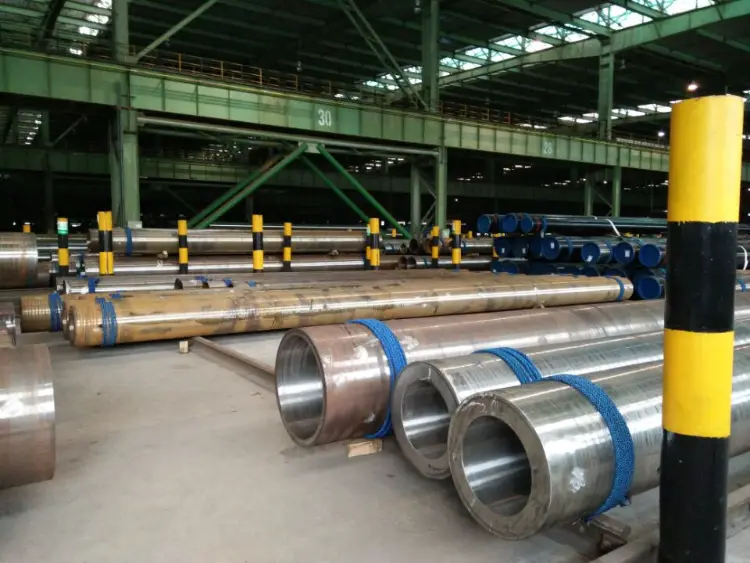
ASTM A312 TP310S Stainless Steel Pipe
ASTM A312 TP310S Stainless Steel Pipe: High-Temperature & Corrosion-Resistant Solution
Comprehensive material data for ASTM A312 TP310S (UNS S31008) stainless steel pipe, including chemical composition, mechanical properties, physical and thermal characteristics, equivalent grades, and application guidance for high-temperature oxidizing environments.
Hot extrusion, cold drawing, welding (GTAW, GMAW, SAW), solution annealing, pickling
- Phone : +8618037372205
- Email : [email protected]
- WhatsApp: Contact via Whtsapp
- WeChat: +8618037372205
ASTM A312 TP310S Stainless Steel Pipe Introduction
ASTM A312 TP310S (UNS S31008) is an austenitic chromium-nickel stainless steel pipe designed for high-temperature service with excellent oxidation resistance up to 1100°C. Its low carbon content minimizes carbide precipitation and enhances weldability while maintaining superior corrosion resistance.
- Excellent creep strength and resistance to thermal fatigue.
- High ductility and weldability, suitable for seamless and welded pipe fabrication.
- Resists sulfidation and carburization in many process environments.
Typically supplied in solution-annealed condition, it is widely used in furnace components, heat exchangers, and petrochemical equipment.
ASTM A312 TP310S Stainless Steel Pipe Chemical Composition
Chemical requirements as per ASTM A312 TP310S (UNS S31008). The low carbon content provides excellent resistance to intergranular corrosion after welding or high-temperature exposure. Chromium and nickel are optimized for oxidation resistance and structural stability.
| Element | Specified Value (%) | Remarks |
|---|---|---|
| Carbon (C) | 0.08 max | Low C improves weldability |
| Manganese (Mn) | 2.00 max | |
| Phosphorus (P) | 0.045 max | |
| Sulfur (S) | 0.030 max | |
| Silicon (Si) | 1.00 max | |
| Chromium (Cr) | 24.0 – 26.0 | Provides oxidation resistance |
| Nickel (Ni) | 19.0 – 22.0 | Stabilizes austenitic structure |
ASTM A312 TP310S Stainless Steel Pipe Thermal, Electrical & Physical Properties
Typical physical and thermal properties for 310S (S31008) stainless steel in the annealed condition. These values are representative for general engineering calculations and may vary slightly depending on the specific product form and processing history. Thermal expansion, conductivity, and electrical resistivity are critical for high-temperature design.
| Property | Typical Value | Unit | Test Condition / Temperature |
|---|---|---|---|
| Density (ρ) | 7.9 | g/cm³ | 20 °C |
| Modulus of Elasticity (E) | 200 | GPa | 20 °C |
| Shear Modulus (G) | 77 | GPa | 20 °C |
| Poisson's Ratio (ν) | 0.28 – 0.30 | — | 20 °C |
| Thermal Expansion Coefficient (α) | 15.5 | 10⁻⁶/K | 20 – 100 °C |
| Thermal Expansion Coefficient (α) | 16.2 | 10⁻⁶/K | 20 – 500 °C |
| Thermal Expansion Coefficient (α) | 17.0 | 10⁻⁶/K | 20 – 1000 °C |
| Thermal Conductivity (λ) | 14.2 | W/(m·K) | 100 °C |
| Thermal Conductivity (λ) | 18.7 | W/(m·K) | 500 °C |
| Specific Heat Capacity (cp) | 500 | J/(kg·K) | 20 °C |
| Electrical Resistivity (ρₑ) | 0.78 | μΩ·m | 20 °C |
ASTM A312 TP310S Stainless Steel Pipe Mechanical Properties
Tensile properties at room temperature as required by ASTM A312 for TP310S seamless and welded pipes in solution-annealed condition. Elongation is based on a gauge length of 50 mm (2 in). These values ensure adequate formability and strength for high-temperature service.
| Property | Specified Value | Unit | Test Condition |
|---|---|---|---|
| Tensile Strength (Rm) | 515 min | MPa | Room temperature |
| Yield Strength (ReH, 0.2% offset) | 205 min | MPa | Room temperature |
| Elongation (A) | 35 min | % | Longitudinal, gauge length 50 mm |
ASTM A312 TP310S Stainless Steel Pipe Equivalent Material Standards & Replaceable Grades
| Country/Region | Standard | Grade | Remarks |
|---|---|---|---|
| USA | ASTM A312 | TP310S (UNS S31008) | Identical; standard for pipe |
| EU | EN 10216-5 / EN 10217-7 | 1.4845 (X8CrNi25-21) | Seamless/welded tube; pipe equivalent |
| Japan | JIS G3459 | SUS310S TP | Pipe for high temperature service |
| China | GB/T 14976 | 06Cr25Ni20 (S31008) | Seamless stainless steel pipe |
| International | ISO 2604-2 | TS9 | Similar chemical composition |
ASTM A312 TP310S Stainless Steel Pipe Application Introduction
ASTM A312 TP310S pipes are employed where high-temperature strength and resistance to oxidizing atmospheres are essential. Typical applications cover industries demanding reliable performance under cyclic heating and corrosive flue gases.
- Excellent for continuous service up to 1150°C and intermittent up to 1035°C.
- Resists scaling in sulfur-containing atmospheres and carburizing environments.
Product Applications: Seamless and welded furnace pipes, Heat exchanger tubes for high-temperature gas-to-gas recuperators, Radiant tubes and retorts, Ethylene cracking tubes, Tube sheets and pressure vessel linings
Processed into products: Burner nozzles and flame holders, Hanger and support structures (e.g., tube supports), Thermowell protection tubes, Flue gas ducts and expansion joints, Piping spools and fittings for hot corrosive gases
Application industries: Petrochemical and Refinery (furnace tubes, reformers), Heat Treatment (radiant tubes, burners, muffles), Power Generation (superheaters, heat recovery steam generators), Chemical Processing (thermal oxidizers, reactors), Steel and Metal Processing (annealing boxes, quenching fixtures)
ASTM A312 TP310S Stainless Steel Pipe Similar or Alternative Material Grades
| Country/Region | Standard | Grade | Remarks |
|---|---|---|---|
| USA | ASTM A312 | TP310 (UNS S31000) | Higher carbon (0.25 max); may be used for lower weldability requirements but similar oxidation resistance |
| USA | ASTM A213 / A312 | TP310H (UNS S31009) | Carbon 0.04–0.10, higher creep strength; preferred for high-temperature structural applications |
| USA | ASTM A312 | TP309S (UNS S30908) | Lower Cr-Ni (22-24Cr, 12-15Ni); suitable for less severe oxidation up to ~980°C |
| EU | EN 10095 | 1.4841 (X15CrNiSi25-21) | Similar oxidation resistance with higher Si for improved scaling resistance |
| China | GB/T 14976 | 06Cr25Ni20 (S31008) | Direct equivalent; also 0Cr25Ni20 (old designation) is close but carbon up to 0.08 |
Notes:
Welding considerations: TP310S can be welded by common methods (GTAW, SMAW, GMAW). Filler metal AWS A5.9 ER310 or ER310S is recommended. Post-weld solution annealing is often specified to restore full corrosion resistance, though the low carbon version reduces sensitization risk.
Post-fabrication cleaning: Pickling and passivation are recommended after welding or hot forming to remove oxide scale and restore the passive surface layer.
Thermal expansion: The higher coefficient of thermal expansion compared to ferritic steels must be considered in design to avoid distortion and thermal fatigue.
- Share



