
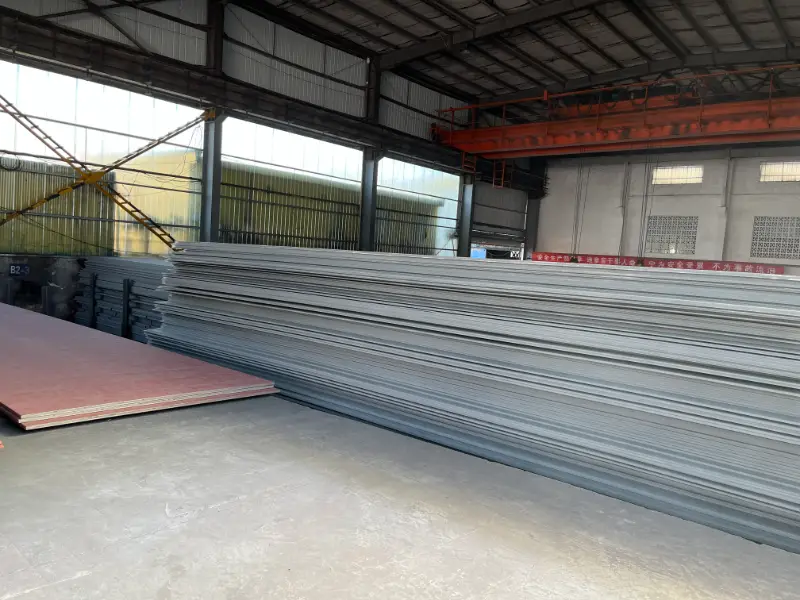
LR Grade DH69 Shipbuilding Steel Plate
LR Grade DH69 Shipbuilding Steel Plate - High-Strength Quenched and Tempered Offshore Structural Steel
Comprehensive material data for LR Grade DH69 shipbuilding steel plate, including chemical composition, mechanical properties, thermal properties, international equivalents, and application guidance.
Cutting, cold forming, hot forming, welding (preheating and PWHT may be required), machining
- Phone : +8618037372205
- Email : [email protected]
- WhatsApp: Contact via Whtsapp
- WeChat: +8618037372205
LR Grade DH69 Shipbuilding Steel Plate Introduction
LR Grade DH69 is a high-strength, quenched and tempered shipbuilding steel plate certified by Lloyd's Register. It provides a minimum yield strength of 690 MPa and is designated for D-grade toughness, with guaranteed Charpy V-notch impact energy at -20°C. The steel is designed for critical structural applications in marine and offshore environments, combining excellent weldability, strength, and low-temperature toughness. It is commonly supplied in the quenched and tempered condition and complies with the LR Rules for the Manufacture, Testing and Certification of Materials. Typical applications include hull structures, offshore platforms, and heavy-lift equipment.
LR Grade DH69 Shipbuilding Steel Plate Chemical Composition
The chemical composition of LR Grade DH69 is controlled to meet strength and toughness requirements. Maximum limits are specified for certain elements to ensure good weldability and toughness. Micro-alloying elements such as Nb, V, Ti, and Al are added for grain refinement. The actual composition may vary depending on thickness and supplier, but must comply with LR Rules. Typical ladle analysis ranges are provided below.
| Element | Standard Requirement (max, %) | Remarks |
|---|---|---|
| C (Carbon) | ≤ 0.20 | Lower carbon improves weldability |
| Si (Silicon) | ≤ 0.55 | Deoxidizer |
| Mn (Manganese) | 0.90 – 1.70 | Strength contributor |
| P (Phosphorus) | ≤ 0.025 | Impurity, controls brittleness |
| S (Sulfur) | ≤ 0.025 | Impurity, controls hot cracking |
| Cr (Chromium) | ≤ 1.50 | Hardenability element |
| Ni (Nickel) | ≤ 2.00 | Toughness and strength |
| Mo (Molybdenum) | ≤ 0.70 | Hardenability and creep resistance |
| Cu (Copper) | ≤ 0.50 | Corrosion resistance, if added |
| V (Vanadium) | ≤ 0.12 | Grain refiner, precipitation hardening |
| Nb (Niobium) | ≤ 0.06 | Grain refiner |
| Ti (Titanium) | ≤ 0.05 | Nitride former for grain refinement |
| Al (Aluminium) | 0.015 – 0.08 (total) | Grain refining and deoxidation |
| N (Nitrogen) | ≤ 0.015 | Residual, controlled to avoid aging |
| CEV (Carbon Equivalent) | ≤ 0.52 (typical) | Calculated per LR Rules for weldability |
LR Grade DH69 Shipbuilding Steel Plate Thermal and Electrical Physical Properties
The physical properties listed below are typical for quenched and tempered high-strength structural steels similar to LR Grade DH69. Exact values may vary slightly with chemical composition and process conditions. These properties are useful for design calculations involving thermal stresses, heat transfer, and electromagnetic compatibility.
| Property | Typical Value | Unit | Test Condition / Remarks |
|---|---|---|---|
| Density (ρ) | 7850 | kg/m³ | At 20°C |
| Modulus of Elasticity (E) | 205 | GPa | Tension/compression, at 20°C |
| Shear Modulus (G) | 79.3 | GPa | Calculated from E and ν |
| Poisson's Ratio (ν) | 0.30 | - | Elastic range, room temperature |
| Thermal Expansion Coefficient (α) | 12.5 × 10⁻⁶ | K⁻¹ | 20°C – 200°C |
| Thermal Conductivity (λ) | 40 | W/(m·K) | At 20°C |
| Specific Heat Capacity (c) | 460 | J/(kg·K) | At 20°C |
| Electrical Resistivity (ρₑ) | 0.23 × 10⁻⁶ | Ω·m | At 20°C |
LR Grade DH69 Shipbuilding Steel Plate Mechanical Properties
Mechanical properties of LR Grade DH69 steel plates are determined according to LR Rules. The values below apply to the quenched and tempered condition for thickness up to 50 mm (unless otherwise stated). For thicker plates (50–100 mm) the minimum yield strength may be reduced to 670 MPa, as per the standard. Impact test temperature is -20°C for D-grade. All tests are performed on specimens taken in the longitudinal direction.
| Property | Standard Requirement | Unit | Test Condition |
|---|---|---|---|
| Yield Strength (ReH) | ≥ 690 | MPa | Room temperature, t ≤ 50 mm |
| Yield Strength (ReH) | ≥ 670 | MPa | Room temperature, 50 < t ≤ 100 mm |
| Tensile Strength (Rm) | 770 – 940 | MPa | Room temperature |
| Elongation (A5) | ≥ 14 | % | Gauge length = 5.65√So, longitudinal |
| Bend Test (d = 3a) | No cracks | - | 180° bend, mandrel diameter 3× thickness |
| Charpy V-Notch Impact (KV₂) | ≥ 69 (average) | J | -20°C, longitudinal |
| Charpy V-Notch Impact (KV₂) | ≥ 52 (single) | J | -20°C, longitudinal |
LR Grade DH69 Shipbuilding Steel Plate Completely Equivalent Standards and Replaceable Grades
| Country/Region | Standard | Grade | Remarks |
|---|---|---|---|
| International (IACS) | LR Rules | DH69 | Original certification |
| USA | ABS Rules | DH69 | Identical mechanical and toughness requirements |
| Norway/Germany | DNV Rules | DH69 | Identical strength and -20°C impact requirement |
| France | BV Rules | DH69 | Identical grade in Bureau Veritas classification |
| China | CCS Rules | DH69 | Identical grade in China Classification Society |
| Japan | NK Rules | DH69 | Identical grade in Nippon Kaiji Kyokai |
LR Grade DH69 Shipbuilding Steel Plate Application Introduction
LR Grade DH69 steel plate is designed for heavy-duty welded structures subjected to high static and dynamic loads in low-temperature marine environments. It is widely adopted in shipbuilding and offshore engineering where a combination of high strength, toughness, and weldability is required. The steel can be cut, formed, and welded using conventional processes, but careful heat control (preheat, interpass temperature, and post-weld heat treatment) is necessary due to its quenched and tempered condition.
Product Applications: Hull plates, decks, and bulkheads, Jack-up rig legs and spudcans, Offshore platform nodes and tubular joints, Wind turbine monopiles and jackets, Boom and arm sections for heavy excavators, Hydraulic press frames and molds
Processed into products: Ship structural parts: shell plating, longitudinal stiffeners, transverse webs, Offshore structural connectors: stiffened panels, pile clusters, brace nodes, Lifting equipment: crane pedestals, boom sections, hook blocks, Mechanical parts: high-strength bolts and fasteners (when machined from plate), Foundation inserts and embedment plates
Application industries: Shipbuilding (naval and merchant vessels), Offshore oil and gas (jack-up rigs, semi-submersibles, FPSO topsides), Offshore renewable energy (wind turbine foundations, transition pieces), Heavy-lift and construction equipment (cranes, excavators), Pressure vessels and boilers (where high strength permits lighter designs)
LR Grade DH69 Shipbuilding Steel Plate Similar or Substitute Materials with Comparable Properties
| Country/Region | Standard | Grade | Remarks |
|---|---|---|---|
| Europe | EN 10025-6 | S690Q (1.8931) / S690QL (1.8928) / S690QL1 | Quenched and tempered; S690QL and QL1 guarantee impact at -20°C and -40°C respectively. Need to verify CEV and impact energy values match LR DH69. |
| USA | ASTM A514 / A517 | Grade B, E, H, F | High yield strength quenched and tempered steel; toughness at -20°C must be specified separately and may require supplementary requirements to match DH69. |
| China | GB/T 16270 | Q690D / Q690E | Q690D with impact at -20°C; check for full LR certification equivalence. |
| Japan | JIS G 3128 | SJ690 (hypothetical, not standard) | No direct JIS equivalent; JIS G 3129 provides SM570 but lower strength. Typically S690Q per EN used. |
Notes:
LR Grade DH69 plates are normally supplied with third-party inspection and certification by Lloyd's Register or equivalent classification society. For thicknesses above 50 mm, a reduction in yield strength is applied (e.g., 670 MPa for 50–100 mm). Weldability guidelines, including CEV limits and hydrogen control measures, must be followed to prevent cold cracking. Preheating temperatures are typically in the range of 100–175°C depending on thickness and combined joint restraint. Post-weld heat treatment is generally not required for thicknesses below 30 mm, but may be necessary for thicker sections or when stress relief is specified.
- Share



