
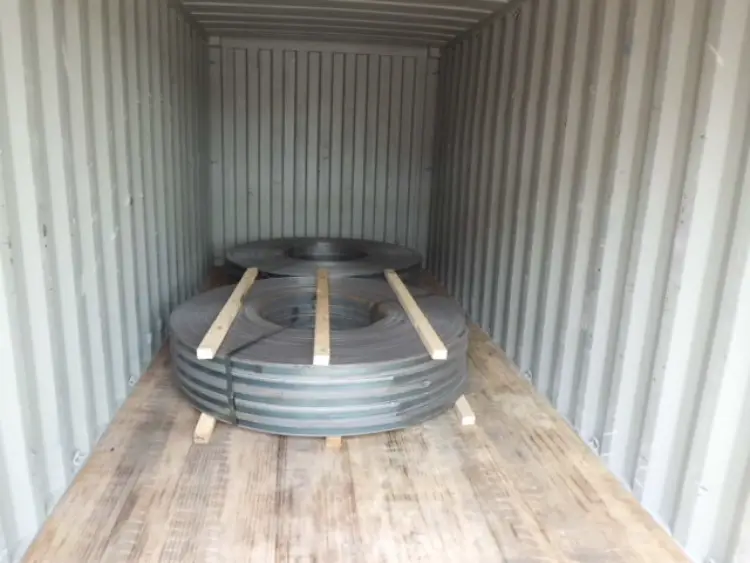
LR FH62 Shipbuilding Steel Coil
LR FH62 Shipbuilding Steel Coil: High-Strength Quenched & Tempered Plate for Cryogenic Service
Comprehensive material data for LR FH62 shipbuilding steel coil: chemical composition, mechanical and physical properties, international equivalents, and application guidance for offshore and marine cryogenic structures.
Hot rolling, quenching and tempering, cold forming (with caution), welding (low hydrogen, preheat), machining
- Phone : +8618037372205
- Email : [email protected]
- WhatsApp: Contact via Whtsapp
- WeChat: +8618037372205
LR FH62 Shipbuilding Steel Coil Introduction
LR FH62 is a high-strength quenched and tempered shipbuilding steel classified by Lloyd's Register (LR) for use in welded structures requiring excellent low-temperature toughness and high yield strength (minimum 620 MPa). The designation 'F' indicates suitability for the lowest design temperature of -60 °C, making it ideal for ice-class vessels, LNG carriers, and Arctic offshore platforms. Produced via controlled rolling followed by quenching and tempering, the steel exhibits a fine-grained microstructure with additions of microalloying elements like niobium, vanadium, and titanium to refine grain size and improve strength. It offers good weldability when proper procedures are followed, although preheating and low hydrogen electrodes are recommended due to the high strength level. Typical delivery condition is quenched and tempered, and the material is supplied as coil, plate, or sheet. LR FH62 complies with the Lloyd's Register Rules for Materials, Chapter 3, ensuring stringent quality controls for chemical composition, mechanical properties, and impact toughness at -60 °C.
LR FH62 Shipbuilding Steel Coil Chemical Composition
The chemical composition of LR FH62 is controlled to balance high strength, low-temperature toughness, and weldability. Maximum limits are specified for impurity elements, while microalloying elements like Nb, V, Ti, and Al are added for grain refinement. Carbon equivalent (CEV) is typically limited to ≤0.45% to ensure weldability. The table below lists the typical limits as per LR Rules.
| Chemical Element | Standard Value (wt%) | Remarks |
|---|---|---|
| C | ≤0.18 | Maximum |
| Si | 0.10–0.55 | Range |
| Mn | 1.00–1.60 | Range, for strength and hardenability |
| P | ≤0.020 | Maximum |
| S | ≤0.015 | Maximum |
| Al (total) | ≥0.015 | Minimum, for grain refinement |
| Nb | ≤0.05 | Maximum, optional microalloying |
| V | ≤0.10 | Maximum, optional microalloying |
| Ti | ≤0.02 | Maximum, for grain refinement and nitrogen control |
| Ni | ≤2.0 | Maximum, enhances low-temperature toughness |
| Cr | ≤0.20 | Maximum |
| Mo | ≤0.08 | Maximum |
| Cu | ≤0.35 | Maximum |
| N | ≤0.012 | Maximum |
| CEV | ≤0.45 (typical) | Carbon equivalent value, controlled for weldability |
LR FH62 Shipbuilding Steel Coil Thermal and Electrical Physical Properties
The following physical properties are typical for quenched and tempered low‑alloy steels of this strength class. They are not part of the material specification but are useful for design calculations involving heat transfer, thermal stress, and electrical behaviour.
| Property | Typical Value | Unit | Condition |
|---|---|---|---|
| Density (ρ) | 7850 | kg/m³ | 20 °C |
| Modulus of elasticity (E) | 205 | GPa | Room temperature |
| Shear modulus (G) | 80 | GPa | Room temperature |
| Poisson's ratio (ν) | 0.3 | — | Room temperature |
| Thermal expansion coefficient (α) | 12 × 10⁻⁶ | 1/K | 20–100 °C |
| Thermal conductivity (λ) | ~50 | W/(m·K) | 100 °C |
| Specific heat capacity (Cp) | ~460 | J/(kg·K) | 20 °C |
| Electrical resistivity (ρe) | ~0.20 | µΩ·m | 20 °C |
LR FH62 Shipbuilding Steel Coil Mechanical Properties
Mechanical properties are guaranteed at delivery condition (quenched and tempered). Tensile testing is performed at room temperature, and Charpy V‑notch impact tests at -60 °C. Property values are valid for plate thicknesses ≤50 mm; for thicker plates, slightly reduced requirements may apply. The bend test ensures formability without cracking.
| Property | Standard Requirement | Unit | Test Condition |
|---|---|---|---|
| Yield strength (ReH) | ≥620 | MPa | Room temperature, thickness ≤50 mm |
| Tensile strength (Rm) | 720–890 | MPa | Room temperature, thickness ≤50 mm |
| Elongation (A) | ≥15 | % | Proportional gauge length 5.65√S0, room temperature |
| Impact energy (KV, longitudinal) | ≥27 | J | Charpy V‑notch at -60 °C |
| Impact energy (KV, transverse) | ≥20 | J | Charpy V‑notch at -60 °C |
| Bend test (180°) | No cracks | — | Bend radius = 3×thickness, thickness ≤50 mm |
LR FH62 Shipbuilding Steel Coil Completely Equivalent Standards and Substitutable Grades
| Country/Region | Standard | Grade | Remarks |
|---|---|---|---|
| International | Lloyd's Register Rules | LR FH62 | Original classification society grade |
| International | American Bureau of Shipping Rules | ABS FH62 | Direct equivalent |
| International | DNV Rules | DNV F620 | Yield strength 620 MPa, -60 °C impact |
| International | Bureau Veritas Rules | BV FH620 | Direct equivalent |
| International | RINA Rules | RINA F620 | Direct equivalent |
| International | RMRS Rules | RMRS F620 | Direct equivalent |
| International | Nippon Kaiji Kyokai Rules | NK KFH62 | Direct equivalent |
| International | Korean Register Rules | KR FH62 | Direct equivalent |
LR FH62 Shipbuilding Steel Coil Application Introduction
LR FH62 is specifically designed for the most demanding marine and offshore applications where high strength and exceptional low‑temperature toughness are required. Its -60 °C impact guarantee makes it suitable for cryogenic environments such as liquefied gas storage and Arctic shipping. Typical applications include:
Product Applications: Ship hull plates and stiffeners, Deck plating for ice‑breaker vessels, Offshore platform legs and bracings, Liquefied gas cargo tank shells, Pressure vessel bodies for low‑temperature service, Heavy‑duty structural beams and columns
Processed into products: Hull bottom and side shell plates, Longitudinal and transverse bulkheads, Stiffening frames and ribs, Welded H‑beams and box girders, Crane booms and chassis, Flanges and gusset plates, Transition pieces and nodes in offshore structures
Application industries: Shipbuilding (ice‑class ships, LNG carriers, naval vessels), Offshore oil & gas (platforms, FPSOs, subsea structures), Cryogenic storage (LNG tanks, LPG spheres), Heavy structural engineering (bridges, cranes, heavy machinery), Mining and earth‑moving equipment
LR FH62 Shipbuilding Steel Coil Similar or Alternative Materials
| Country/Region | Standard | Grade | Remarks |
|---|---|---|---|
| Europe | EN 10025‑6 | S620Q | 620 MPa yield, Q&T, impact -20 °C; less cryogenic toughness |
| USA | ASTM A514/A517 | Grade B | 690 MPa yield, Q&T, impact -40 °C possible, not fully equivalent to -60 °C |
| International | ABS Rules | ABS EH62 | Same strength, but impact only -40 °C; not suitable for -60 °C service |
| International | DNV Rules | DNV E620 | Same strength, but impact -40 °C; higher design temperature |
Notes:
- Welding: Low‑hydrogen processes (SMAW, GMAW, SAW) are mandatory. Preheating to 100–200 °C is recommended depending on plate thickness and carbon equivalent. Post‑weld heat treatment (PWHT) is generally not required for thicknesses ≤50 mm unless specified by design codes.
- Forming: Cold forming may require intermediate stress‑relief heat treatment to avoid cracking. Hot forming should be followed by re‑quenching and tempering.
- Inspection: Ultrasonic testing (UT) per LR rules is normally performed for plates above 12 mm. Charpy testing is mandatory per heat/lot.
- Corrosion protection: As a carbon‑manganese steel, LR FH62 requires protective coatings or cathodic protection in marine environments.
- Share



