
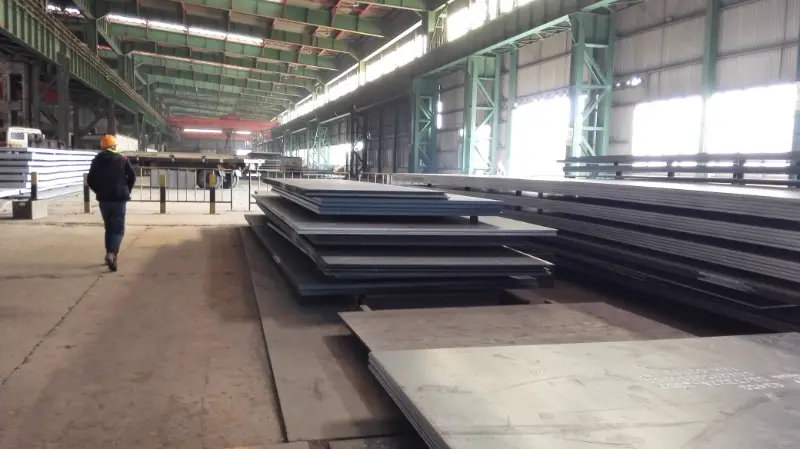
Austenitic 310MoLN (S31050) Stainless Steel Plate/Coil
Austenitic 310MoLN (S31050) Stainless Steel Plate/Coil: Superior High-Temperature Strength & Urea Grade Corrosion Resistance
Analysis and data sheet for 310MoLN (S31050) stainless steel plate/coil. Includes chemical composition, mechanical properties (yield, tensile strength), thermal conductivity, equivalent standards (EN 1.4466), and applications in urea synthesis and high-temperature processing.
Bending, Stamping, Welding, Hot Forming, Cold Forming
- Phone : +8618037372205
- Email : [email protected]
- WhatsApp: Contact via Whtsapp
- WeChat: +8618037372205
Austenitic 310MoLN Stainless Steel Plate/Coil Introduction
310MoLN (UNS S31050) is a high-alloy austenitic stainless steel engineered for superior performance in highly corrosive and high-temperature environments. As an enhanced derivative of the standard 310 grade, it features a precisely controlled ultra-low carbon content combined with deliberate nitrogen and molybdenum additions. This specific chemical balance is designed to maximize resistance to intergranular corrosion while significantly boosting high-temperature mechanical strength, creep resistance, and resistance to acid attack, particularly in urea-carbamate environments. The steel is fully austenitic and non-magnetic in the solution-annealed condition. Its metallurgical structure provides excellent ductility and weldability, making it a preferred choice for critical components in the chemical processing and petrochemical industries. The lean carbon content ensures effective protection against sensitization during welding, eliminating the need for post-weld heat treatment in many applications. This grade is primarily supplied as plates, coils, and strips conforming to ASTM A240 / ASME SA-240 standards, often associated with the European designation EN 1.4466 (X1CrNiMoN25-22-2).
Austenitic 310MoLN Stainless Steel Plate/Coil Chemical Composition
The alloy design of 310MoLN relies on a strict balance of key elements. Ultra-low carbon (C ≤ 0.020%) is critical to preventing chromium carbide precipitation and subsequent intergranular corrosion. Chromium (24-26%) and Nickel (21-23%) provide the stable austenitic matrix and high-temperature oxidation resistance. Molybdenum (2-3%) enhances pitting and crevice corrosion resistance, while Nitrogen (0.10-0.16%) serves as a strengthening agent, improving yield strength and microstructure stability without compromising ductility. Iron constitutes the balance.
| Chemical Element | Standard Value (%) | Remarks |
|---|---|---|
| Carbon (C) | ≤ 0.020 | Ultra-low carbon for enhanced intergranular corrosion resistance |
| Manganese (Mn) | ≤ 2.00 | Austenite stabilizer and deoxidizer |
| Phosphorus (P) | ≤ 0.030 | Impurity; controlled to maintain toughness |
| Sulfur (S) | ≤ 0.010 | Impurity; kept low for weldability |
| Silicon (Si) | ≤ 0.50 | High-temperature oxidation resistance enhancer |
| Chromium (Cr) | 24.0 - 26.0 | Key element for passivity and corrosion resistance |
| Nickel (Ni) | 21.0 - 23.0 | Stabilizes the austenitic phase and improves ductility |
| Molybdenum (Mo) | 2.0 - 3.0 | Improves resistance to reducing acids and pitting |
| Nitrogen (N) | 0.10 - 0.16 | Increases strength and improves pitting resistance |
| Iron (Fe) | Balance | Base element |
Austenitic 310MoLN Stainless Steel Plate/Coil Physical, Thermal & Electrical Properties
The physical properties of 310MoLN are typical of high-alloy austenitic stainless steels. Density (ρ) is slightly lower than standard carbon steels. The material exhibits relatively high thermal expansion (α) and low thermal conductivity (λ), which must be considered during welding and high-temperature design to account for thermal stresses and heat dissipation. It is non-magnetic in the annealed state, with a relative permeability typically below 1.02.
| Property | Typical Value | Unit | Test Condition / Temperature |
|---|---|---|---|
| Density (ρ) | 8.0 | g/cm³ | 20 °C |
| Modulus of Elasticity (E) | 195 | GPa | 20 °C |
| Shear Modulus (G) | 75 | GPa | 20 °C |
| Poisson's Ratio (ν) | 0.30 | – | 20 °C |
| Thermal Expansion Coefficient (α) | 16.5 | µm/m·°C | 20-100 °C |
| Thermal Expansion Coefficient (α) | 18.0 | µm/m·°C | 20-500 °C |
| Thermal Conductivity (λ) | 15 | W/m·K | 100 °C |
| Thermal Conductivity (λ) | 19 | W/m·K | 500 °C |
| Specific Heat Capacity | 500 | J/kg·K | 20 °C |
| Electrical Resistivity (ρ_e) | 0.85 | µΩ·m | 20 °C |
Austenitic 310MoLN Stainless Steel Plate/Coil Mechanical Properties
Mechanical properties are tested under solution-annealed condition as specified in ASTM A240. 310MoLN offers a superior combination of strength and ductility compared to standard 300-series austenitics. The high yield strength (ReH) is primarily attributed to solid solution strengthening by Nitrogen. The material exhibits excellent toughness and work hardening characteristics, allowing it to withstand significant plastic deformation before fracture. Standard tensile testing is performed on flat samples in accordance with ASTM E8.
| Property | Standard Requirement | Unit | Test Condition |
|---|---|---|---|
| Yield Strength (ReH) | ≥ 310 | MPa | Room Temp, Annealed |
| Tensile Strength (Rm) | ≥ 580 | MPa | Room Temp, Annealed |
| Elongation (A) | ≥ 35 | % | 50mm (2 inch) gauge length, Annealed |
| Hardness | ≤ 96 | HRB | Room Temp, Annealed |
| Hardness | ≤ 217 | HBW | Room Temp, Annealed |
Austenitic 310MoLN Stainless Steel Plate/Coil Fully Equivalent Material Standards & Replaceable Grade Recommendations
| Country / Region | Standard | Grade | Remarks |
|---|---|---|---|
| USA | ASTM A240 / A240M | UNS S31050 (310MoLN) | Base standard for plates, sheets, and strips. |
| Europe | EN 10088-2 / EN 10028-7 | 1.4466 (X1CrNiMoN25-22-2) | Fully equivalent in chemical and mechanical properties for pressure vessels. |
| Japan | JIS G4304 | SUS310MoLN | Corresponding Japanese Industrial Standard grade. |
| China | GB/T 4237 | 022Cr25Ni22Mo2N | Chinese equivalent standard for hot-rolled stainless steel plates. |
Austenitic 310MoLN Stainless Steel Plate/Coil Application Introduction
310MoLN is the premium material choice for severe service conditions requiring a combination of high-temperature strength, thermal stability, and corrosion resistance in aggressive acid environments. Its primary development was driven by the urea industry, where it is internationally recognized as a standard grade for carbamate solutions. The fully austenitic microstructure ensures cryogenic toughness as well as high-temperature stability. It is predominantly used in fabricated equipment where strict intergranular corrosion testing (Huey Test) applies.
Product Applications: Urea Reactors and Strippers, Shell and Tube Heat Exchangers, High-Temperature Pressure Vessels, Expansion Joints, Flue Gas Desulfurization (FGD) Absorber Towers, Thermal Oxidizers
Processed into products: Stripper tubes and ferrules, Reactor liners and trays, Tube sheets and baffle plates, Welded pipe sections for high-pressure transfer lines, Centrifugal compressor impellers (for specific corrosive gases), Furnace burner nozzles and retorts
Application industries: Fertilizer (Urea Production), Petrochemical Processing, Chemical Processing (High-Temperature Acids), Pulp & Paper (Digesters and Bleaching), Power Generation (FGD Scrubbers), Heat Treatment Equipment
Austenitic 310MoLN Stainless Steel Plate/Coil Similar or Near-Equivalent Substitute Material Recommendations
| Country / Region | Standard | Grade | Remarks |
|---|---|---|---|
| USA | ASTM A240 | 310S (UNS S31008) | Lower high-temperature strength and pitting resistance; lacks molybdenum and nitrogen strengthening. Suitable for less demanding scaling conditions. |
| Europe | EN 10088 | 1.4845 (X8CrNi25-21) | Standard 310 grade without controlled nitrogen or molybdenum. Economical choice if specific acid resistance is not required. |
| USA | ASTM A240 | 317L (UNS S31703) | Contains ~3% Mo but has significantly lower Ni and Cr content. Offers good acid resistance but lower structural stability at extreme temperatures. |
| Europe | EN 10088 | 1.4539 (X1NiCrMoCu25-20-5) | High-alloy austenitic (904L) with excellent general corrosion resistance, though designed more for sulfuric acid environments than high-temperature urea. |
Notes:
Welding of 310MoLN must be performed with matching or over-alloyed filler metals (e.g., AWS ER310 or Ni-based fillers for dissimilar joints) to maintain corrosion resistance. Due to the ultra-low carbon content (<0.020%), the alloy is resistant to sensitization in the as-welded condition for thin sections. However, intergranular corrosion susceptibility should be validated via the ASTM A262 Practice C (Huey test) for urea-grade applications. Because of its high alloy content, work hardening rates are high; intermediate annealing may be required during severe cold forming operations.
- Share



