
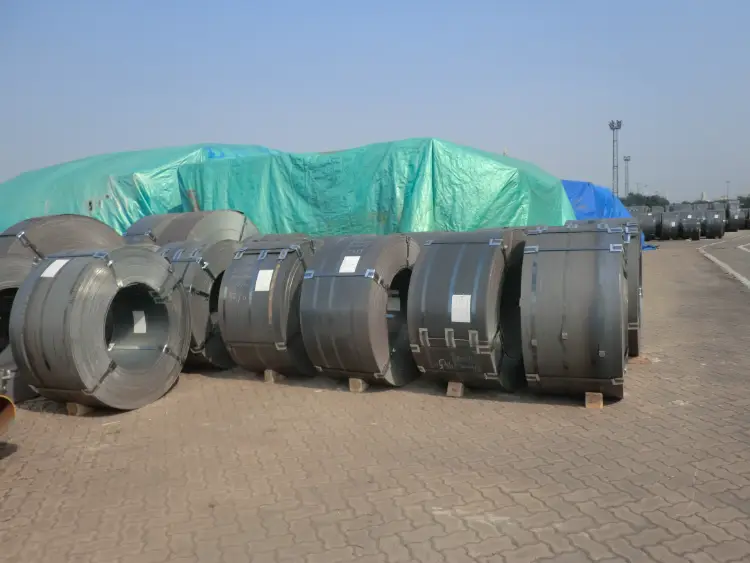
LR EH62 Shipbuilding Steel Coil
LR EH62 Shipbuilding Steel Coil - High-Strength Marine Plate for Arctic Applications
Comprehensive material data sheet for LR EH62 shipbuilding steel coil: chemical composition, mechanical properties, thermophysical properties, international equivalents, and applications in extreme marine environments.
Hot rolling, thermo-mechanical controlled processing (TMCP), normalizing, cutting, welding, forming, machining
- Phone : +8618037372205
- Email : [email protected]
- WhatsApp: Contact via Whtsapp
- WeChat: +8618037372205
LR EH62 Shipbuilding Steel Coil Introduction
LR EH62 is a high-strength, normalized or thermo-mechanically rolled shipbuilding steel grade certified by Lloyd's Register (LR) for structural hull and offshore applications. With a minimum yield strength of 620 MPa and guaranteed impact toughness down to -40°C, it is specifically designed for thick-section plates in ice-class vessels, naval ships, and deep-sea platforms. The steel is microalloyed with niobium, vanadium, and titanium to achieve fine grain refinement and excellent weldability, meeting the stringent requirements of LR Rules for the Manufacture, Testing and Certification of Materials. It is typically supplied as hot-rolled coils or plates in the normalized or TMCP condition, offering a favorable strength-to-weight ratio for lightweight design and enhanced fatigue resistance.
LR EH62 Shipbuilding Steel Coil Chemical Composition
Chemical composition limits in accordance with LR Rules for EH62 grade. The steel is fully killed and fine-grain treated. Microalloying elements such as Nb, V, Ti are added to ensure strength and toughness. Carbon equivalent (CEV) typically ≤ 0.48 for thickness ≤ 50mm, to guarantee excellent weldability.
| Element | Standard Value (max, %) | Remarks |
|---|---|---|
| Carbon (C) | 0.20 | Depending on thickness and CEV control |
| Silicon (Si) | 0.10 – 0.55 | Typically 0.25–0.50 for deoxidation |
| Manganese (Mn) | 0.90 – 1.70 | Higher Mn for thicker plates |
| Phosphorus (P) | 0.025 | Strict control for toughness |
| Sulfur (S) | 0.025 | Strict control for ductility |
| Aluminum (Al) | ≥ 0.015 (acid soluble) | Grain refinement |
| Niobium (Nb) | 0.02 – 0.05 | Microalloy for grain refining |
| Vanadium (V) | 0.05 – 0.10 | Optional strength enhancer |
| Titanium (Ti) | 0.007 – 0.05 | Grain refinement and nitrogen fixation |
| Nitrogen (N) | ≤ 0.012 | Typically controlled to ensure TiN formation |
| Copper (Cu) | ≤ 0.35 | Residual; may be higher for corrosion resistance |
| Chromium (Cr) | ≤ 0.20 | Residual |
| Nickel (Ni) | ≤ 0.40 | Residual; may be increased for toughness |
| Molybdenum (Mo) | ≤ 0.08 | Residual |
| Boron (B) | ≤ 0.0005 | Not intentionally added |
LR EH62 Shipbuilding Steel Coil Thermal and Electrical Physical Properties
Physical properties are not mandated by LR Rules but are typical for high-strength low-alloy shipbuilding steels. These values are for room temperature unless specified and serve as engineering reference for design and welding simulations.
| Property | Typical Value | Unit | Test Condition / Remarks |
|---|---|---|---|
| Density (ρ) | 7.85 | g/cm³ | 20°C |
| Elastic Modulus (E) | 205 | GPa | 20°C, tensile modulus |
| Shear Modulus (G) | 80 | GPa | Calculated from E and ν |
| Poisson's Ratio (ν) | 0.30 | - | At 20°C |
| Thermal Expansion Coeff. (α) | 11.5 – 12.5 | 10⁻⁶/K | 20–100°C range |
| Thermal Expansion Coeff. (α) | 12.5 – 13.5 | 10⁻⁶/K | 20–200°C range |
| Thermal Conductivity (λ) | 48 – 52 | W/(m·K) | At 20°C |
| Specific Heat Capacity (cₚ) | 460 – 500 | J/(kg·K) | At 20°C |
| Electrical Resistivity (ρₑ) | 0.20 – 0.25 | ×10⁻⁶ Ω·m | At 20°C |
LR EH62 Shipbuilding Steel Coil Mechanical Properties
Mechanical properties are specified according to LR Rules, for plates of thickness ≤ 100 mm in the transverse direction unless noted. Impact test temperature is -40°C for EH grade. Thicker plates may require agreement on property values.
| Property | Required Value | Unit | Test Conditions |
|---|---|---|---|
| Yield Strength (ReH) | ≥ 620 | MPa | Transverse, t ≤ 100 mm |
| Tensile Strength (Rm) | 720 – 890 | MPa | Transverse, t ≤ 100 mm |
| Elongation (A) | ≥ 15 | % | Gauge length 5.65√So, t ≤ 40 mm |
| Elongation (A) | ≥ 14 | % | Gauge length 5.65√So, 40 < t ≤ 100 mm |
| Charpy Impact Energy (KV) | ≥ 31 (L), 24 (T) | J | At -40°C, V-notch; average of 3 tests, single min 70% |
| Bend Test (Diameter) | 3t (180°) | - | Transverse bend, no cracks; t = specimen thickness; for t ≤ 25 mm |
| Bend Test (Diameter) | 4t (180°) | - | For 25 < t ≤ 40 mm |
LR EH62 Shipbuilding Steel Coil Full Equivalent Material Standards and Replaceable Grades
| Country / Region | Standard | Grade | Remarks |
|---|---|---|---|
| International (LR) | Lloyd's Register Rules | EH62 | Original grade; normalized or TMCP |
| USA (ABS) | ABS Rules for Materials and Welding | EH62 | Identical requirements for yield and toughness at -40°C |
| Norway/Germany (DNV) | DNV Rules for Classification of Ships | E620 | FE620; similar yield class, toughness at -40°C |
| France (BV) | Bureau Veritas Rules | E620 | Equivalent grade with minor chemical tolerance differences |
| China (CCS) | CCS Rules for Materials and Welding | E620 | Harmonized with IACS UR W11 |
| Japan (NK) | ClassNK Rules | KE62 | Mechanical properties equivalent; designated KE62 |
| South Korea (KR) | Korean Register Rules | RE62 | Same strength and toughness designation |
| Italy (RINA) | RINA Rules | E620 | Grade for high-strength hull structural steel |
| Russia (RMRS) | RMRS Rules | E620 | Similar to D620 and E620 class; -40°C impact |
| Europe (offshore) | EN 10225 | S620Q/QL | Weldable structural steel for offshore; similar strength, with optional longitudinal Charpy |
LR EH62 Shipbuilding Steel Coil Application Introduction
LR EH62 steel is optimized for extreme service conditions where high strength, low-temperature toughness, and weldability are essential. It is widely adopted in ice-class vessels and structural members subjected to heavy static and dynamic loads. The TMCP delivery condition enables reduced preheating during welding and improved fatigue life. Typical applications span shipbuilding, offshore engineering, and heavy machinery.
Product Applications: Hull plates and stiffeners for ice-class ships, Deck plating for heavy-lift vessels, Leg chords and rack structures of jack-up rigs, Nodes and transition pieces for offshore wind monopiles, Pressure hulls for manned submersibles, Bridge plates on ice-going tankers
Processed into products: Ship frames, stringers, and girders, Ice belt and bow plates (thickness 40–80 mm), Helicopter decks on offshore platforms, Crane pedestals and slew rings, Fatigue-critical welded T-joints and cruciform joints, Seawater ballast tank panels
Application industries: Marine & Shipbuilding (icebreakers, naval vessels, LNG carriers), Offshore Oil & Gas (jack-up rigs, semi-submersible platforms, FPSO hulls), Port & Heavy Infrastructure (crane booms, offshore wind turbine foundations), Arctic Engineering (polar research vessels, ice-resistant structures), Defense (military ships, submarine pressure hulls)
LR EH62 Shipbuilding Steel Coil Similar or Comparable Material Recommendations
| Country / Region | Standard | Grade | Remarks |
|---|---|---|---|
| International (LR) | LR Rules | EH550 | Yield ≥ 550 MPa, same toughness class (-40°C); lower strength alternative for less demanding areas |
| International (LR) | LR Rules | EH690 | Yield ≥ 690 MPa, same toughness; higher strength option for weight-critical designs |
| USA (ABS) | ABS Rules | EQ70 | Yield ≥ 690 MPa, -40°C toughness; higher strength equivalent to EH690 |
| Europe | EN 10025-6 | S690QL | Quenched and tempered structural steel; similar strength but not specific to ship classification |
| Japan | JIS G 3106 (archival) | SM570 (modified) | Older standard; 570 MPa class, but does not guarantee -40°C toughness; may be used as comparison |
| USA | ASTM A514/A514M | Grade Q | Quenched & tempered 690 MPa plate; requires impact test agreement to match EH62 toughness |
Notes:
- All values for chemical composition are maximum unless a range is indicated. The manufacturer may apply tighter controls to meet CEV limits (Carbón equivalent value typically ≤0.48% for thickness 50 mm).
- Mechanical properties must be certified by the classification society surveyor; testing includes tensile, impact (at -40°C), and bend tests on a per-heat and per-plate basis.
- Welding consumables must be approved for EH62 and preheating may be required for thick sections (>50 mm) depending on CEV and hydrogen control.
- Ultrasonic testing to Class A or Class B as per LR is normally required for primary structure plates.
- This steel is not intended for elevated temperature service above 300°C due to possible strength degradation from TMCP condition.
- Share



