
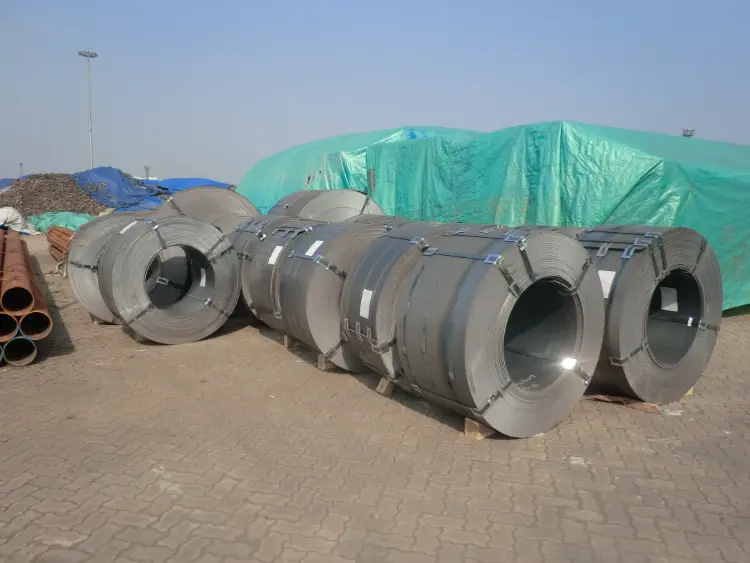
LR DH62 Shipbuilding Steel Coil
LR DH62 Shipbuilding Steel Coil: High Strength Hull Structural Steel Data
Comprehensive analysis of LR DH62 shipbuilding steel coil, including chemical composition, mechanical properties, physical properties, equivalent grades and applications. Data derived from Lloyd's Register class requirements for comparable high strength steel DH36.
Hot rolling, controlled rolling, normalising, thermo-mechanical controlled process (TMCP)
- Phone : +8618037372205
- Email : [email protected]
- WhatsApp: Contact via Whtsapp
- WeChat: +8618037372205
LR DH62 Shipbuilding Steel Coil Introduction
LR DH62 is a designation commonly used in commercial practice for rolled steel coils employed in shipbuilding. The term often appears as a shorthand for Lloyd's Register Grade DH36 – a high-strength hull structural steel with a specified minimum yield strength of 355 MPa and excellent low-temperature toughness (impact test at -20 °C). The material is delivered as hot-rolled coil and can be further processed by normalising or thermo-mechanical controlled rolling (TMCP). It offers good weldability, reliable strength and resistance to brittle fracture, making it suitable for critical structural members in marine and offshore environments. Data presented in this sheet are based on the official LR Rules for Materials (Ch. 3) for DH36 grade, the direct equivalent of the nominally referred DH62.
LR DH62 Shipbuilding Steel Coil Chemical Composition
Typical ladle analysis limits according to Lloyd's Register requirements for DH36 high strength hull steel. Individual elements may be adjusted to achieve the required mechanical properties. All values are weight percent maximum unless a range is given.
| Element | Content (%) | Remarks |
|---|---|---|
| Carbon (C) | ≤ 0.18 | Control for weldability |
| Silicon (Si) | ≤ 0.50 | |
| Manganese (Mn) | 0.90 – 1.60 | Primary strengthener |
| Phosphorus (P) | ≤ 0.035 | Detrimental to toughness |
| Sulfur (S) | ≤ 0.035 | Detrimental to ductility |
| Aluminum (Al) acid soluble | ≥ 0.015 | Grain refining, deoxidation |
| Niobium (Nb) | ≤ 0.05 | Microalloying for TMCP |
| Vanadium (V) | ≤ 0.10 | Microalloying |
| Titanium (Ti) | ≤ 0.02 | Microalloying, grain refinement |
| Copper (Cu) | ≤ 0.35 | Residual element |
| Chromium (Cr) | ≤ 0.20 | Residual |
| Nickel (Ni) | ≤ 0.40 | Residual |
| Molybdenum (Mo) | ≤ 0.08 | Residual |
| Nitrogen (N) | ≤ 0.012 | Controlled when Al added |
| Carbon Equivalent (CEV) | ≤ 0.38 | Typical for thickness ≤ 50 mm; CEV = C + Mn/6 + (Cr+Mo+V)/5 + (Ni+Cu)/15 |
LR DH62 Shipbuilding Steel Coil Thermal and Electrical Physical Properties
Representative physical properties for shipbuilding steel DH36 grade at room temperature. These values are typical for carbon-manganese structural steels and may vary slightly depending on exact composition and processing route. They are provided for design and modelling purposes.
| Property | Value | Unit | Test Condition |
|---|---|---|---|
| Density (ρ) | 7850 | kg/m³ | 20 °C |
| Elastic Modulus (E) | 205 | GPa | 20 °C |
| Shear Modulus (G) | 80 | GPa | 20 °C |
| Poisson's Ratio (ν) | 0.3 | — | 20 °C |
| Thermal expansion coefficient (α) | 11.1 × 10⁻⁶ | 1/K | 20 – 100 °C |
| Thermal expansion coefficient (α) | 12.3 × 10⁻⁶ | 1/K | 20 – 200 °C |
| Thermal conductivity (λ) | 50 | W/(m·K) | 20 °C |
| Specific heat capacity (c) | 460 | J/(kg·K) | 20 °C |
| Electrical resistivity (ρ_e) | 2.0 × 10⁻⁷ | Ω·m | 20 °C |
LR DH62 Shipbuilding Steel Coil Mechanical Properties
Tensile and impact properties as specified in Lloyd's Register Rules for DH36, which is considered the correct grade corresponding to the commonly termed DH62. Values are valid for hot-rolled, normalised or TMCP conditions. Bend test requirements are also included.
| Property | Required Value | Unit | Test Conditions |
|---|---|---|---|
| Upper Yield Strength (ReH) | ≥ 355 | MPa | Thickness t ≤ 50 mm |
| Upper Yield Strength (ReH) | ≥ 355 | MPa | 50 < t ≤ 70 mm |
| Upper Yield Strength (ReH) | ≥ 355 | MPa | 70 < t ≤ 100 mm |
| Tensile Strength (Rm) | 490 – 620 | MPa | t ≤ 100 mm |
| Elongation (A5) | ≥ 21 | % | Gauge L₀ = 5.65√S₀, t ≤ 50 mm |
| Elongation (A5) | ≥ 21 | % | 50 < t ≤ 70 mm |
| Elongation (A5) | ≥ 21 | % | 70 < t ≤ 100 mm |
| Bend test (180°), d = bend diameter, a = specimen thickness | No cracks | – | d = 2a, t ≤ 50 mm |
| Bend test (180°) | No cracks | – | d = 3a, 50 < t ≤ 100 mm |
| Charpy impact (KV), longitudinal | ≥ 34 | J | At -20 °C, t ≤ 50 mm |
| Charpy impact (KV), longitudinal | ≥ 34 | J | 50 < t ≤ 70 mm |
| Charpy impact (KV), longitudinal | ≥ 41 | J | 70 < t ≤ 100 mm |
| Charpy impact (KV), transverse | ≥ 24 | J | At -20 °C, t ≤ 50 mm |
| Charpy impact (KV), transverse | ≥ 24 | J | 50 < t ≤ 70 mm |
| Charpy impact (KV), transverse | ≥ 27 | J | 70 < t ≤ 100 mm |
LR DH62 Shipbuilding Steel Coil Fully Equivalent International Standards and Substitute Grades
| Country/Region | Standard | Grade | Remarks |
|---|---|---|---|
| International | IACS UR W11 | DH36 | Harmonised requirements for high strength hull steel |
| USA | ASTM A131 / ABS Rules | DH36 | Identical strength and toughness category |
| Norway/Germany | DNV GL Rules | DH36 | Same -20 °C impact requirement |
| France | BV Rules | DH36 | Matches LR grade |
| China | CCS Rules | DH36 | Widely accepted equivalent |
| Japan | NK Rules | DH36 | Equivalent specification |
| Korea | KR Rules | DH36 | Equivalent specification |
| Italy | RINA Rules | DH36 | Equivalent specification |
| UK | LR Rules | DH36 | Original classification society grade |
LR DH62 Shipbuilding Steel Coil Application Introduction
LR DH62 / DH36 steel coil is extensively used in shipbuilding and offshore engineering where a combination of moderate weight, high strength and good low-temperature toughness is required. The material is easily weldable with standard procedures and is approved by major classification societies. Typical applications include primary structural components that must withstand sea water exposure, cyclic loads and potential impact at low service temperatures.
Product Applications: Vessel hull envelopes, Strength decks and bottom structures, Bulkheads and watertight doors, Offshore jacket legs and bracings, FPSO and FLNG modules, Marine crane pedestals
Processed into products: Longitudinal and transverse frames, Stringers and web frames, Deck girders, Keel plates, Shell plating, Stiffeners (bulb flats, angles), Deck plates and hatch coamings, Bilge keels
Application industries: Shipbuilding (merchant and navy vessels), Offshore oil & gas platforms, Marine renewable energy structures, Barge and pontoon construction, Port and harbour equipment
LR DH62 Shipbuilding Steel Coil Comparable or Analogous Steel Grades
| Country/Region | Standard | Grade | Remarks |
|---|---|---|---|
| International | IACS UR W11 | EH36 | Lower temperature toughness (-40 °C); slightly higher cost |
| USA | ASTM A131 | EH36 | Better toughness for cold service |
| Europe | EN 10025-4 | S355ML | Thermo-mechanical rolled fine-grain structural steel, similar yield strength |
| International | IACS UR W11 | AH36 | Impact tested at 0 °C; suitable for less severe conditions |
| International | IACS UR W11 | DH40 | Higher minimum yield (390 MPa) for heavier loaded structures |
Notes:
The commercial designation 'LR DH62' does not exist in current Lloyd's Register rules. It is likely a misinterpretation or informal shorthand. The technical community often uses 'DH62' where the number could refer to an approximate 62 kgf/mm² tensile strength, which corresponds to the tensile range of DH36 (490–620 MPa, i.e. 50–63 kgf/mm²). All official certificates and class-approved materials under this category will be marked DH36. Users should confirm with the mill certificate that the steel meets LR DH36 requirements. For demanding applications where a guaranteed minimum yield of 460 MPa is needed, refer to LR Grade DH460 per LR Rules for Offshore Structures.
- Share



