
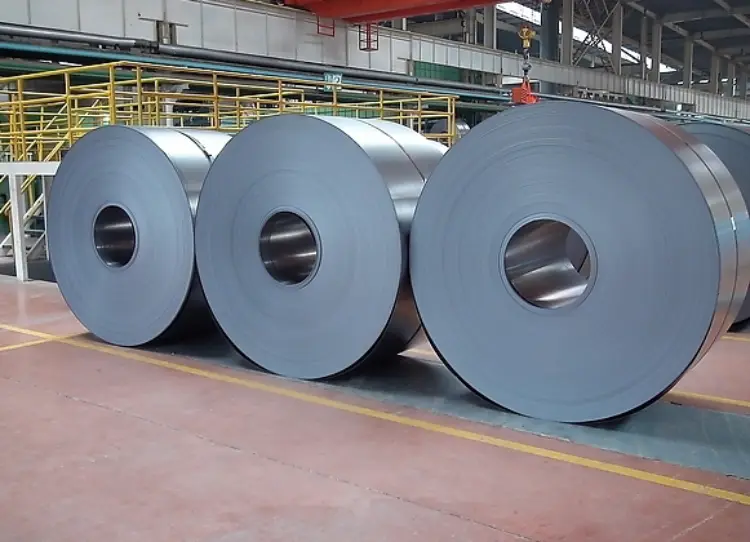
LR AH62 High-Strength Shipbuilding Steel Coil
LR AH62 High-Strength Shipbuilding Steel Coil - Grade, Properties & Equivalents
Comprehensive technical data for LR AH62 shipbuilding steel coil: chemical composition, mechanical properties, thermal and electrical properties, international equivalents, and application guide.
TMCP, normalized, quenched and tempered (optional depending on thickness)
- Phone : +8618037372205
- Email : [email protected]
- WhatsApp: Contact via Whtsapp
- WeChat: +8618037372205
LR AH62 High-Strength Shipbuilding Steel Coil Introduction
LR AH62 is an extra-high-strength shipbuilding structural steel grade certified by Lloyd's Register (LR). It belongs to the high-tensile, fine-grain structural steel family with a minimum yield strength of 620 MPa, making it suitable for critical offshore and marine constructions. The grade is designed for excellent weldability, good toughness at 0°C, and high resistance to brittle fracture. It is typically delivered in normalized or thermo-mechanically controlled processed (TMCP) condition, ensuring consistent properties across thick sections. The steel is widely used in hulls, decks, and structural members of large vessels and offshore platforms.
LR AH62 High-Strength Shipbuilding Steel Coil Chemical Composition
Typical chemical requirements for LR AH62 according to LR Rules. Note: All values are maximum unless a range is given. Grain-refining elements such as Al, Nb, V, Ti are added to ensure fine grain structure and high strength. Carbon equivalent (CEV) is controlled to guarantee weldability.
| Element | Standard Value | Remarks |
|---|---|---|
| Carbon (C) | ≤0.18 | Ladle analysis |
| Silicon (Si) | ≤0.55 | Ladle analysis |
| Manganese (Mn) | 0.90 – 1.65 | Ladle analysis |
| Phosphorus (P) | ≤0.025 | Ladle analysis |
| Sulfur (S) | ≤0.025 | Ladle analysis |
| Aluminum (Al) | ≥0.015 (acid soluble) | Minimum for fine grain practice |
| Niobium (Nb) | ≤0.05 | Optional grain refiner |
| Vanadium (V) | ≤0.10 | Optional grain refiner |
| Titanium (Ti) | ≤0.05 | Optional grain refiner |
| Chromium (Cr) | ≤0.25 | Residual element control |
| Nickel (Ni) | ≤0.80 | May be added for notch toughness |
| Molybdenum (Mo) | ≤0.25 | Residual element control |
| Copper (Cu) | ≤0.35 | Residual element control |
| Carbon Equivalent (CEV) | ≤0.45 – 0.50 (typical) | Depending on thickness and delivery condition |
LR AH62 High-Strength Shipbuilding Steel Coil Thermal and Electrical Physical Properties
Physical properties for LR AH62 steel (typical for low-alloy high-strength steel). Values are provided for design calculations and may vary slightly depending on exact chemical composition and heat treatment condition.
| Property | Typical Value | Unit | Test Condition |
|---|---|---|---|
| Density (ρ) | 7850 | kg/m³ | Room temperature |
| Modulus of elasticity (E) | 208 | GPa | Room temperature, static |
| Shear modulus (G) | 80 | GPa | Room temperature |
| Poisson's ratio (ν) | 0.3 | — | Room temperature |
| Thermal expansion coefficient (α) | 11.5×10⁻⁶ | K⁻¹ | 20 – 100°C |
| Thermal expansion coefficient (α) | 12.2×10⁻⁶ | K⁻¹ | 20 – 200°C |
| Thermal conductivity (λ) | 48 | W/(m·K) | 20°C |
| Thermal conductivity (λ) | 45 | W/(m·K) | 200°C |
| Specific heat capacity | 460 | J/(kg·K) | 20°C |
| Electrical resistivity (ρ_e) | 0.22×10⁻⁶ | Ω·m | 20°C |
LR AH62 High-Strength Shipbuilding Steel Coil Mechanical Properties
Longitudinal tensile and impact properties for LR AH62 as per LR Rules (normally tested on transverse specimens for plate thinner than 40 mm, but longitudinal data given as reference). Test conditions: Room temperature tensile test as per ISO 6892-1, Charpy V-notch impact test at 0°C.
| Property | Required Value | Unit | Test Condition |
|---|---|---|---|
| Minimum yield strength (ReH) | ≥620 | MPa | Thickness ≤ 50 mm |
| Minimum yield strength (ReH) | ≥580 | MPa | 51 mm < thickness ≤ 70 mm |
| Minimum yield strength (ReH) | ≥540 | MPa | 71 mm < thickness ≤ 100 mm |
| Tensile strength (Rm) | 720 – 890 | MPa | All thickness (typical range) |
| Elongation (A5) | ≥15 | % | Gauge length 5.65√So, transverse |
| Bend test (mandrel diameter) | 3a | — | Thickness ≤ 25 mm, 180° bend, no cracks |
| Bend test (mandrel diameter) | 4a | — | Thickness > 25 mm, 180° bend, no cracks |
| Charpy impact energy (KV, longitudinal) | ≥34 | J | 0°C, average of 3 specimens |
| Charpy impact energy (KV, transverse) | ≥24 | J | 0°C, average of 3 specimens |
LR AH62 High-Strength Shipbuilding Steel Coil Fully Equivalent Material Standards and Substitute Grades
The following grades are fully equivalent to LR AH62 under the IACS (International Association of Classification Societies) unified requirements. They can be substituted with agreement from the classification society.
| Country/Region | Standard | Grade | Remarks |
|---|---|---|---|
| International | ABS Rules | AH62 | American Bureau of Shipping |
| International | DNV Rules | AH62 | Det Norske Veritas |
| International | BV Rules | AH62 | Bureau Veritas |
| China | CCS Rules | AH62 | China Classification Society |
| South Korea | KR Rules | AH62 | Korean Register |
| Japan | NK Rules | AH62 | Nippon Kaiji Kyokai |
| Italy | RINA Rules | AH62 | Registro Italiano Navale |
LR AH62 High-Strength Shipbuilding Steel Coil Application Introduction
LR AH62 is specifically developed for weight-critical, high-load structures in the marine and offshore sectors. Its 620 MPa minimum yield strength allows for significant weight reduction without compromising structural integrity. The steel combines high strength with good toughness at 0°C and excellent weldability (CEV ≤ 0.45 typically), making it ideal for thick-section assemblies welded by conventional methods.
- Used in longitudinal stiffeners, deck plating, and hull bottom shells of large container ships, bulk carriers, and floating production units.
- Suitable for leg components of jack-up rigs, module support stools, and crane pedestals.
- Can be processed into heavy welded pipes, pressure vessels, and polar-class vessel reinforcement structures.
Product Applications: Hull plates and shell structures, Deck and bottom longitudinals, Transverse bulkheads and frames, Jack-up rig leg chords and bracings, Offshore crane pedestals and boom sections, Reinforced panels for ice-class vessels
Processed into products: Stiffeners, brackets, and tripping brackets, Upper deck plating of large container ships, Inner bottom plates of bulk carriers, Can sections for offshore wind towers, Rudder horns and stern frames, Highly loaded structural nodes and connections
Application industries: Shipbuilding (container ships, oil tankers, naval vessels), Offshore oil & gas (fixed platforms, jack-up rigs, FPSOs), Renewable energy (offshore wind turbine foundations, substations), Heavy civil engineering (bridges, hydraulic gates)
LR AH62 High-Strength Shipbuilding Steel Coil Similar/Semi-Equivalent Alternative Materials
These materials exhibit comparable strength levels and applications but may differ in notch toughness temperature, delivery condition, or minor chemistry. Substitution must be evaluated by the design authority.
| Country/Region | Standard | Grade | Remarks |
|---|---|---|---|
| UK/Europe | EN 10225 | S620Q | Weldable structural steels for fixed offshore structures; quenched and tempered; equivalent 620 MPa yield; impact properties may vary |
| UK/Europe | EN 10225 | S620QL1 | Same base, with low temperature impact requirement (-40°C); may replace AH62 with extra toughness if needed |
| USA | ASTM A514/A517 | Grade Q | Quenched and tempered high yield strength plate; 690 MPa tensile, similar yield; for structural applications |
| International | IACS | AH62 | All IACS members recognize the grade; DH62, EH62, FH62 provide lower temperature toughness |
Notes:
Additional notes: The steel is usually supplied with LR certification and stamping. Ultrasonic testing per LR rules is often required for thicknesses above 25 mm. The material is weldable with low-hydrogen processes; preheat and interpass temperatures may be advised depending on thickness and CEV. For polar service, LR AH62 may be ordered with supplementary notch toughness at lower temperatures (e.g., -20°C or -40°C) by agreement, effectively aligning with DH62 or EH62 requirements.
- Share



