
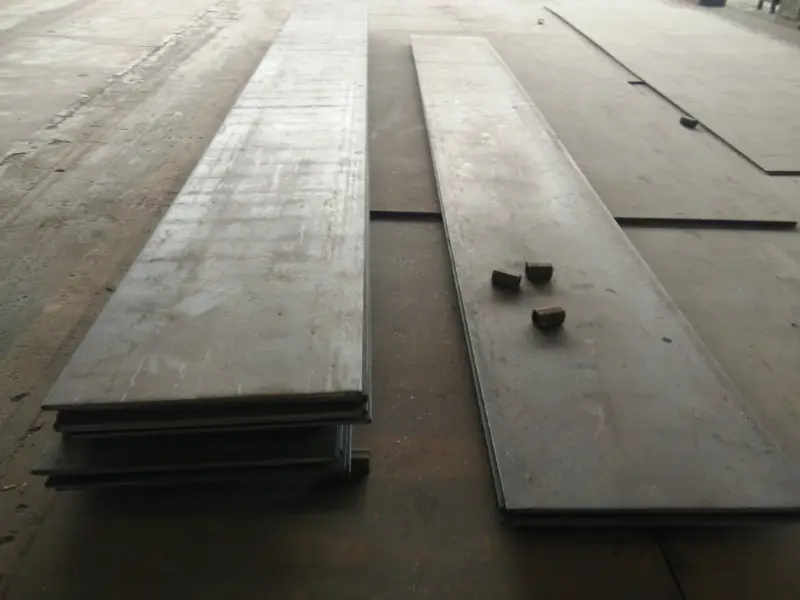
LR FH55 Shipbuilding Steel Plate & Coil
LR FH55 High-Strength Shipbuilding Steel Coil | lr fh55 steel properties, chemical composition and equivalent grades
LR FH55 is a high-strength hull structural steel grade certified by Lloyd's Register with a minimum yield strength of 550 MPa. This article provides full details on chemical composition, mechanical properties, thermal and electrical physical properties, international equivalent grades, and applications.
Cutting, welding (SMAW, SAW, GMAW, FCAW), cold forming, hot forming, bending, edge machining
- Phone : +8618037372205
- Email : [email protected]
- WhatsApp: Contact via Whtsapp
- WeChat: +8618037372205
LR FH55 Shipbuilding Steel Plate & Coil Introduction
LR FH55 is a normalized or thermomechanically rolled high-strength fine-grain structural steel for shipbuilding, certified under Lloyd's Register Rules for the Manufacture, Testing and Certification of Materials (Chapter 3). It is intended primarily for hull and offshore structures where high strength and excellent weldability are required. The grade designation "FH" indicates a minimum yield strength of 550 MPa in the transverse direction, with impact testing at -60°C confirming suitability for arctic and low-temperature service. Typical delivery condition is normalized (N), normalizing rolling (NR), or thermomechanical rolling (M). The material exhibits a fine-grained microstructure, good notch toughness, and can be subjected to cold forming and welding using standard procedures. It is available in plate, coil, and wide flat bar forms, and is widely used in decks, bottom shells, longitudinal frames, and offshore platform modules.
LR FH55 Shipbuilding Steel Plate & Coil Chemical Composition
Typical ladle analysis range for LR FH55 as per LR Rules Chapter 3, Section 2, Table 2.1.1 for Grade FH55 (Ceq ≤ 0.43–0.48 depending on thickness). All values are maximum unless a range is given. The steel is fully killed and contains grain refining elements such as aluminium, niobium, vanadium, and/or titanium. The carbon equivalent Ceq = C + Mn/6 + (Cr+Mo+V)/5 + (Ni+Cu)/15 is controlled to ensure weldability. Fine grain practice per ASTM E112 grain size 6 or finer is typical.
| Element | Standard Value (max %) | Remarks |
|---|---|---|
| Carbon (C) | 0.18 | Ladle analysis, depending on thickness; max 0.20 may be agreed |
| Silicon (Si) | 0.10–0.55 | Typical range for killed steel; Si ≥ 0.15 if Al is not present |
| Manganese (Mn) | 0.90–1.70 | High Mn for strength and toughness; upper limit varies with C content |
| Phosphorus (P) | 0.025 | Strictly controlled for low-temperature toughness |
| Sulfur (S) | 0.025 | Low S for ductility and through-thickness properties |
| Chromium (Cr) | 0.25 | Residual or microalloy; may be intentionally added to meet mechanicals |
| Nickel (Ni) | 0.40 | May be increased for improved toughness, especially at arctic grades |
| Molybdenum (Mo) | 0.08 | Commonly present as microalloy or residual |
| Copper (Cu) | 0.35 | Residual element; may be slightly higher for atmospheric corrosion resistance |
| Aluminium (Al) | 0.020 min (total) | Grain refining; acid soluble Al is typically 0.015% min |
| Niobium (Nb) | 0.05 | Microalloying element for grain refinement and precipitation strengthening |
| Vanadium (V) | 0.10 | Optional microalloying element |
| Titanium (Ti) | 0.05 | Optional; used for grain refinement and nitrogen fixation |
| Nitrogen (N) | 0.012 | Typical limit |
| Carbon Equivalent (CEV) | 0.43 (≤50mm), 0.48 (>50mm) | CEV = C + Mn/6 + (Cr+Mo+V)/5 + (Ni+Cu)/15, based on ladle analysis; may be adjusted by thickness |
LR FH55 Shipbuilding Steel Plate & Coil Thermal and Electrical Physical Properties
Physical properties representative of quenched and tempered or thermomechanically rolled fine-grain structural steels (similar to EN 10025-6 S550Q). Values are typical for room temperature unless otherwise indicated. Variations may occur depending on actual heat treatment, composition, and product thickness. These data are based on manufacturer catalogs and standard reference materials; they are not mandatory in the LR Rules but are useful for design.
| Property | Typical Value | Unit | Test Condition |
|---|---|---|---|
| Density (ρ) | 7850 | kg/m³ | At 20°C |
| Young's Modulus (E) | 210,000 | MPa | At 20°C |
| Shear Modulus (G) | 81,000 | MPa | At 20°C (calculated from E and ν) |
| Poisson's Ratio (ν) | 0.3 | – | Elastic range, at 20°C |
| Thermal Expansion Coefficient (α) | 12.0 × 10⁻⁶ | 1/K | Mean value, 20–100°C |
| Thermal Expansion Coefficient (α) | 13.0 × 10⁻⁶ | 1/K | Mean value, 20–200°C |
| Thermal Expansion Coefficient (α) | 14.0 × 10⁻⁶ | 1/K | Mean value, 20–300°C |
| Thermal Conductivity (λ) | 42 | W/(m·K) | At 20°C |
| Thermal Conductivity (λ) | 41 | W/(m·K) | At 100°C |
| Thermal Conductivity (λ) | 39 | W/(m·K) | At 200°C |
| Specific Heat Capacity (cp) | 460 | J/(kg·K) | At 20°C |
| Specific Heat Capacity (cp) | 490 | J/(kg·K) | At 100°C |
| Electrical Resistivity (ρe) | 0.25 × 10⁻⁶ | Ω·m | At 20°C |
LR FH55 Shipbuilding Steel Plate & Coil Mechanical Properties
Mechanical properties according to LR Rules Chapter 3, Section 3, Table 3.1.1 for FH55 grade. Values are for the transverse direction unless otherwise noted and apply to plates up to 100 mm thickness (for thicker plates property reductions may be agreed). Charpy V-notch impact test at -60°C is mandatory for FH grade. Yield strength may decrease slightly for thicknesses above 50 mm. Elongation is proportional to gauge length using 5.65√So (A5). Bending test diameter depends on thickness and test direction.
| Property | Standard Required Value | Unit | Test Condition |
|---|---|---|---|
| Yield Strength (ReH), min | 550 | MPa | Transverse, t ≤ 50 mm |
| Yield Strength (ReH), min | 530 | MPa | Transverse, 50 < t ≤ 70 mm |
| Yield Strength (ReH), min | 510 | MPa | Transverse, 70 < t ≤ 100 mm |
| Tensile Strength (Rm) | 670–830 | MPa | Transverse, t ≤ 50 mm |
| Tensile Strength (Rm) | 650–810 | MPa | Transverse, 50 < t ≤ 70 mm |
| Tensile Strength (Rm) | 630–800 | MPa | Transverse, 70 < t ≤ 100 mm |
| Elongation (A), min | 17 | % | Transverse, gauge length 5.65√So (A5) |
| Bend Test (Mandrel diameter) | 3 t | – | Transverse, 180° bend, t = plate thickness |
| Charpy V-notch Impact Energy (KV), min | 27 (average) / 20 (single) | J | Longitudinal, at -60°C, full-size specimen (10×10 mm) |
| Charpy V-notch Impact Energy (KV), min | 19 (average) / 14 (single) | J | Transverse, at -60°C, full-size specimen (10×10 mm) |
LR FH55 Shipbuilding Steel Plate & Coil Identical Equivalent Standards and Replaceable Grades
| Country/Region | Standard | Grade | Remarks |
|---|---|---|---|
| United Kingdom | LR Rules | FH55 | Original classification; this data sheet refers to this grade |
| International | IACS Unified Requirement W11 | FH55 (or W11: F550) | Coordinated specification across IACS members; identical technical delivery conditions |
| USA | ASTM A131/A131M | FH55 (or EH55) | ASTM EH55 meets FH55 for -40°C; FH55 may be specifically ordered with -60°C impact test |
| Germany/France/Europe | EN 10025-6 | S550Q / S550QL / S550QL1 | Quenched and tempered structural steel; "QL" and "QL1" versions provide specific low-temperature toughness that can match FH55 when additional Charpy requirements at -60°C are agreed upon. Note: EN 10025-6 is not specific to shipbuilding, but the grade can be used as an alternative if certified by the classification society. |
| Norway/Germany | DNV Rules | F550 | DNV high-strength grade; identical technical concept to LR FH55 |
| France | BV Rules | F550 | Bureau Veritas equivalent; same yield class and temperature designation |
| China | CCS Rules | F550 | China Classification Society equivalent; frequently used in Chinese shipyards |
| Japan | NK Rules (ClassNK) | KF550 | Nippon Kaiji Kyokai equivalent; same strength and toughness class |
| South Korea | KR Rules | F550 | Korean Register of Shipping equivalent grade |
| Italy | RINA Rules | F550 | Registro Italiano Navale equivalent; KF550 may be used for some records |
LR FH55 Shipbuilding Steel Plate & Coil Application Introduction
LR FH55 is designed for critical hull structural members in vessels operating in low-temperature or Arctic environments. Its high yield strength enables lighter constructions without compromising safety. Excellent weldability and notch toughness allow fabrication with conventional shipyard practices. Typical processing includes plasma/laser cutting, submerged arc welding (SAW), and automated panel line assembly. Post-weld heat treatment is generally not required for thicknesses below 50 mm. The steel is suitable for both longitudinal and transverse stiffening systems.
Product Applications: Hull plates and coils for container ships, bulk carriers, tankers, Decks and bottom shell of icebreakers, Longitudinal and transverse frames, floors, girders, Offshore platform decks and legs, Flare booms and helideck structures, Wind turbine installation vessel hulls, Module support structures for LNG plants
Processed into products: Main deck plating, Bottom shell plating, Bilge keel, Sheer strake, Longitudinal bulkheads, Web frames and brackets, Stiffeners (angle bulb profiles, flat bars), Keel plate, Rudder horn and steering flat, Crane pedestal shells (heavy lift)
Application industries: Shipbuilding (commercial and naval), Marine offshore engineering, Arctic and ice-going vessel construction, Heavy offshore lifting equipment, FPSO and FLNG hulls, Jack-up rig and semi-submersible platform structures
LR FH55 Shipbuilding Steel Plate & Coil Similar / Substitute Material Recommendations
| Country/Region | Standard | Grade | Remarks |
|---|---|---|---|
| EU | EN 10025-6 | S620Q/QL/QL1 | Higher strength grade (min YS 620 MPa); may be considered for weight reduction, but weldability and toughness must be re-evaluated. A Charpy test at -60°C must be specifically ordered. |
| EU | EN 10225 | S550G2+M/QT | Weldable structural steels for fixed offshore structures; similar strength level and improved through-thickness properties (Z-quality optional). Not specifically a shipbuilding grade, but often accepted in offshore modules when combined with certification. |
| USA | ASTM A514/A514M | Grade Q (or Type Q) | Quenched and tempered high yield strength steel (YS ≥ 690 MPa). Greater strength but may need attention to welding procedures and reduced toughness at -60°C. Typically not used as direct substitute without class approval. |
| USA/International | API 2W/2Y | Grade 50 (or 550 class) | Steel for offshore structures; similar strength and toughness profiles; can be used for FPSO or platform hulls when certified by LR. |
| Japan | JIS G 3106 | SM570 (Quenched and Tempered) | JIS structural steel with YS ≥ 460 MPa (lower than FH55). SM570 TMC options may reach 550 MPa class, but Charpy requirement is usually -5°C; therefore it is only a lower-strength substitute after full requalification. |
| Korea | KS D 3515 | SH 60 (or SH 62) | High performance steel for shipbuilding; KS SH60 is similar to EH36/FH36 class, not FH55. KS standards for 550 MPa class shipbuilding steel exist but are generally covered by classification society rules. |
Notes:
- Thickness tolerance according to EN 10029 or equivalent standard. Flatness tolerance per LR Rules or EN 10051.
- Ultrasonic testing to Class S2/E2 or higher per EN 10160 can be specified for critical applications.
- Through-thickness properties (Z-quality) per EN 10164 can be agreed; Z25 or Z35 may be required for heavily loaded joints.
- The steel is suitable for cold forming with minimum bending radius 3t (transverse) without risk of cracking under standard workshop conditions.
- Preheat is recommended when welding plates thicker than 30 mm at low ambient temperatures; typical preheat range 50–100°C depending on CEV and thickness.
- Weldability: CEV ≤ 0.43 ensures low susceptibility to cold cracking when using low-hydrogen processes and appropriate heat input.
- The material does not resist corrosion beyond standard carbon-manganese steel levels; protective coatings are mandatory in seawater service.
- Share



