
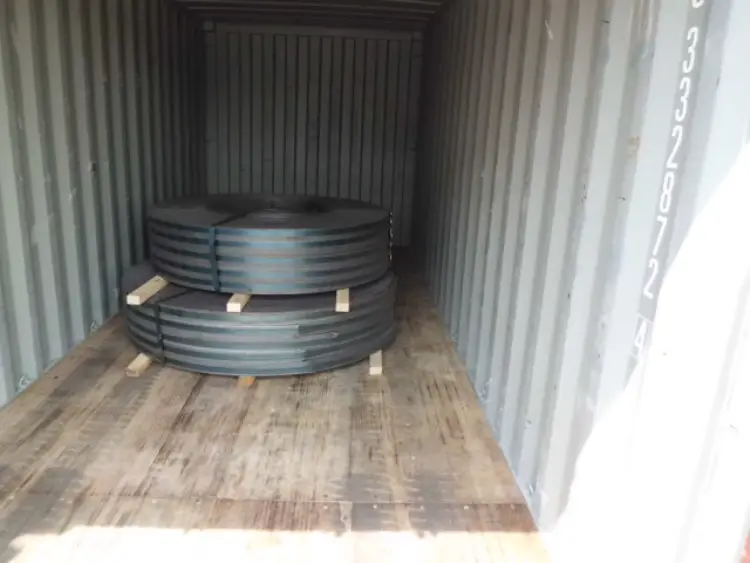
LR AH69 Shipbuilding Steel Coil
LR AH69 Shipbuilding Steel Coil - High-Strength Marine Structural Material
Complete material data for LR AH69 shipbuilding steel coil according to Lloyd's Register rules, including chemical composition, mechanical properties, thermal and electrical properties, international equivalents, and application guidance.
Hot rolling followed by Thermo-Mechanical Control Process (TMCP), normalizing, or quenching and tempering (QT)
- Phone : +8618037372205
- Email : [email protected]
- WhatsApp: Contact via Whtsapp
- WeChat: +8618037372205
LR AH69 Shipbuilding Steel Coil Introduction
LR AH69 is a high-strength structural steel specifically designed for shipbuilding and offshore engineering, certified by Lloyd's Register. It falls under the 690 MPa yield strength class, offering a combination of very high strength, good weldability, and excellent low-temperature toughness. The steel is typically produced via the Thermo-Mechanical Control Process (TMCP) or quenching and tempering (QT) to achieve fine-grain microstructure and consistent mechanical performance.
- Minimum yield strength of 690 MPa for thicknesses up to 100 mm
- Good notch toughness guaranteed at 0°C (AH grade)
- Low carbon equivalent (CEV) to ensure excellent weldability without preheating in moderate conditions
- Available in coil and plate form, suitable for heavy-loaded hull structures, deck plating, and critical offshore components
- Conforms to Lloyd's Register Rules for Materials and is globally accepted by major classification societies
LR AH69 Shipbuilding Steel Coil Chemical Composition
Chemical requirements according to Lloyd's Register Rules for Materials. Ladle analysis values are shown. Elements not listed may be present as residuals brought by the steelmaking process but are controlled below detectable or specified limits. Carbon equivalent (CEV) is typically limited to ≤0.52% to ensure cold cracking resistance.
| Element | Requirement (max, wt%) | Remarks |
|---|---|---|
| Carbon (C) | ≤0.20 | |
| Silicon (Si) | ≤0.55 | |
| Manganese (Mn) | 1.00–1.70 | Depending on thickness and CEV control |
| Phosphorus (P) | ≤0.025 | |
| Sulfur (S) | ≤0.025 | |
| Copper (Cu) | ≤0.35 | |
| Chromium (Cr) | ≤0.20 | |
| Nickel (Ni) | ≤0.40 | |
| Molybdenum (Mo) | ≤0.08 | |
| Aluminium (Al, total) | ≥0.015 | Minimum for fine-grain practice |
| Niobium (Nb) | ≤0.05 | |
| Vanadium (V) | ≤0.10 | |
| Titanium (Ti) | ≤0.02 | |
| Nitrogen (N) | ≤0.012 |
LR AH69 Shipbuilding Steel Coil Thermal and Electrical Physical Properties
These physical constants are typical for quenched and tempered or TMCP steels of this composition range and are not mandatory requirements of Lloyd's Register. They serve as engineering reference for design calculations. Actual values may vary slightly with processing conditions and temperature.
| Property | Typical Value | Unit | Test Conditions |
|---|---|---|---|
| Density (ρ) | 7.85 | g/cm³ | At 20°C |
| Modulus of elasticity (E) | 205 | GPa | At 20°C |
| Shear modulus (G) | 80 | GPa | At 20°C, estimated from E/(2(1+ν)) |
| Poisson's ratio (ν) | 0.30 | – | At 20°C |
| Thermal expansion coefficient (α) | 11.7×10⁻⁶ | /K | Between 20–100°C |
| Thermal expansion coefficient (α) | 12.3×10⁻⁶ | /K | Between 20–200°C |
| Thermal expansion coefficient (α) | 13.0×10⁻⁶ | /K | Between 20–300°C |
| Thermal conductivity (λ) | 50 | W/(m·K) | At 20°C |
| Thermal conductivity (λ) | 45 | W/(m·K) | At 200°C |
| Specific heat capacity (c) | 460 | J/(kg·K) | At 20°C |
| Electrical resistivity (ρₑ) | 0.25×10⁻⁶ | Ω·m | At 20°C |
LR AH69 Shipbuilding Steel Coil Mechanical Properties
Mechanical properties are guaranteed by classification society rules for plates and coils in the as-delivered condition. Testing is performed on transverse or longitudinal specimens depending on product form and agreement. Bend test mandates no cracks or defects. Impact test values are the minimum average absorbed energy for Charpy V-notch specimens (full-size, 10×10 mm). For sub-size specimens, proportional adjustments apply.
| Property | Specified Value | Unit | Test Conditions |
|---|---|---|---|
| Yield strength (ReH) | ≥690 | MPa | Thickness ≤100 mm, transverse |
| Tensile strength (Rm) | 770–940 | MPa | Thickness ≤100 mm, transverse |
| Elongation (A) | ≥14 | % | Gauge length 5.65√S₀, transverse, t≤100 mm |
| Bend test (mandrel diameter) | 3a | – | Thickness ≤25 mm, 180° bend |
| Bend test (mandrel diameter) | 4a | – | Thickness 25–50 mm, 180° bend |
| Impact energy (KV₂) | ≥69 | J | Longitudinal, at 0°C (AH grade), full-size specimen |
| Impact energy (KV₂) | ≥46 | J | Longitudinal, at 0°C, 7.5×10 mm sub-size specimen |
| Impact energy (KV₂) | ≥27 | J | Longitudinal, at 0°C, 5×10 mm sub-size specimen |
LR AH69 Shipbuilding Steel Coil Fully Equivalent Grades from Other Classification Societies
| Country / Region | Standard / Society | Designation | Remarks |
|---|---|---|---|
| United States | ABS (American Bureau of Shipping) | AH69 | High strength 690 MPa grade, identical requirements |
| Norway / Germany | DNV (Det Norske Veritas) | AH69 | Formerly NV AH69, unified DNV rules |
| France | BV (Bureau Veritas) | AH69 | BM AH69 notation in some editions |
| China | CCS (China Classification Society) | AH69 | Fully traceable to CCS Rules |
| Japan | NK (Nippon Kaiji Kyokai / ClassNK) | AH69 | Identical chemistry and mechanical scope |
| South Korea | KR (Korean Register) | AH69 | Same grade for building at Korean yards |
| Italy | RINA (Registro Italiano Navale) | AH69 | Equivalent notation, may include additional impact options |
LR AH69 Shipbuilding Steel Coil Application Introduction
LR AH69 steel is engineered for the most demanding structural parts of ships and offshore installations where weight reduction and high strength are critical. Its superior toughness at low temperatures allows use in Arctic service. The material is readily weldable with low-hydrogen processes and, due to its fine-grain structure, exhibits excellent fatigue resistance.
- Commonly processed by plasma cutting, laser cutting, bending, and forming; care must be taken to avoid excessive cold deformation.
- Welding consumables matching the 690 MPa strength level (e.g., AWS A5.28 ER110S-1, E11018M) are recommended.
- Post-weld heat treatment is generally not required for thicknesses up to 50 mm when using TMCP condition.
Product Applications: Main deck plating and stringers, Bottom shell and bilge plates in high-stress areas, Hatch coamings and container cell guides, Crane pedestals and heavy-duty bollards, Longitudinal stiffeners and web frames
Processed into products: Deck panels and bulkhead stiffeners in VLCC/ULCC tankers, Transverse frames and girders in container ships, Ice belt strakes on polar vessels, Lifting lugs and pad-eyes for heavy lifts, Jack-up rig legs and spudcan structures, Flange and web plates of large box girders, Wind turbine transition pieces and tower connection flanges
Application industries: Commercial and naval shipbuilding, Offshore oil and gas platforms (jack-ups, semi-submersibles), Renewable energy structures (offshore wind turbine foundations), Heavy lifting and transportation vessels, Arctic-class ships and icebreakers
LR AH69 Shipbuilding Steel Coil Similar / Alternative Materials with Close Properties
| Country / Region | Standard | Grade | Remarks |
|---|---|---|---|
| Europe | EN 10025-6 | S690Q / S690QL / S690QL1 | Quenched and tempered structural steel; yield ≥690 MPa, tensile 770–940 MPa; impact down to -40°C or -60°C depending on suffix. Slightly different chemistry; welding recommendations should be reviewed. |
| United States | ASTM A514 / A514M | Grade Q / Grade S | High-yield-strength quenched and tempered alloy steel plate; 690 MPa min yield; thickness up to 150 mm. CEV may be higher; preheat often required. |
| United States | ASTM A709 / A709M | Grade HPS 100W | Might be considered for structural applications with yield 690 MPa, but designed for bridge steel; not a classification society grade. |
| China | GB/T 1591-2018 | Q690D / Q690E | High strength low alloy structural steel; 690 MPa class; delivery condition QT or TMCP; mechanicals similar but impact temperatures differ (D: -20°C, E: -40°C). |
Notes:
CEV and PCM limits: The carbon equivalent value (CEV) is normally controlled to ≤0.52% (using the IIW formula) for thicknesses up to 100 mm, ensuring good weldability without excessive preheat. Ultrasonic testing: May be required per LR rules for critical applications (e.g., UT to EN 10160 class S2/E2). Through-thickness properties: When specified with Z-quality (Z25, Z35), the steel exhibits guaranteed reduction of area in the thickness direction to resist lamellar tearing. Surface condition: Coils are typically hot-rolled and pickled/oiled or shot-blasted and primed. Detailed LR certification and stamp marking are mandatory for traceability.
- Share



